


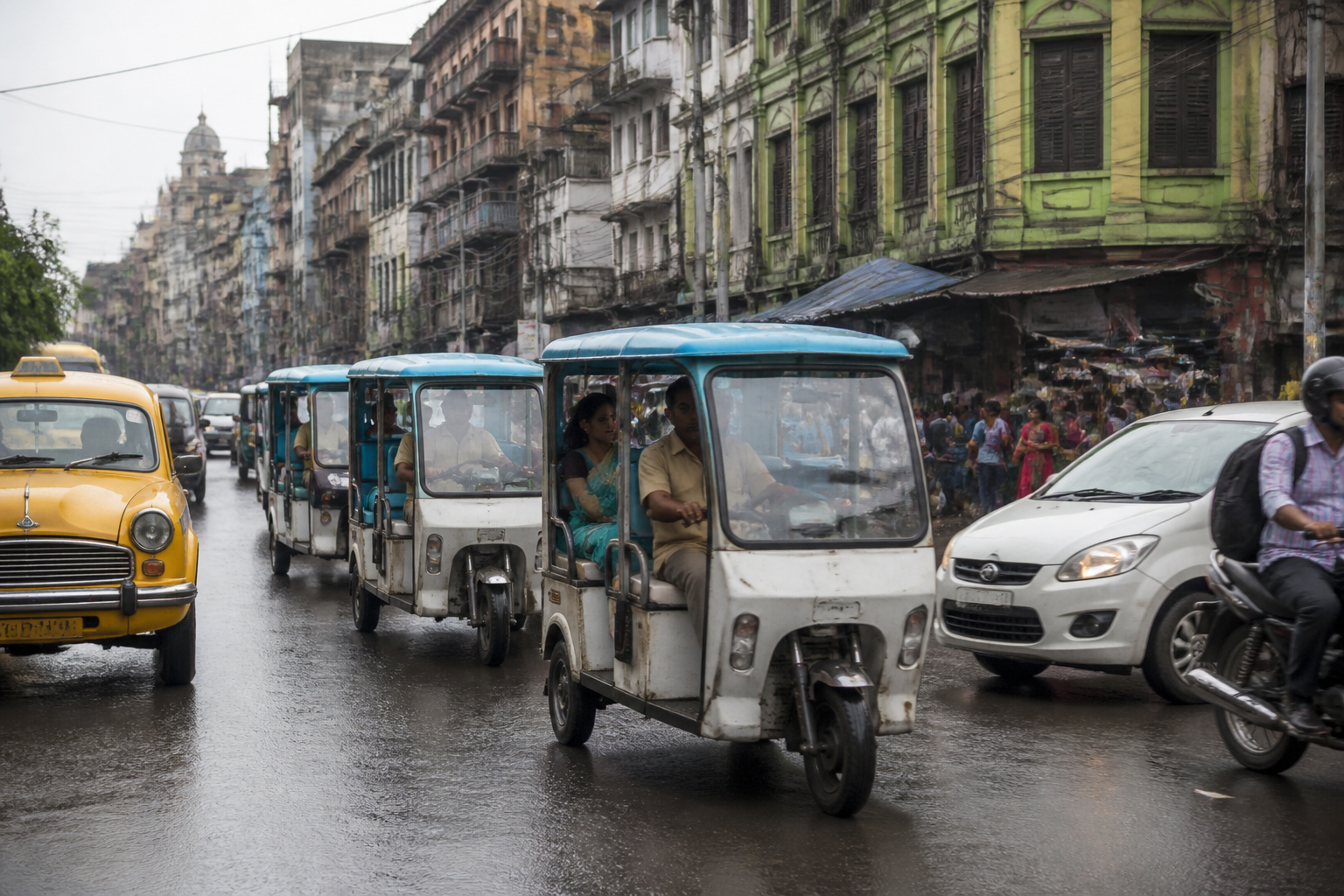
Kolkata’s electric-auto transition is advancing through the economics of daily operation rather than through a clearly visible policy-led expansion. A field study by Sustainable Mobility Network found that electric autos accounted for 118 of 598 surveyed vehicles across routes where both total and electric-auto numbers were available, putting electrification at about 19.7%. That figure signals a meaningful shift in the city’s para-transit system, but the route-level differences show why adoption cannot be understood as a uniform citywide trend.
The study, titled Accelerating the Electric Transition of Kolkata’s Para-transit System, found that electric autos formed 41.7% of the vehicles surveyed on the Taratala-Ramnagar route. Their share was 38.1% on Ballykhal-Uttarpara and 25% on Howrah Station-Salkia. The picture changed considerably on other routes: electric autos accounted for 11.8% on Taratala-Hazra, 5.2% on RG Kar-Dum Dum and 1.6% on Dum Dum Station-30A Stand. No electric autos were recorded on the RG Kar-Beleghata ID and Bagbazar-Bata routes included in the survey.
This spread is the most important finding in the available evidence. A citywide average can suggest that the transition is already under way, but it does not explain the conditions that make an electric auto workable on one route and unattractive on another. Para-transit vehicles operate within tightly defined daily circuits. Their viability depends not only on the purchase price or fuel bill, but also on distance travelled, charging opportunities, service access, passenger demand and the time available to keep the vehicle in operation.
For drivers, the immediate financial case is straightforward. Those interviewed for the study said a full electric charge typically costs Rs 50-70, compared with Rs 300-400 for an LPG refill. Electric autos also avoid several conventional mechanical maintenance requirements, including engine oil, clutch and gearbox-related servicing. These savings matter because the vehicle is both a livelihood asset and an operating expense. A lower daily running cost can have a direct effect on what remains with the driver after paying for energy, repairs, finance and other costs.
The study’s payback calculations indicate how powerful that operating difference could be. An electric auto costing around Rs 4.65 lakh could recover its higher purchase price in about one year and five months under the modelled assumptions. When a driver pays Rs 50,000 upfront and finances the balance, the estimated payback period rises to around one year and eight months. These calculations, cited by Aditi Kundu of Sustainable Mobility Network, explain why some drivers are switching even without what the report describes as a major policy push.
But a payback period is only as reliable as the operating conditions behind it. The study records a set of uncertainties that could make the transition harder for drivers who operate longer routes or lack convenient support infrastructure. Drivers reported that real-world battery range was 20-40% lower than advertised figures. That gap can alter the number of trips possible in a day, increase the need for intermediate charging and make route selection more consequential.
Battery replacement is the largest long-term uncertainty identified in the report. Drivers estimated that replacement could cost between Rs 1.5 lakh and Rs 1.8 lakh. This is a substantial future expense when compared with the initial upfront payment modelled in the study. It also complicates the calculation of ownership cost: a vehicle that appears economical in its early operating years may require a large replacement outlay later, depending on battery life, usage intensity and warranty conditions. The supplied study does not establish a common replacement schedule, so the eventual cost burden remains uncertain.
Charging is another dividing line between routes. Overnight charging is sufficient for many operations, according to the study, but high-mileage services may require daytime charging. This creates a practical distinction between an auto that returns to a predictable parking location and one that remains in service for long hours. For the latter, charging is not simply an energy issue. It is a question of where the vehicle can stop, how long it must remain there and whether that pause reduces the driver’s earning time.
The route-level numbers suggest that electric-auto adoption is being shaped by these operational conditions. The high shares recorded on Taratala-Ramnagar, Ballykhal-Uttarpara and Howrah Station-Salkia indicate that electric vehicles can gain a strong presence in particular para-transit markets. The very low or zero presence on other surveyed routes shows that the same purchase economics have not produced the same result everywhere. The data does not identify a single cause for these differences, but it establishes that adoption is uneven and route-specific.
Service access adds another layer to the problem. Drivers cited the distance from service centres and uncertainty over resale value as concerns. These issues affect confidence in the vehicle beyond the first purchase. A conventional vehicle may be more familiar to local repair networks, while an electric auto can depend on a smaller service ecosystem. If a breakdown takes longer to resolve or requires travel to a distant facility, the direct repair cost may be only part of the loss; the vehicle may also be unavailable for passenger service.
The resale question is similarly connected to the wider market. A driver deciding whether to finance an electric auto must assess not only today’s fuel and maintenance savings but also the value of the vehicle when it is sold or replaced. The study identifies this uncertainty but does not provide resale data. That absence matters because financing decisions are made over time, while technology and battery expectations can change during the ownership period.
The transition nevertheless has operational features that drivers viewed positively. They reported quieter operation, less engine heat and reduced dependence on LPG. Some also said electric autos could negotiate waterlogged stretches more easily. These observations connect the vehicle choice to Kolkata’s street-level conditions, where heat, noise, fuel access and waterlogging influence the experience of both drivers and passengers. They are not a substitute for broader performance data, but they show that adoption is being evaluated through everyday use rather than only through headline purchase prices.
The institutional response remains open-ended in the available material. Bengal urban development and municipal affairs junior minister Umesh Rai said electric vehicles are the future and asked stakeholders to share practical issues, adding that the government was there to help. The statement recognises that the next phase will depend on addressing operational problems, but the supplied report does not detail a new subsidy, charging programme, route mandate or implementation timetable. That distinction is important: an expression of support is not the same as a defined policy mechanism.
For Kolkata’s para-transit system, the evidence points to a transition that is already commercially rational in some conditions but not yet operationally secure across the network. The 19.7% share across the surveyed routes is significant, yet it conceals sharp differences between corridors. Lower energy and maintenance costs can accelerate adoption, while battery range, replacement costs, service access, charging time and resale value can slow it.
The larger urban question is therefore not whether electric autos can work in Kolkata. The study indicates that they can, and that drivers are already responding to the savings. The question is whether the city’s mobility system can provide the route-level support needed to make that choice dependable beyond the corridors where conditions are already favourable. Further evidence on charging locations, battery life, financing, service networks and route performance will determine whether the current shift remains concentrated or becomes a broader transformation of Kolkata’s para-transit fleet.

