


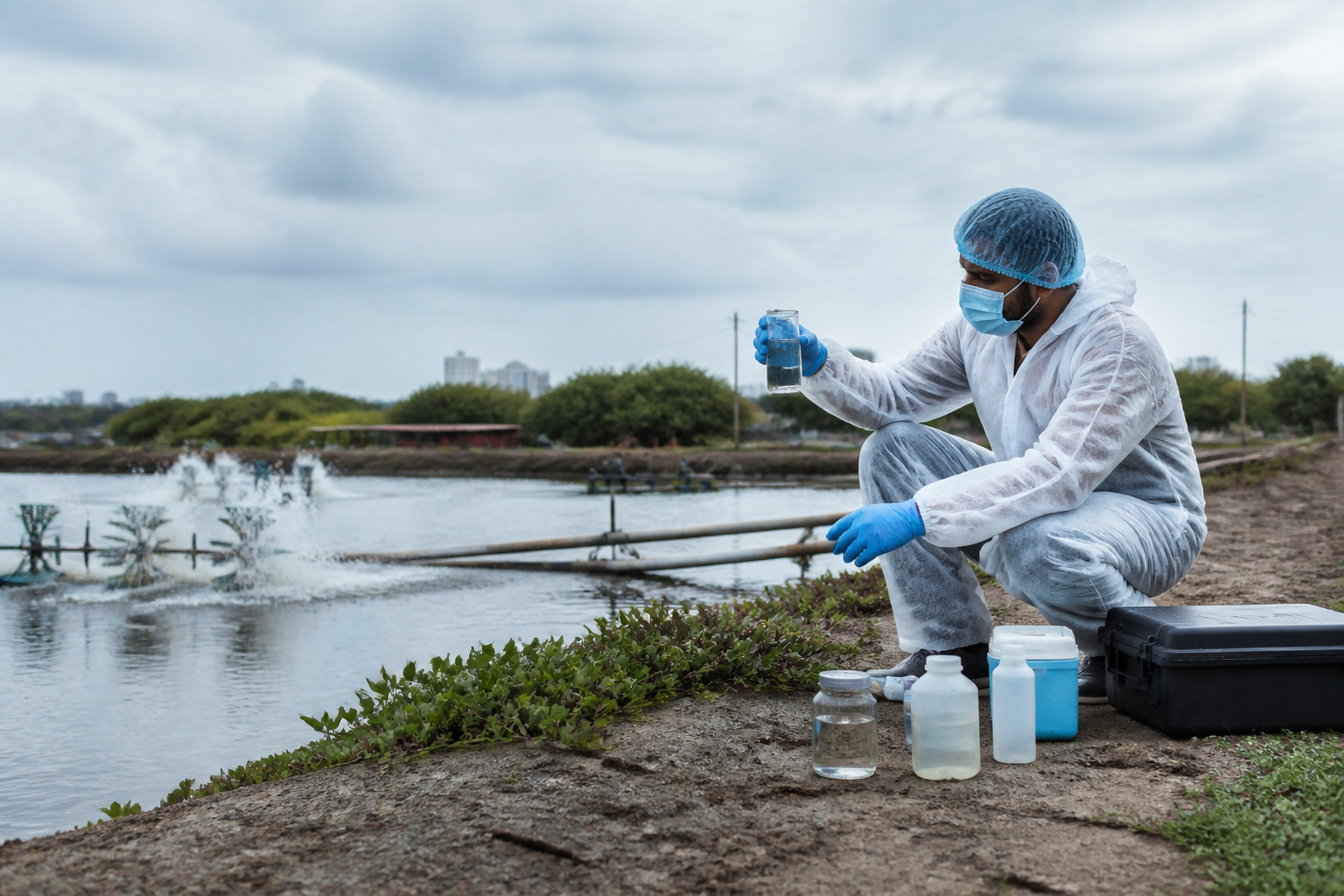
The development of ReCAnt, a free database covering 690 chemicals used in aquaculture, is more than a research milestone for Chennai. It is an attempt to make visible a largely fragmented part of the food, coastal and environmental governance system: the chemicals used to prevent disease, control pests, treat water and maintain production in aquatic farming.
Created by researchers at the Institute of Mathematical Sciences in collaboration with the National Centre for Coastal Research, ReCAnt brings together information on the therapeutic and toxic effects, environmental fate, movement through food webs and regulatory status of chemicals reported in aquaculture. The resource was described in a study published in Cell Reports Sustainability and is available for free access.
The database does not establish that all the chemicals it lists are dangerous, nor does the absence of regulatory information prove that a chemical is unregulated. Its importance lies elsewhere. It brings together evidence that was previously dispersed across scientific literature and databases, allowing researchers and regulators to identify chemicals that may require closer monitoring and risk assessment.
That distinction matters because chemical management in aquaculture operates across several connected systems. A substance applied in a pond or coastal farm may affect the farmed organism, the surrounding water, sediments and other organisms in the food web. It may also become relevant to food safety and human health depending on how it behaves, accumulates and moves through the environment. The database therefore places aquaculture chemicals within a One Health framework linking ecosystems, animals and people.
The researchers’ work also exposes the limits of current knowledge. Of the 605 chemicals for which the curated literature was reviewed for regulatory information, 558 had no regulatory information reported in the literature. Only 47 had at least one reported status in that review. Cross-referencing with established regulatory lists increased the number of chemicals with some associated regulatory information to 57.
These figures should not be read as a count of illegal or unsafe chemicals. The study specifically cautioned that its assessment was not exhaustive and that the absence of regulatory information did not mean a chemical was unregulated. The numbers instead demonstrate how difficult it can be to answer a basic governance question: what is known about a chemical, where is it regulated, and what evidence supports decisions about its use?
This is the central institutional problem that ReCAnt addresses. Aquaculture depends on a range of chemical inputs, including antibiotics, disinfectants, pesticides, anaesthetics and water-treatment agents. These products may serve different purposes and may be subject to different rules across countries and jurisdictions. Information about their physical and chemical characteristics, toxicity, environmental persistence and regulatory treatment can consequently remain scattered across specialised sources.
A regulator attempting to assess risk must therefore do more than identify a product used by farmers. It may need to understand the substance’s structural and physicochemical characteristics, its therapeutic purpose, its toxic effects, how it moves through water and sediments, and whether it can accumulate in organisms. ReCAnt is designed to bring these strands together. According to corresponding author Areejit Samal, it provides data on structural and physicochemical characteristics and integrates information from toxicological databases.
The database’s urban significance is not limited to the city’s research institutions. Chennai is closely connected to coastal production, marine environments, food markets and public-health systems. The source material does not quantify the volume or geographic distribution of aquaculture activity around the city, nor does it claim that the database represents local chemical use alone. But the research originates in Chennai and addresses a sector whose environmental effects can cross administrative boundaries.
That makes information infrastructure an important part of environmental governance. Chemical risks do not necessarily remain within the boundaries of a farm, district or municipal jurisdiction. Water movement, discharge, food chains and market distribution can connect production areas to coastal ecosystems and consumers. A database cannot replace field monitoring, enforcement or product-specific assessment, but it can help determine where those activities should begin.
The resource may also help reduce an information imbalance between scientific evidence and operational decision-making. Researchers can use it to identify chemicals requiring further study. Regulators can use it as a screening resource when designing monitoring priorities. Aquaculture systems can be examined for chemicals of potential concern rather than treated as if every input carries the same level of risk. The study said ReCAnt could be adapted to specific aquaculture systems for screening and risk assessment.
This adaptation is important because risk is context-dependent. The same chemical may behave differently depending on the species farmed, the production system, the surrounding environment, the dose and duration of use, and the way waste or water is managed. The supplied study does not provide a risk ranking for all 690 chemicals and does not claim to replace detailed assessments. Its contribution is to create a common starting point from which such assessments can be developed.
The regulatory figures also show why simple lists of approved and prohibited substances may be insufficient. For 558 of the 605 chemicals reviewed for regulatory information, no such information was reported in the curated literature. That gap may reflect limited research, differences in regulatory systems, incomplete documentation or the difficulty of matching chemical identities across sources. The study does not assign a single cause. What it establishes is that the available regulatory picture is incomplete.
This has consequences for monitoring. When information is fragmented, authorities may find it harder to decide which substances to test for, which environmental pathways to track and which aquaculture systems need closer scrutiny. A shared database can improve the visibility of those choices, but the quality of decisions will still depend on updated records, local sampling, institutional coordination and clear regulatory responsibilities.
The work also highlights the difference between availability of information and availability of enforcement capacity. ReCAnt is free, which lowers the access barrier for researchers and institutions. But a database alone cannot confirm how a chemical is being used in a particular farm, whether it has entered surrounding water or whether residues remain in organisms. Those questions require field-level surveillance and laboratory capacity, neither of which is quantified in the supplied material.
The researchers’ emphasis on informed decision-making and sustainable chemical management therefore points to a wider governance chain. Scientific information must move from databases to monitoring plans, from monitoring plans to regulatory action, and from regulation to compliance. Each stage depends on institutions having the authority, resources and technical capacity to act on evidence.
For Chennai and other coastal regions, the immediate value of ReCAnt is that it makes a previously scattered body of information easier to examine. Its longer-term significance will depend on whether it is used to shape research priorities, identify chemicals for monitoring and support assessments tailored to specific aquaculture systems. The database can support those processes, but it cannot by itself establish the safety or illegality of any individual chemical.
What the study confirms is a substantial information gap around aquaculture chemicals and a practical attempt to organise the available evidence. What remains uncertain is how comprehensively the database reflects real-world use, how frequently its regulatory information will be updated and how it will connect with monitoring and enforcement systems. Those are the next questions for regulators, researchers and institutions responsible for protecting aquatic ecosystems, food security and human health.
