


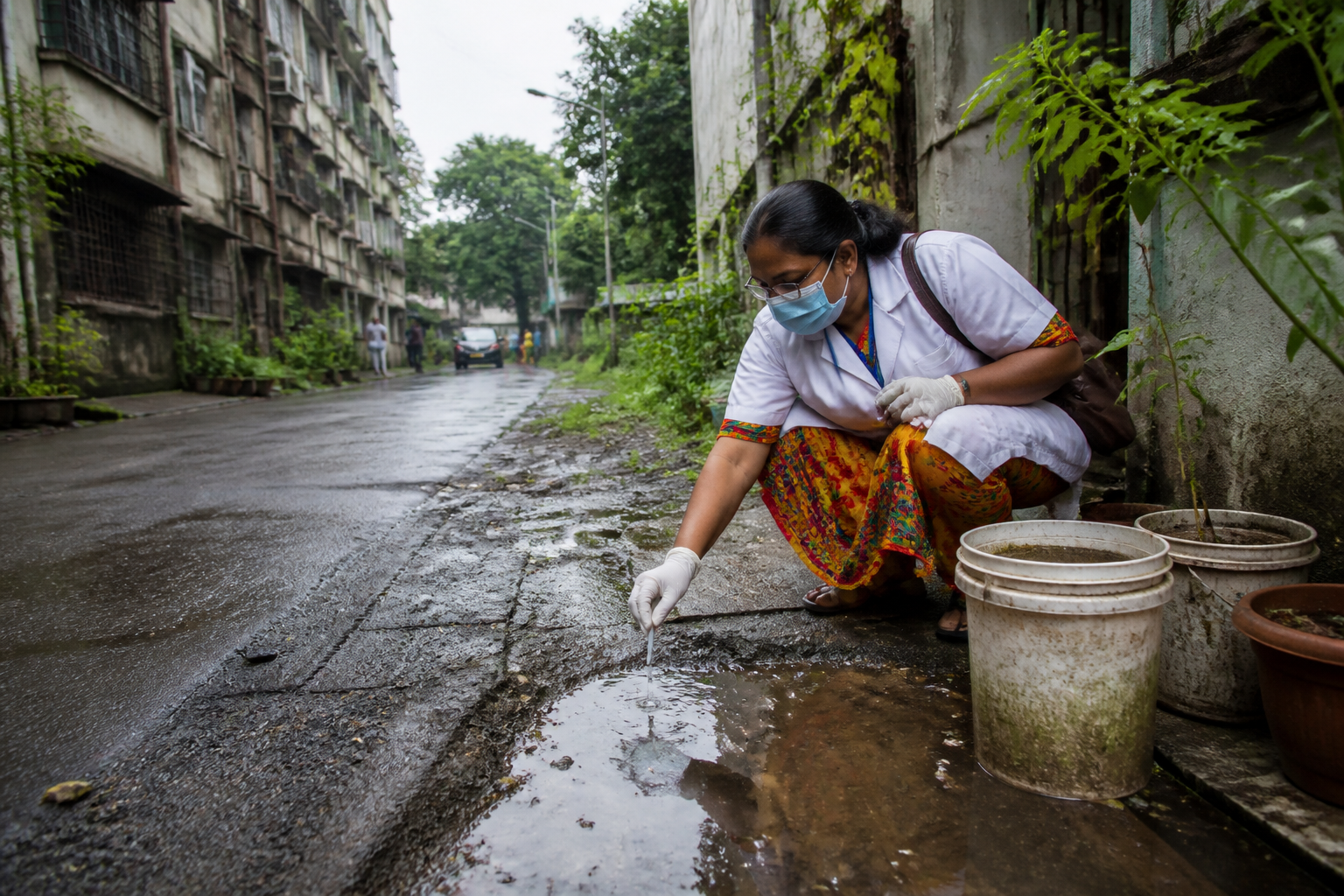
West Bengal’s dengue count has crossed 5,000 after more than 2,500 infections were reported in the past month, turning what had been a relatively quiet season into a late public-health warning. Kolkata, with about 500 confirmed cases, is among the state’s three most affected areas, showing how quickly urban mosquito-breeding conditions can change when intermittent rain, standing water and humidity coincide.
The numbers reported by the Times of India do not describe a statewide outbreak. They describe a sharp acceleration after a prolonged period in which dengue cases were comparatively infrequent. That distinction matters because a low case count early in the season can reflect a temporary combination of weather and transmission conditions rather than the disappearance of the underlying urban risk.
The Health Department has designated 29 municipalities and multiple rural blocks as high-risk vector-control zones. The designation places the recent rise within an administrative framework rather than treating dengue only as a hospital or household problem. The disease is transmitted by Aedes aegypti mosquitoes, which breed in small collections of stagnant water. In a dense city, those sites can occur in drains, containers, construction areas, rooftops, roadside depressions and other spaces where rainwater remains undisturbed.
The reported geography also shows that dengue pressure is not confined to Kolkata. Murshidabad has recorded 1,072 cases, while North 24 Parganas has recorded 450, according to the report. Kolkata’s approximately 500 cases place it among the three highest-incidence areas, but the distribution indicates a wider challenge involving both urban municipalities and rural blocks. Vector control therefore depends on coordinated surveillance and field operations across different local administrative settings.
The timing of the surge is central to understanding the current situation. The report links the increase to intermittent showers that leave behind small puddles of rainwater. Heavy rain does not automatically create the same breeding pattern: according to Charnock Hospital’s head of emergency, Nishant Agarwal, larval growth becomes erratic when rainfall is intense and temperatures fall, or when conditions become completely dry and temperatures rise. The conditions currently prevailing in south Bengal, he said, are warm and humid, which are more favourable for larvae.
Agarwal also said high humidity can shorten the incubation period of the dengue virus inside the mosquito, allowing mosquitoes to become infectious faster and live longer. The point is not that humidity alone produces dengue transmission. Rather, it illustrates how transmission depends on a combination of mosquito ecology, weather and the availability of small water-holding sites. The same city may experience limited transmission during one phase of the monsoon and a late rise when weather conditions change.
This makes the urban environment an important part of the disease story. Aedes aegypti does not require a large lake or a flooded neighbourhood to reproduce. The risk can be distributed through thousands of small, overlooked locations. Intermittent showers are particularly significant because they can refill containers and shallow depressions without necessarily producing the dramatic flooding that attracts public attention. If those sites remain undisturbed, they can support breeding in places that are difficult to identify through broad, event-based responses.
The evidence in the report also suggests why the season initially appeared quieter. Sengupta, head of pulmonology at Charnock Hospital, said dengue patients and even suspected cases had been very few until a couple of weeks before the report. She attributed the lower numbers partly to a prolonged influenza A and B outbreak, which may have shaped the pattern of patients seeking care, and partly to greater awareness and heavy rain that did not allow water to stagnate. She said sporadic showers in recent days may have supported larval breeding.
These observations should be read as clinical and field-level explanations rather than as a definitive epidemiological account. The supplied report does not establish how many breeding sites were inspected, how many municipalities have completed control drives, or how testing volumes changed over the period. It does, however, show that reported infections doubled from the state’s mid-August total after more than 2,500 new cases were recorded in the following month. That acceleration is the clearest signal in the available data.
The distinction between reported cases and actual transmission is also important. The figures represent confirmed cases reported in the article, while the hospital observations describe patients arriving for outpatient treatment. Agarwal said the sporadic dengue cases seen at Charnock Hospital had not, so far, required admission. That provides a limited indication of the clinical burden at one facility, but it cannot be used to describe the severity of illness across Kolkata or West Bengal as a whole.
For city administrations, the designation of high-risk vector-control zones is significant because it identifies dengue as a continuing operational responsibility. Municipal action must reach beyond large-scale sanitation campaigns and include the routine inspection of small water-collection points. The report does not provide details of the staffing, inspection frequency, larvicide use, public reporting systems or enforcement mechanisms in the 29 municipalities. Those are the administrative details that will determine whether the designation produces measurable control rather than remaining a classification on paper.
The institutional challenge is made harder by the biology of the mosquito. Aedes aegypti can exploit domestic and commercial spaces, meaning that municipal activity alone may not remove every breeding site. Residents, hospitals, schools, construction sites, housing complexes and commercial premises can all form part of the transmission environment. At the same time, asking households to manage the entire burden would ignore the role of public drains, roads, waste collection, building sites and other shared urban systems in creating or retaining standing water.
The late increase also exposes a weakness in relying on seasonal expectations. Dengue surveillance is often associated with the monsoon, but the report’s account points to a narrower and more variable window in which rainfall, temperature and humidity interact. A season with fewer cases in its early phase can still develop a late spike. This complicates planning because response capacity has to remain active even when hospitals are not seeing a heavy dengue load and residents perceive the immediate risk as low.
The available numbers provide a clear but incomplete picture. West Bengal has crossed 5,000 cases, more than 2,500 of them in the past month. Kolkata has recorded about 500, Murshidabad 1,072 and North 24 Parganas 450. The report does not provide comparable figures from earlier years, age-wise data, deaths, hospital admissions, testing rates or municipality-level trends. It is therefore not possible from the supplied evidence to determine whether the state is performing better or worse than previous dengue seasons, or whether the current total will continue to rise.
What can be established is that the city’s risk is dynamic. A comparatively low-incidence period, heavy rain and continuing public awareness may have limited breeding earlier, according to the doctors quoted. Later intermittent showers and warm, humid conditions appear to have altered that balance. The public-health system is now responding to a rise that is geographically dispersed but concentrated enough in several areas to require targeted vector-control work.
The larger urban question is whether dengue prevention is treated as a short seasonal campaign or as a continuous function of city management. The present surge connects public health with drainage, waste, building maintenance, weather monitoring and municipal field capacity. None of those systems operates independently. A puddle may be a small physical feature, but the failure to detect and remove it can reflect a larger gap between municipal planning and street-level conditions.
The evidence currently confirms a late dengue acceleration in West Bengal, with Kolkata among the areas reporting the highest numbers and 29 municipalities identified as high-risk vector-control zones. It does not establish that the state is facing an outbreak, nor does it provide enough information to assess the effectiveness of the ongoing response. The next developments to monitor are the state’s case trend after the late-season showers, the implementation of control measures in the designated municipalities and whether hospitals begin reporting a rise in admissions rather than only outpatient cases.
