


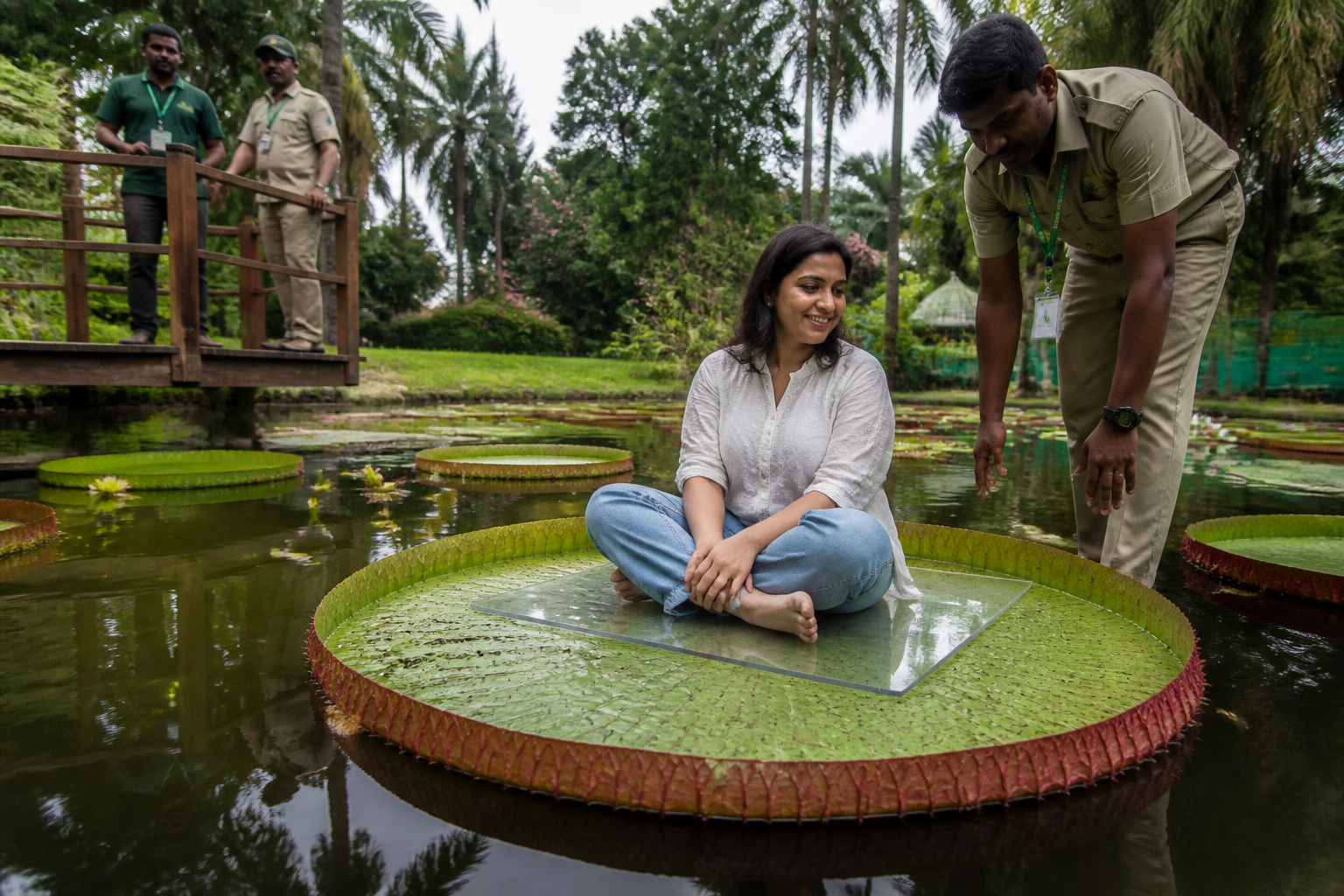
The Indian Botanic Garden in Howrah has turned a botanical curiosity into a carefully controlled visitor experience: people can sit on a 4kg acrylic board placed over the giant leaves of Victoria amazonica, the water lily whose return to the garden followed a difficult conservation effort after Cyclone Amphan. The experiment is being presented as a “joyride”, but its significance extends beyond novelty. It shows how a public botanical institution is attempting to make conservation visible without treating a fragile living collection as an ordinary recreational facility.
The programme began nearly 176 years after Victoria amazonica was introduced at the garden by a Scottish botanist. According to the Times of India report, around 250 visitors have taken part so far, including a visitor weighing 96kg. The garden has allowed participants ranging from an 11-month-old child to a 90-year-old adult to sit on the acrylic board. Staff weigh visitors beforehand and assist them from a sturdy wooden platform extending from the edge of the lake.
The arrangement is designed around weight distribution rather than direct contact. The board is placed on the leaf to spread the rider’s weight, while trained staff help visitors board. Garden authorities said safety measures were being followed for both visitors and plants. The experiment has so far tested a combined weight of up to 100kg, including the board, according to botanist R Sarvanan, who proposed the idea.
That qualification is important. The activity is not an open-ended attraction in which visitors can approach the plants independently. It depends on a sequence of institutional controls: weighing, supervised boarding, a platform at the water’s edge and a board intended to prevent damage to the leaf. The programme therefore reflects a broader challenge faced by public gardens and ecological sites: how to increase public engagement while retaining control over the conditions that protect the collection.
Victoria amazonica is particularly suited to attracting public attention because of its unusual structure. Its plate-like leaves have an average diameter of about 2 metres and raised rims roughly 4 inches high. The upper surface, or lamina, is about 1cm thick, while the underside is denser and stronger, with an air-filled vascular network. Depending on the species, the overall thickness ranges from 4cm to 8cm.
The leaf’s apparent strength is not simply a matter of size. Sarvanan told the newspaper that numerous veins, sub-veins and hollow, air-filled ribs support the underside. Air shifts within these ribs according to the weight placed on the leaf, helping the structure remain balanced. Microscopic pores called stomatodes drain excess water, while a waxy coating limits water accumulation and helps riders maintain their balance.
These details turn the visitor experience into an informal lesson in plant structure. The garden is not only displaying a large aquatic plant; it is using the plant’s own biology to explain why the experience is possible and why it must be limited. The board, platform and staff supervision translate botanical knowledge into an operating protocol. In that sense, the ride is less a conventional amusement activity than a public demonstration of how an aquatic plant responds to load.
The experiment also has a strict biological deadline. Garden authorities said it will stop when flower buds begin appearing later in the season. The leaves become smaller and weaker after budding as the plant prepares to bloom. This condition places the plant’s life cycle above the visitor programme. The attraction can continue only while the plant is in a phase that can tolerate the carefully managed activity; once that changes, access must end.
That approach matters because all 16 ponds at the garden currently have Victoria amazonica. The number indicates that the experiment is taking place within a larger living collection, not around a single isolated specimen. Any damage to leaves, therefore, would have implications beyond one visitor interaction, particularly because the garden’s present population is the result of a recovery process after a major environmental shock.
In 2020, Cyclone Amphan devastated the garden and killed all its giant water lilies. The institution then contacted organisations that had previously received giant lilies from it. Yogi Vemana University in Kadapa, Andhra Pradesh, had received two plants in 2019 and supplied seeds in October 2021. The garden tried to germinate the seeds in soil, sand, tissue and cotton, but those attempts failed.
The recovery came through an unexpected method. Sarvanan said he placed some seeds in a bottle of water and kept it in an almirah, changing the water regularly. In February 2022, he found that two or three seeds had sprouted. That discovery enabled the giant water lily to return to the Indian Botanic Garden. The account demonstrates how conservation can depend on institutional memory, exchange between organisations and persistence with methods that are not always part of a straightforward propagation plan.
The garden’s history with the species also includes a 1950 effort by botanist Robert Scott, who brought 50 saplings from the Amazon forest for research and conservation. Eleven adapted, survived and later propagated. The present collection therefore rests on several layers of intervention: introduction, adaptation, propagation, distribution to other institutions, recovery after cyclone damage and renewed cultivation from seeds.
This history changes the meaning of the “joyride”. Without it, the activity could be read simply as a promotional device for a popular garden. With it, the visitor experience becomes the latest stage in a longer institutional story about maintaining a species in an urban botanical setting. The programme draws attention to the plants, but the plants also draw attention to the systems required to keep them alive: ponds, horticultural staff, scientific knowledge, inter-institutional cooperation and protection from extreme weather.
The arrangement also illustrates the limits of turning conservation into public access. The garden has not claimed that a leaf can support unlimited weight. Instead, staff have gradually allowed heavier visitors to board and have reported a maximum total weight of 100kg with the board. The ride is suspended when the plant’s condition changes. These limits are central to the programme’s credibility because they acknowledge that the living exhibit cannot be separated from its biological vulnerability.
For visitors, the experience offers a direct encounter with a plant that is usually viewed from the edge of a pond. For the institution, it creates a way to communicate the plant’s structure and recovery story through participation. Yet the reported numbers also show that the attraction is being managed at a modest scale: 250 people have taken part, and each experience requires staff intervention and controlled access. It is not a mass-use facility, and the evidence supplied does not establish whether the programme will continue beyond the current season or become a permanent feature.
The institutional chain behind the initiative is equally significant. Sarvanan developed the idea, while director Kanad Das and additional director and garden-in-charge Manas Bhaumik approved it. Staff members manage weighing, boarding and supervision. This division of responsibility shows that even a seemingly simple visitor activity requires administrative authorisation and operational oversight when it takes place inside a living collection.
The Indian Botanic Garden’s experiment therefore raises a larger urban question: how can public institutions make ecological assets accessible without reducing them to consumable experiences? In this case, the answer is provisional rather than complete. Access is being offered, but only through a board, a platform, staff assistance, weight limits and a seasonal stop condition. The conservation history behind the programme reinforces why those restrictions matter.
What the available evidence confirms is that Victoria amazonica has returned to the garden after the loss of its giant water lilies in 2020, that all 16 ponds currently contain the species, and that a supervised visitor trial has allowed about 250 people to sit on its leaves through an acrylic board. What remains to be observed is how the garden assesses the trial over time, whether it records any effect on the plants and whether the experience remains subordinate to the collection’s conservation needs. For now, the programme’s strongest lesson is that public engagement works best when the institution’s ecological responsibilities set the terms of access.
