


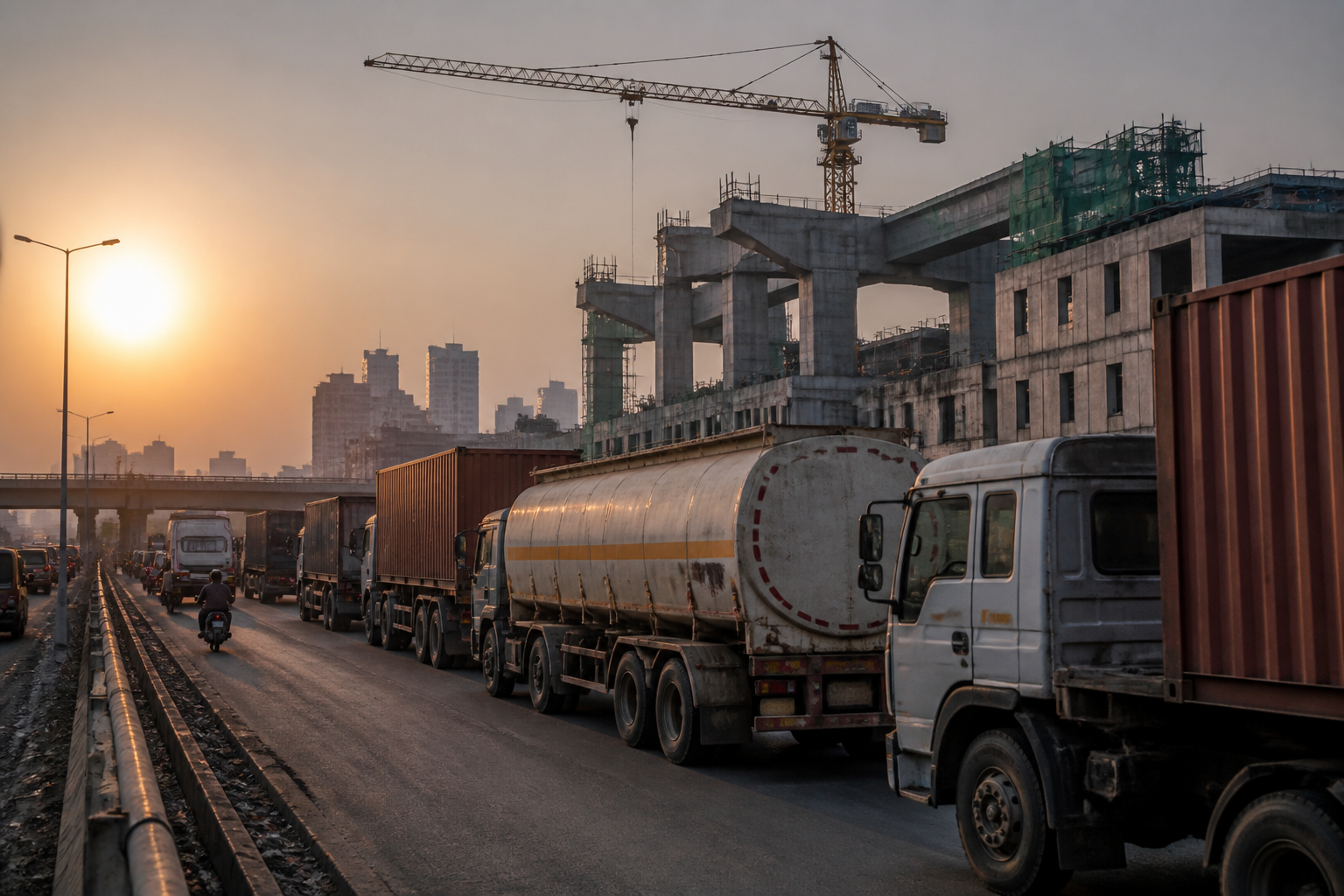
Diesel prices have reached record or near-record levels across major markets as wars in the Middle East and Ukraine disrupt refineries, exports and shipping routes. The immediate story is a global fuel squeeze. The larger urban story is how heavily cities still depend on diesel-powered freight, construction equipment, industry and food supply chains—and how few rapid alternatives exist when those systems are disrupted.
European diesel futures more than doubled from the start of 2026 before closing at an all-time high last week, according to the report. Average retail diesel prices in the United States crossed $6 a gallon for the first time on record this month, reaching $6.52 per gallon on Monday, based on figures from the Automobile Association. France’s average diesel price reached €2.41 per litre on Sunday, according to an AFP analysis cited in the report. Asian benchmark diesel prices have also remained close to record levels.
These figures describe more than a commodity-market shock. Diesel is the working fuel of the physical economy. Trucks move construction materials, manufactured goods, food and waste. Diesel-powered machinery excavates, hauls and builds. Agricultural equipment depends on it, while industrial users rely on diesel either directly or through transport contractors. When fuel becomes scarce or expensive, the pressure can move through the entire urban system even if residents do not buy diesel themselves.
The present squeeze is being intensified by disruptions at both ends of the supply chain. Refineries in the Middle East and Ukraine have been damaged, while other facilities are operating at high utilisation to compensate for lost production. US refineries were running at their highest level in eight years in late August, according to the International Energy Agency. Yet the IEA said many refineries were already stretched to capacity, leaving few options to prevent further tightening and higher prices.
That constraint is important because crude oil availability alone does not guarantee diesel availability. Refineries must have suitable crude, functioning plants, transport access and enough time to convert feedstock into usable products. Rystad Energy vice-president Janiv Shah said some refining capacity existed on paper but little could be activated quickly or supplied with the appropriate crude. The distinction between nominal capacity and immediately usable capacity is therefore central to understanding why prices can rise sharply even when producers attempt to increase output.
Trade routes have added another layer of vulnerability. Middle East diesel exports fell by half between March and August compared with a year earlier, averaging 800,000 barrels per day, according to shipping data from Kpler. The region supplied nearly 41% of Europe’s diesel imports in 2025. Kpler analyst George Shaw, cited by Reuters, warned that further disruption to Red Sea flows could tighten an already stretched global market, with refining capacity remaining a key constraint.
For cities, the Red Sea is not a distant logistical detail. Shipping routes determine whether fuel, construction inputs and industrial goods arrive on time and at what cost. A disruption can force importers to seek longer or more expensive routes, compete for alternative cargoes or draw down inventories. Those costs do not remain confined to shipping companies. They can affect freight rates, project logistics and the price of goods moved through urban distribution networks.
Russia’s role illustrates how a supply shock can spread through markets even when the initial disruption is geographically concentrated. Russia, described in the report as the world’s second-largest diesel exporter after the United States, banned diesel exports in July after Ukrainian drone attacks reduced refinery production. Before the ban, Russia had supplied significant volumes to countries including Turkey and Brazil, prompting importers to search for alternative sources.
European inventories show the effect of that competition. Diesel stocks at the Amsterdam-Rotterdam-Antwerp refining and storage hub were at their lowest level for that time of year on September 10, according to Insights Global. In the United States, inventories rose by about 600,000 barrels in the previous week but still stood at 96.97 million barrels—nearly 15% below the five-year average for the second week of September.
Low inventories matter because they reduce the buffer available when supply is interrupted. Storage allows distributors and consumers to absorb short disruptions without an immediate price spike. When stocks are already below seasonal norms, each additional disruption has a greater chance of affecting prices and availability. The market then has to rely more heavily on new refinery output, replacement imports or demand reduction, all of which have limits in the short term.
Asia is experiencing a similar pressure through Middle Eastern and Russian supply disruptions. The benchmark diesel swaps price had eased from a March record above $200 a barrel but remained around $180 a barrel on September 18, according to the report. That was still roughly twice its pre-war value. China’s diesel exports fell 26% year on year in the April-June period after the government limited refined-product exports, tightening global supplies. Exports later recovered to around 320,000 barrels per day in August, their highest level in nearly two and a half years, while domestic stocks declined.
China’s experience highlights the tension between domestic energy security and international market relief. Releasing more refined products into global markets can ease external shortages, but it may also reduce domestic buffers. Restricting exports can protect local availability while tightening supply elsewhere. The resulting market is shaped not only by production but also by national decisions about strategic stocks, export controls and domestic priority.
The urban consequences are likely to be transmitted through sectors with limited immediate fuel substitution. The report notes that trucking, agriculture, construction and industry have few short-term alternatives to diesel. This matters particularly for construction and infrastructure, where equipment and material movement are organised around diesel-dependent fleets and machinery. A fuel shock can therefore affect the operating cost of contractors and logistics providers even before it changes the price of the underlying material or equipment.
The same mechanism applies to everyday urban supply. Freight vehicles connect ports, warehouses, industrial areas, wholesale markets, construction sites and neighbourhoods. If transport operators face higher fuel costs, they may pass them into freight charges. The supplied report does not quantify those downstream effects or establish their impact on any specific Indian city, but the dependence it describes is clear: the built environment is supplied by a chain whose mobility remains closely tied to liquid fuels.
The policy challenge is made more difficult by the absence of quick supply-side solutions. Shah said that resuming oil shipments through the Strait of Hormuz would likely be the fastest way to ease prices because it would allow Asian refineries to receive supplies. That option depends on the restoration of secure flows rather than on a rapid expansion of new infrastructure. Other responses, such as increasing refinery utilisation, are constrained when plants are already operating near capacity or lack the right crude feedstock.
The IEA’s warning also points to the role of demand. Toril Bosoni, head of the agency’s oil industry and markets division, said that if Gulf supplies remained constrained and commercial inventories continued to fall rapidly, higher prices and further reductions in demand could be needed to close the supply-demand gap. In practice, this means the market may rebalance partly by making fuel expensive enough to reduce consumption. That is a blunt adjustment for sectors such as freight, construction and agriculture, where activity cannot easily stop or switch energy sources.
For urban policymakers, the episode raises a structural question about resilience. Cities routinely plan for roads, transit systems, warehouses, housing and utilities, but the fuel systems that operate and supply them are often treated as an external commercial matter. The current squeeze shows that refinery geography, maritime corridors, export controls and inventory levels can become urban variables. They influence whether materials move, whether machinery operates and how much it costs to maintain or expand the built environment.
The evidence supplied in the report does not establish how long the current price surge will last or how it will affect particular national markets. It does, however, establish a pattern of simultaneous pressure: damaged refineries, disrupted Middle Eastern and Russian supplies, constrained trade routes, low inventories and limited spare refining capacity. The immediate developments to monitor are the restoration of Gulf flows, the direction of commercial inventories, Russia’s export position, China’s refined-product shipments and whether refinery utilisation can rise further without creating new operational constraints.
