


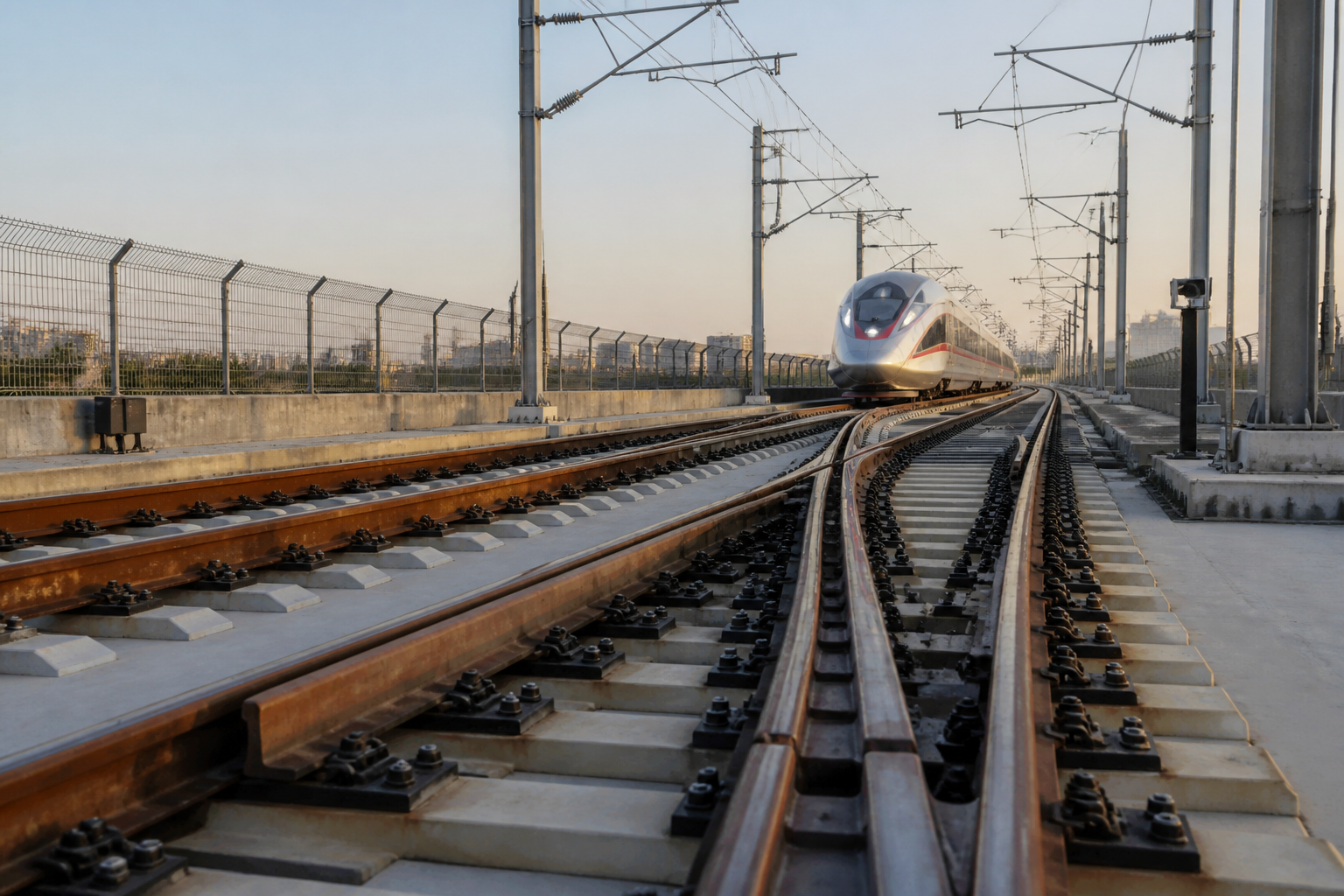
The Mumbai-Ahmedabad bullet train project is using swing-nose movable crossings for the first time in Indian Railways’ history, introducing a track technology designed to support trains travelling at up to 320 kmph. The change addresses a basic problem in high-speed rail: the point where one rail route crosses or branches must remain continuous and stable enough to limit shocks, vibration, noise and wear.
The technology, reported by Loksatta, replaces the limitations of a conventional fixed crossing with a movable crossing nose. In a traditional railway turnout, the wheel passes over a gap at the crossing point. At ordinary speeds, that interruption can be managed through track design and maintenance. At very high speeds, however, the interaction between the wheel and the rail at that point becomes more demanding. The report says the gap can generate sharp impacts, vibration, noise and increased wear on both wheels and rails.
A swing-nose crossing is intended to remove that discontinuity when the route is set for a train movement. Its crossing tip shifts into the required position, allowing the wheel to receive continuous support across the turnout. According to the report, this provides an unbroken rail surface for the bullet train and reduces the impact and vibration experienced as the wheel passes through the crossing.
That distinction is important because high-speed railway infrastructure is not defined only by the maximum speed printed in a project specification. It also depends on how consistently the track, switches, crossings and control systems can maintain the required geometry under operating conditions. A train travelling at 320 kmph has less tolerance for irregularities at a turnout than a slower service. Even a small discontinuity can influence ride quality, component stress and maintenance requirements.
The reported technology therefore represents more than a change in one track component. It links the physical design of the turnout to the operating speed of the railway. The central engineering objective is to ensure that the wheel remains supported through the branch or crossing without encountering the pronounced impact associated with a conventional fixed crossing.
The report identifies several expected effects. The movable crossing is intended to reduce shocks and vibration, lower noise inside the coaches, and decrease wear on wheels and rails. It is also expected to support safer operations and improve the maintenance regime. These outcomes are connected: lower impact at the crossing can reduce stress on components, while lower wear may make it easier to preserve the condition of the track and rolling stock.
The system also introduces a more demanding control and locking arrangement. Each high-speed turnout uses two independent point machines, according to the report. One machine positions and locks the rail at the beginning of the turnout. The second positions and secures the movable crossing nose. Both machines operate in coordination under a common control system.
A train is permitted to pass only after the system confirms that both components are in the correct position and locked. This requirement shows that the crossing is not treated as a passive piece of track. It is part of an integrated safety sequence involving mechanical movement, electrical or control logic, position detection and route authorisation. The source report does not specify the exact signalling architecture or the locations where these crossings are being installed, but it makes clear that the two locking points must be verified before movement is allowed.
This is the institutional significance of the reported development. High-speed rail safety depends on several railway functions working together rather than on a single piece of equipment. Track engineering determines how the rail supports the wheel. Point machines move and lock the route. The control system confirms the status of the equipment. Only after these conditions are satisfied can the train be cleared through the turnout.
The arrangement also changes the maintenance question. A fixed crossing contains a permanent geometric feature over which wheels must pass. A movable crossing adds mechanisms that have to move accurately, lock reliably and remain coordinated. The report presents the technology as improving maintenance through reduced wheel and rail wear, but the system itself will require disciplined inspection and upkeep of the two point machines, the movable nose and the associated control arrangements.
That balance is central to understanding the technology. The use of a movable crossing can reduce the physical shock imposed on high-speed trains, but it also makes the turnout mechanically and operationally more sophisticated. The benefit depends on reliable positioning, locking and confirmation. The report’s description of dual point machines indicates that the safety case rests on ensuring that neither the route-setting rail nor the movable crossing nose is left in an incorrect or unsecured position.
The Mumbai-Ahmedabad project is consequently being used to introduce a railway component whose design is closely tied to high-speed operation. The source describes the application as a first in Indian Railways’ history, making it a technology milestone as well as a project update. It signals a move away from treating conventional railway components as automatically suitable for higher speeds and towards infrastructure designed around the different forces and tolerances of high-speed travel.
The report also highlights an often overlooked part of passenger experience. Track technology is normally discussed through speed, journey time or corridor length, but the quality of the ride depends on what happens beneath the train. Reducing shocks and vibration at a turnout can affect the sound and movement experienced inside coaches. The expected reduction in noise and component wear connects a technical track decision to the everyday experience of passengers.
For the railway system, the implications extend beyond the train itself. Wheel and rail wear affect inspection cycles, replacement requirements and the availability of maintenance teams. A crossing that produces fewer impacts may help reduce stress on these components, although the supplied report does not provide quantitative data on expected savings, inspection intervals or operating performance. Those figures will be necessary to assess the technology after it enters regular service.
The available information also leaves several implementation questions unanswered. It does not state how many swing-nose crossings will be used on the corridor, where they are located, when installation will be completed, or whether the technology has already undergone operational testing. It also does not provide comparative measurements for vibration, noise or wear between a fixed crossing and the movable system. These details will determine how far the reported technical advance translates into measurable operational benefits.
Even without those figures, the engineering logic described by Loksatta is clear. A 320 kmph railway cannot rely solely on increasing train power or improving rolling stock. Its safety and performance depend on the continuity of the rail path, the precision of route-setting equipment and the ability of the control system to prevent movement until the turnout is correctly secured.
The larger urban question is how new high-speed transport systems are integrated into the wider infrastructure network. A bullet train corridor is visible through stations, viaducts and trains, but much of its reliability will be determined by less visible systems such as crossings, point machines, locking arrangements and maintenance protocols. These components rarely shape public announcements, yet they govern whether a high-speed railway can operate smoothly and safely.
The swing-nose crossing reported on the Mumbai-Ahmedabad route is therefore best understood as a systems-level intervention. It addresses the interface between wheel and rail, but its performance depends on mechanical equipment, signalling controls, route verification and maintenance working together. The confirmed development is the adoption of the technology for high-speed turnouts. The next important evidence will be operational information showing how the system performs under actual service conditions, including its reliability, maintenance needs and effect on ride quality.

