


The planned September 23 meeting between US President Donald Trump and Chinese President Xi Jinping is being watched in India not because India is expected to be on the formal agenda, but because the outcome could alter the geopolitical conditions that have helped strengthen India’s manufacturing and technology ambitions. A less confrontational US-China relationship would not erase India’s advantages, but it could reduce the urgency that has pushed companies and governments to diversify away from China.
That distinction is central to understanding India’s China+1 opportunity. The strategy was never based on the assumption that global companies would abandon China completely. It emerged from a different calculation: dependence on one manufacturing ecosystem had become too risky. The operating logic shifted from “just in time” to “just in case”, with supply-chain resilience becoming a commercial and national-security priority.
India has benefited from that shift through its large domestic market, democratic institutions, technology capabilities, geographic position and potential to become an alternative manufacturing base. Government efforts such as the production-linked incentive scheme have targeted electronics, telecom equipment, pharmaceuticals and other industries. Electronics production has expanded, while suppliers to Apple have increased their presence in India, according to the report.
But a more predictable relationship between Washington and Beijing could change the competitive equation. China still has supplier networks, infrastructure, ports, skilled labour and manufacturing clusters built over decades. If geopolitical risk declines, the additional cost that companies are willing to bear to establish production outside China could also decline. Diversification would remain important after the disruption caused by Covid-19, but the decision on where to locate the next factory could become more commercially demanding for India.
China+1 moves from risk management to performance
The report’s central argument is that India cannot depend indefinitely on China being viewed as an unusually risky manufacturing location. China+1 may continue, but the reasons behind it could become more balanced. Instead of choosing India primarily because China is unavailable or politically difficult, companies would need stronger operational reasons to choose India over China or other competing locations.
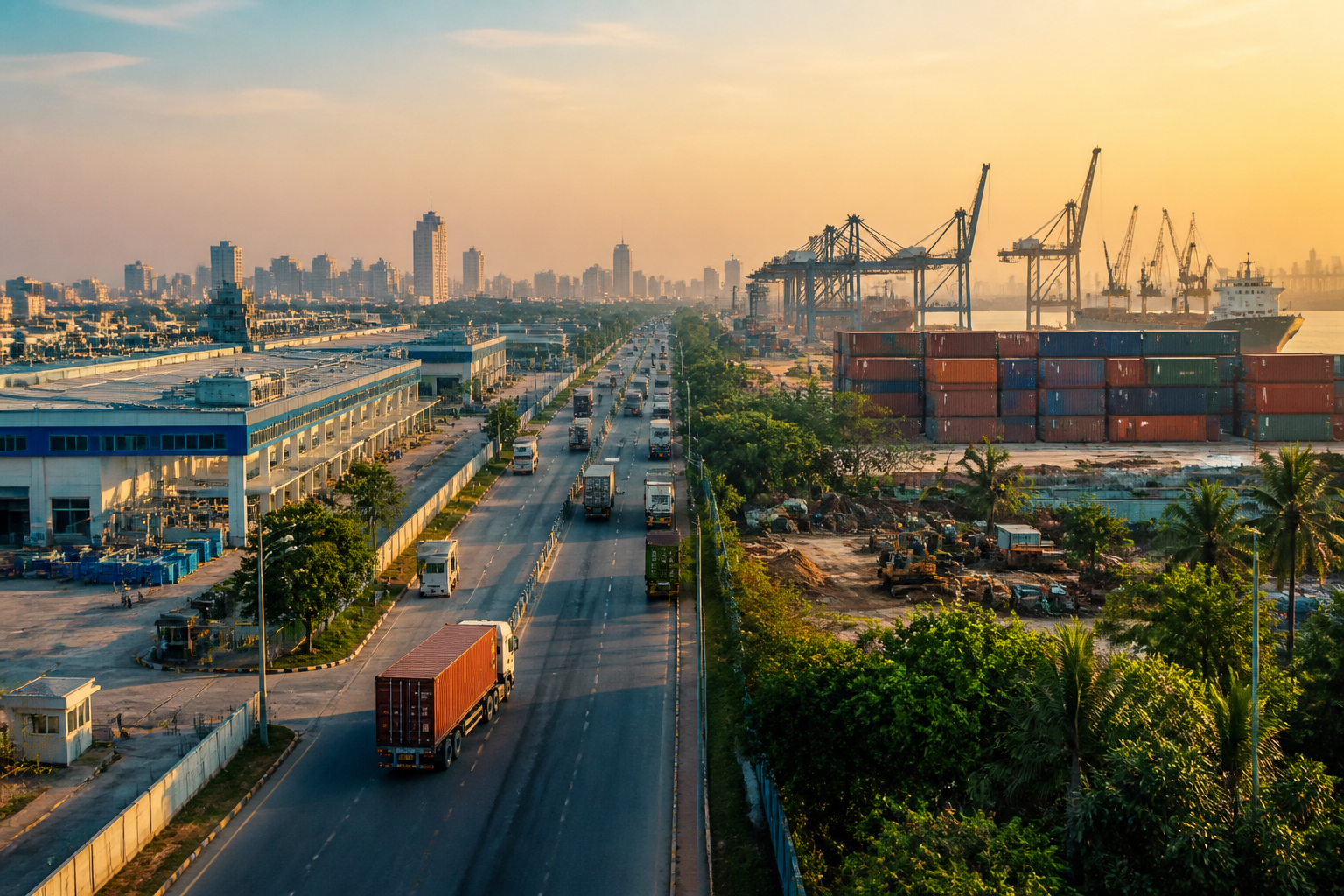
That raises questions about the built systems behind manufacturing competitiveness. Investment decisions depend not only on wages or diplomatic alignment, but also on the availability of industrial land, reliable power, logistics networks, ports, supplier clusters, skilled workers and predictable regulation. The report does not provide a comparative dataset on these factors, but it identifies the scale of China’s accumulated advantage: its supplier networks and industrial infrastructure have been built over several decades.
For India, the implication is that geopolitical opportunity must be converted into durable productive capacity. Incentives can attract factories, but long-term competitiveness depends on whether those factories can source inputs, move goods and scale production efficiently. The report’s warning is therefore broader than a question of trade diplomacy. It concerns whether India can build an industrial ecosystem strong enough to remain attractive when geopolitical pressure on China eases.
The issue also affects the geography of Indian urbanisation. Manufacturing investment is not absorbed by national policy alone. It creates demand for industrial corridors, freight links, worker housing, logistics services, utilities and urban infrastructure around production centres. If supply-chain diversification becomes less urgent, competition among locations will place greater weight on the quality and reliability of those systems.
Semiconductors and AI raise the technology stakes
Semiconductors are another area where the Trump-Xi meeting could influence India’s position. The United States has spent years restricting China’s access to advanced chips and manufacturing technology. India, meanwhile, has sought to position itself as a trusted technology partner. The US-India TRUST initiative covers semiconductors, artificial intelligence, quantum technology, critical minerals, biotechnology, energy and space, and includes an AI infrastructure roadmap intended to accelerate US-origin AI investment and infrastructure in India, according to the report.
The difficulty is that technology restrictions can change without disappearing. The two countries are exploring ways to manage risks from increasingly powerful AI models, while Washington remains committed to maintaining its technological advantage. If the United States permits more commerce involving non-sensitive technologies with China, American companies could regain access to a large market and Chinese firms could receive additional room to operate.
That would not automatically undermine India’s technology ambitions. However, it could make India’s proposition more demanding. The country would have to offer capabilities that remain valuable even when China is not fully excluded from advanced technology networks. The report describes this as a shift from “choose us because China is unavailable” to “choose us because India is indispensable.”
The distinction matters for India’s digital and industrial infrastructure. A trusted technology partner requires more than diplomatic alignment. It needs research capacity, data infrastructure, skilled professionals, dependable energy, secure facilities and the ability to connect global firms with domestic production and innovation networks. The report establishes the policy initiatives but does not offer evidence on their implementation or measurable outcomes. Those details will be important in assessing whether the technology opportunity is becoming institutional capacity.
Critical minerals expose the infrastructure gap
Rare earths and critical minerals may be the least visible but most consequential element of the US-China relationship. They are used in electric vehicle motors, wind turbines, electronics, chips and advanced weapons. China dominates their processing, giving Beijing leverage over industries that are central to the energy transition, advanced manufacturing and strategic security.
This creates an opportunity for India, but also exposes the complexity of building alternative supply chains. India and the United States have signed a Strategic Critical Minerals Cooperation Framework covering mining, processing, recycling, financing and resilient supply chains. India is also developing rare-earth corridors in Odisha, Kerala, Andhra Pradesh and Tamil Nadu, the report says.
Mining alone, however, cannot create resilience. Critical-mineral security requires processing facilities, recycling systems, transport links, industrial users, financing and environmental oversight. The report does not provide project timelines, investment values or production targets for the proposed corridors, so their current capacity cannot be established from the supplied evidence.
The timing of investment could nevertheless be affected by the Trump-Xi relationship. If Washington considers Chinese rare-earth exports more predictable, the immediate pressure to finance expensive alternatives could weaken. For India, that makes policy consistency important. Supply-chain projects that depend only on a temporary geopolitical emergency may be vulnerable if the diplomatic environment changes.
Energy diplomacy could create uneven pressure
India’s position is also linked to energy. Both India and China are major purchasers of energy from countries that Washington seeks to isolate. The report says the Trump administration wants Beijing to reduce purchases of Iranian oil, while US pressure on Russian energy has placed India under scrutiny as well.
Iran is expected to feature in discussions between Trump and Xi, and India would be watching whether Beijing receives exemptions, tariff relief or other concessions as part of a wider agreement. The report presents this as a risk that India could face tougher treatment for pursuing its own energy interests while China obtains negotiated flexibility.
The broader urban and infrastructure connection is straightforward: energy access and energy prices shape industrial competitiveness, transport costs and the viability of manufacturing clusters. Yet the supplied material does not establish what arrangements, if any, may emerge from the meeting. The relevant question for India is therefore not only the substance of any US-China agreement, but whether its terms create different operating conditions for the two Asian economies.
The Quad’s economic role may evolve
The final issue is strategic. The Quad, comprising India, the United States, Japan and Australia, gained greater relevance as concern grew about China’s influence across the Indo-Pacific. A US-China thaw would not remove India’s concerns about China’s relationship with Pakistan, competition in the Indian Ocean, Taiwan or the South China Sea. The report also notes that Washington and New Delhi are continuing to build mechanisms to diversify critical-mineral and technology supply chains.
Still, the political importance of the Quad could change if China appears less threatening to Washington. That does not mean the grouping would disappear. It means its economic and strategic rationale could require clearer definition beyond balancing China. For India, the challenge is to ensure that cooperation around technology, minerals, energy and infrastructure produces capabilities with value even when diplomatic tensions fluctuate.
The report ultimately points to a structural test for India’s rise. India has scale, demographics, geography, technological talent, military weight and a large domestic market. But those advantages become durable only when supported by industrial infrastructure, institutional capacity and competitive execution.
The Trump-Xi meeting will not determine India’s manufacturing or strategic future on its own. It could, however, reveal whether the next phase of India’s opportunity will be driven mainly by China’s perceived risk or by India’s own ability to become a necessary part of global production and technology networks. The developments to monitor are the treatment of non-sensitive technology, any arrangements on critical minerals and energy, and the continued implementation of India’s cooperation frameworks with the United States.
