


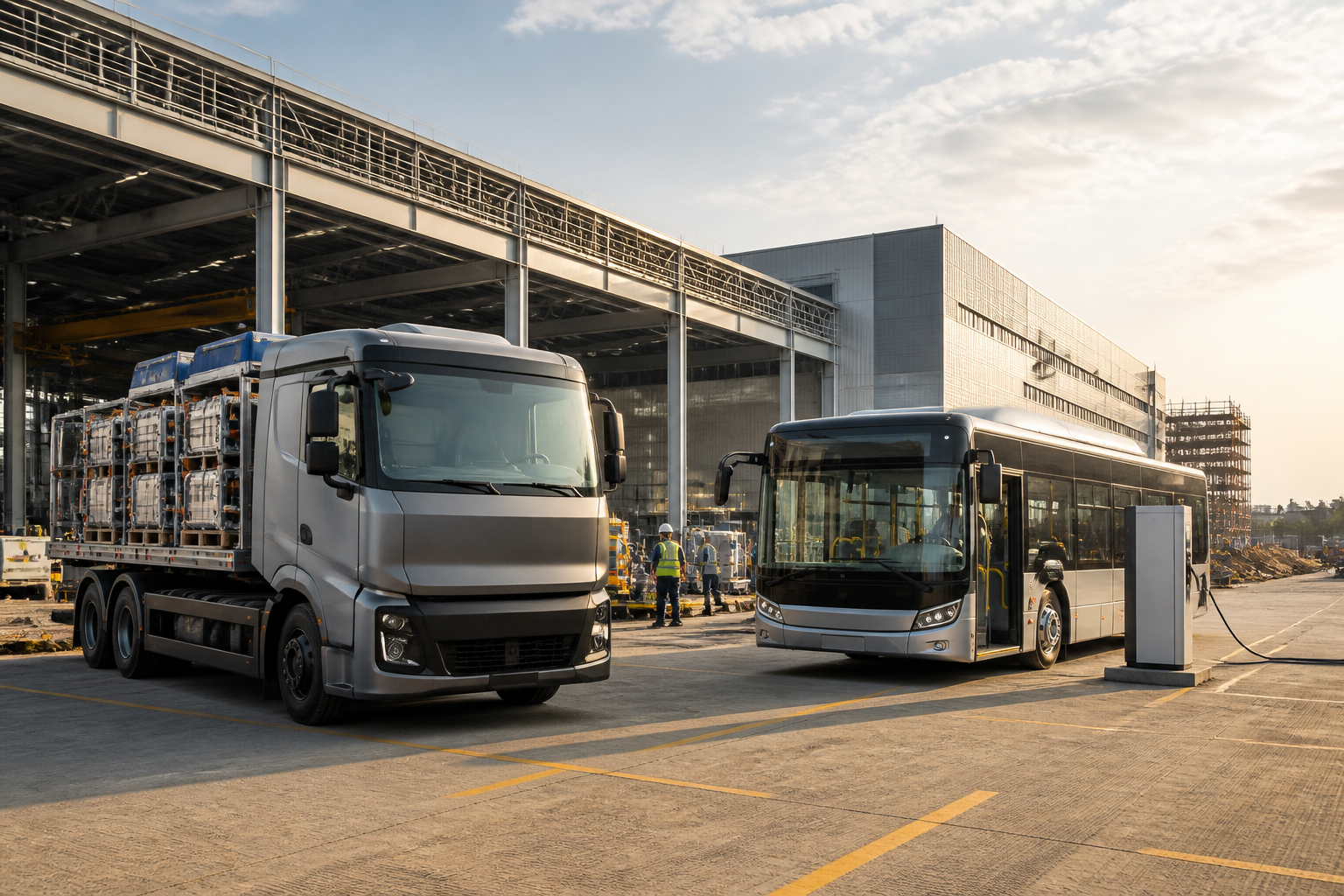
JSW Group is investing ₹2,000 crore to enter India’s electric commercial vehicle market, beginning with a 90-acre factory in Chhatrapati Sambhajinagar and targeting a place among the country’s top two or three commercial vehicle makers by around 2030.
Chairman Sajjan Jindal said the group would pursue both organic expansion and acquisitions as it builds an electric truck and bus business. The initial plant will have annual capacity for 15,000 vehicles, comprising 10,000 electric buses and 5,000 electric trucks. Jindal described the facility as an “entry strategy” for a longer-term plan to produce up to one lakh electric trucks annually by around 2030.
The first truck planned by JSW will be a 55-tonne tractor-trailer. The company intends to follow it with tippers, fixed-body trucks and dumpers. Its electric bus portfolio is expected to cover vehicles ranging from 7 metres to 18 metres, serving city transit, staff transport, school bus and airport applications.
Jindal said the group was particularly focused on trucks because their high utilisation could improve the economics of replacing diesel vehicles. JSW estimates that a heavy diesel truck costs about ₹25 lakh, compared with approximately ₹85-88 lakh for an electric equivalent. However, a truck travelling 100,000 kilometres a year at around 2.5 kilometres per litre could consume about 40,000 litres of diesel, costing nearly ₹40 lakh annually at ₹100 per litre.
JSW Greentech Chief Executive Sumit Mittal said the company was targeting a 15-20 per cent reduction in total cost of ownership. “The disruption is not in the upfront price, but in the total cost of ownership,” he said. The calculation places fleet utilisation, energy costs and operating patterns at the centre of the commercial vehicle transition rather than the initial purchase price alone.
The group also plans to use its existing industrial operations as an early testing ground. Around 17,000 trucks currently operate across JSW’s steel, cement and ports businesses. Mittal estimates that 40-50 per cent of their use-cases could be electrified relatively quickly, particularly vehicles running on predictable, closed-loop routes.
The Sambhajinagar plant is planned to integrate cell-to-battery-pack manufacturing, truck cabin production and in-house bus body construction. JSW also said the facility would include what it described as India’s first commercial vehicle plant with a pre-treatment and electro-deposition facility.
The company’s entry comes as established truck manufacturers continue to dominate India’s commercial vehicle market. Jindal said the shift to electric powertrains created an opening for a new player because JSW would not have decades of investment in diesel engines and related technologies to protect. He acknowledged that the group would face difficulties in building capabilities in an industry where it has limited legacy experience.
The immediate operational opportunity for JSW lies in controlled fleet environments, where routes, vehicle utilisation and charging requirements may be easier to manage than in open-market freight operations. The company’s next steps are the launch of its commercial electric vehicle brand and the development of the Sambhajinagar manufacturing facility.
