


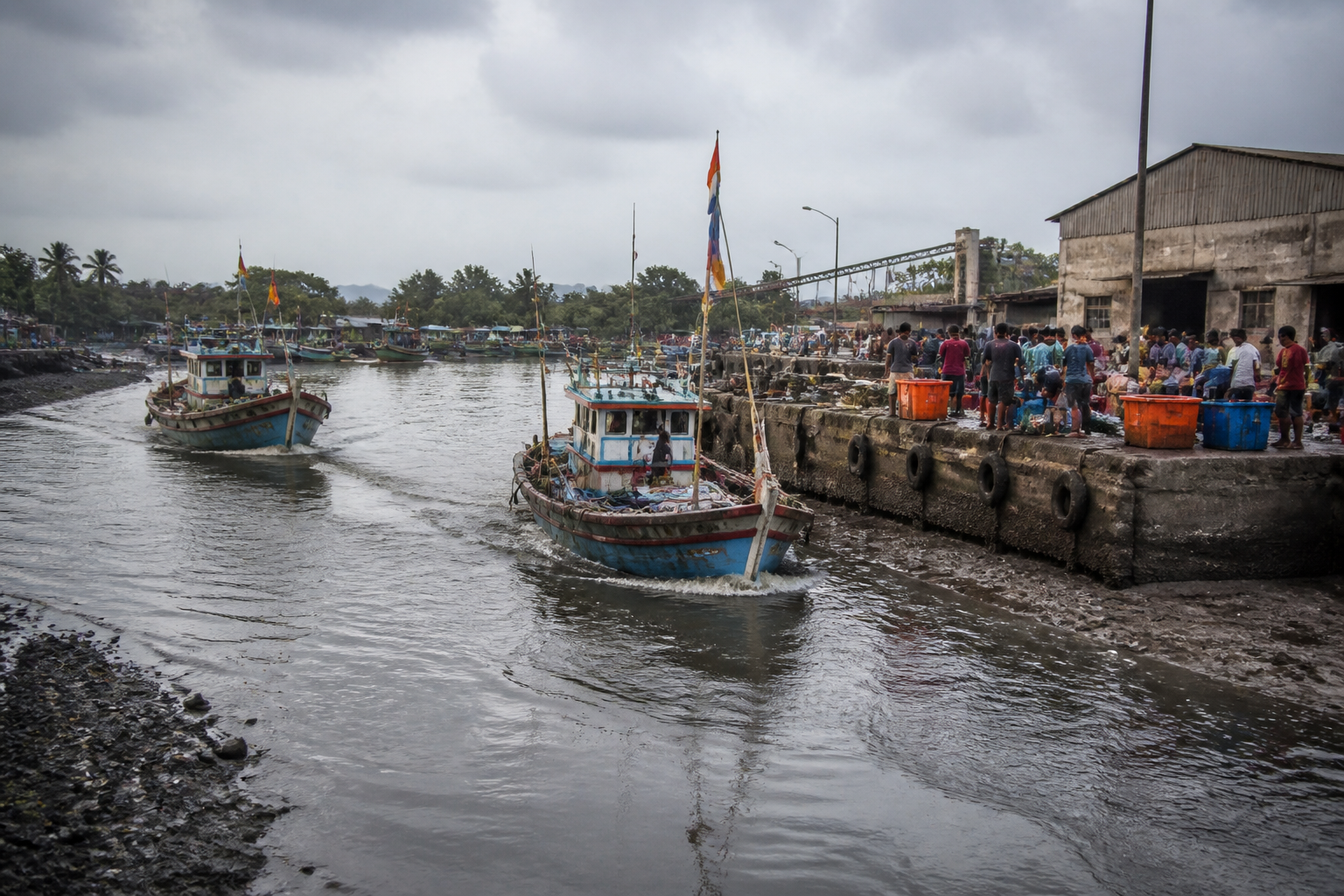
The Maharashtra Fisheries Department has sanctioned Rs 136.76 crore for 21 development works at Karanja fishing port in Uran, Raigad, including dredging the access channel and building an additional 370-metre berth wall. Work is scheduled to begin in November, according to information provided by Fisheries Department Joint Commissioner Mahesh Deore and reported by Loksatta.
The funding is aimed at addressing the accumulation of silt that has disrupted fishing operations at the port for the past two years. The shallow approach channel has made it difficult for boats to enter and leave, particularly during low tide, forcing fishers to wait for four to six hours after unloading their catch before returning to sea.
The delay has affected boats inside and outside the port, with hundreds reportedly getting stuck in the silt. The Karanja Fishermen’s Association and local fishers had been seeking dredging and additional berthing infrastructure to address the problem.
The approved works include dredging and widening the access channel at an estimated cost of Rs 21.25 crore. The construction of a 370-metre additional berth wall will cost approximately Rs 26.78 crore. Together, these works are intended to improve vessel movement and reduce congestion caused by the limited usable space and silted approach route.
The remaining Rs 88.75 crore will be spent on a range of supporting facilities. These include concreting within the port, Auction Centre 4, an administrative building, a radio building for communications, a restaurant, security rooms, a compound wall, a sewage treatment plant, an ice factory, a 100-tonne cold storage facility, water supply infrastructure, drainage and sewage systems, and a diesel pump.
Karanja fishing port plays a significant role in the regional fish economy. During the fishing season, fish worth an estimated Rs 550 crore is exported through the port. However, the silt accumulation has reduced operational efficiency and increased waiting time for fishers, affecting the movement of boats and the handling of the catch.
The sanctioned package combines navigation-related work with facilities for fish handling, storage, water, sanitation and port administration. This means the project is not limited to removing silt from the channel; it also covers the basic infrastructure needed to support fishing activity after boats arrive at the port.
The approval follows sustained demands from fishers and the Karanja Fishermen’s Association. The Fisheries Department’s next stated milestone is the commencement of work in November. The extent to which dredging and the new berth wall reduce waiting time and improve access will depend on the implementation of these sanctioned works.
