


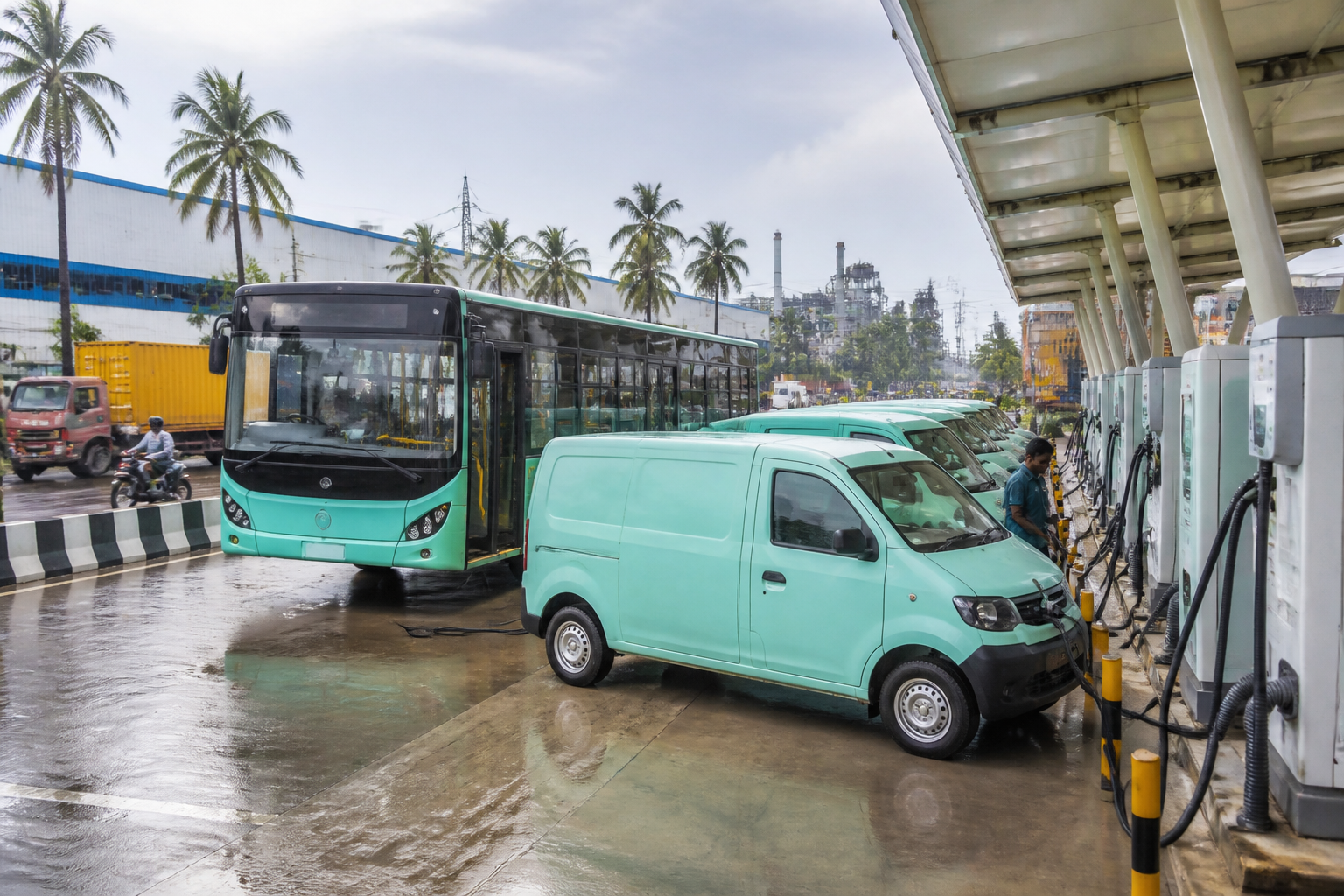
Tamil Nadu’s electric vehicle story is beginning to divide into two very different narratives. The state is a major EV manufacturing hub, private electric vehicle registration is strong and charging-related readiness has improved. Yet commercial EV adoption remains weak, exposing a gap between the infrastructure needed to produce electric vehicles and the financial and operational conditions required to use them at scale.
The Niti Aayog India Electric Mobility Index 2025 places Tamil Nadu sixth among 36 states and Union Territories and third among 17 large states. Its score rose by two points to 61, well above the national average of 42. But the state fell one place from its 2024 position, suggesting that progress in individual areas has not been uniform enough to maintain its earlier standing.
The most important weakness is commercial EV adoption. Tamil Nadu scored only 20 out of 100 for commercial EV registration, while purchase incentives scored 8. By contrast, private EV registration scored 92. The gap is too large to treat electric mobility as a single market. Private users, fleet operators, freight companies and last-mile delivery businesses face different cost, charging and utilisation conditions, and the index shows that Tamil Nadu’s progress is concentrated more heavily among individual consumers than commercial users.
That distinction matters because commercial vehicles spend more time on the road, operate against tighter turnaround requirements and depend on predictable operating costs. A private vehicle can often be charged at home or at a workplace. A bus, delivery van or truck requires access to infrastructure that is available when the vehicle needs it, delivers sufficient power within its operating schedule and remains reliable over repeated use. For such users, a charger is not simply an amenity. It is part of the vehicle’s operating system.
Kartikey Hariyani, founder and chief executive officer of EV charging network company Charge Zone, said the charging requirements of personal and commercial mobility were increasingly diverging. For personal mobility, he described a shift towards reliable fast charging for intercity travel as well as dependable home and workplace charging. For commercial mobility, he said the infrastructure equation changes significantly because charging speed, uptime and turnaround directly influence vehicle economics.
The scale of the commercial opportunity is visible in the heavy-vehicle segment. A 2025 study by the Council on Energy, Environment and Water and Climate Group, cited in the report, estimates that India’s roughly four million medium- and heavy-duty trucks account for nearly 35% of on-road fuel consumption and around 45% of on-road transport emissions. The figures underline why commercial electrification cannot be measured only through private car registrations. Trucks and other high-use vehicles have a larger relationship with fuel demand and transport emissions, but they also impose more demanding requirements on charging capacity and network reliability.
Hariyani said predictable demand from buses, trucks and fleets could make high-capacity charging corridors viable earlier, while the same infrastructure could support passenger EV mobility. This points to an institutional challenge for Tamil Nadu: commercial adoption and charging deployment are mutually dependent. Fleet operators may hesitate to invest without dependable charging, while charging providers may find it difficult to deploy high-capacity infrastructure without predictable fleet demand.
Tamil Nadu’s charging infrastructure score rose by 16 points to 73. The state received a score of 100 for renewable energy capacity, power availability, building byelaws for EVs and capital subsidies for charging. It ranked fourth among large states, behind Karnataka, Maharashtra and Haryana. These indicators show that the state has established several conditions for charging expansion, but the overall charging score remains below the national average cited in the report, pointing to gaps in charger availability and deployment.
The distinction between policy readiness and user access is central. A state may have power availability, supportive building rules and subsidies for charging infrastructure, but commercial operators still need chargers in the locations and formats that match their routes. A high-capacity facility on a major transport corridor serves a different purpose from a neighbourhood charger. The report’s emphasis on wider deployment and high-capacity charging indicates that the next stage is not only about increasing the number of chargers, but also about aligning their location and capacity with actual transport demand.
Tamil Nadu has undertaken feasibility studies for 528 locations across the state under the PM E-Drive scheme to support a statewide EV charging network. The studies could help address the spatial problem of charging access, although the supplied report does not establish how many of these locations will be built, when they will become operational or what charging capacity each site will provide. Those implementation details will determine whether feasibility work translates into a network that commercial operators can use reliably.
The index also shows that charging infrastructure alone will not close the adoption gap. The report recommends scrapping incentives for old commercial vehicles, stronger purchase subsidies, reserved EV parking and low-emission zones. Each measure addresses a different part of the commercial transition. Scrapping support and purchase subsidies can reduce the upfront cost of replacing an existing vehicle. Reserved parking can improve operational convenience and charging access. Low-emission zones can create a regulatory reason for operators to shift away from older vehicles, although the supplied material does not indicate whether Tamil Nadu has announced such zones.
The low purchase-incentive score of 8 is particularly significant. Commercial vehicles are purchased for their operating economics, and a higher initial cost can be difficult for small fleet owners and last-mile operators to absorb even when electric vehicles may offer savings during use. The report does not provide vehicle-level cost comparisons or details of Tamil Nadu’s existing commercial EV incentive structure. It does, however, make clear that the current level of purchase support is not matching the state’s manufacturing strengths or private EV adoption.
Transport electrification is another weak area. Tamil Nadu’s score rose by only two points to 48, substantially below the national average of 77. This suggests that the state’s broader transport system is not electrifying at the same pace as its private EV market or industrial base. The difference matters because manufacturing capacity can establish supply, while transport electrification depends on procurement, fleet conversion, charging operations, financing and route-level planning.
The state’s performance in research and innovation adds another layer to the picture. Its score fell by 14 points to 77. Research and development initiatives scored 100 and EV startup activity scored 81, but the patent score was only 30. The pattern indicates a gap between research activity and the creation of intellectual property. For a state with a long-established automotive manufacturing ecosystem, that gap is relevant to the transition from assembling and producing vehicles to developing proprietary technologies, components and systems.
Tamil Nadu’s existing industrial base remains a substantial advantage. The state already has an automotive manufacturing ecosystem and strong private EV registration. It is also investing in skills, with a programme to train 22,500 people in EV servicing and battery repair over five years. The programme includes 12,500 existing petrol and diesel vehicle mechanics. This could help address a practical constraint on adoption: vehicles require technicians who can maintain electric drivetrains and batteries, and the transition affects not only manufacturers and vehicle buyers but also the wider repair and service economy.
The skills programme is especially relevant to commercial users because downtime has a direct operational cost. A fleet operator needs access to service capacity that is geographically available and technically capable. The supplied report does not establish whether the training programme is concentrated in specific districts or linked to commercial fleet corridors, but its inclusion reflects the broader infrastructure needs of electrification. Charging stations, service networks, trained mechanics, battery repair capabilities and vehicle financing all form part of the same transition.
Tamil Nadu’s index results therefore present a mixed picture rather than a simple success or failure. The state has improved its overall score, retains a strong manufacturing base, performs well on private EV registration and has strengthened charging-related indicators. At the same time, commercial registration, purchase incentives and transport electrification remain weak. Research activity has not translated fully into patents, while charging availability still needs wider deployment despite strong scores for power availability and related policy conditions.
The larger urban question is whether Tamil Nadu’s EV transition can move from consumer adoption and industrial production into the daily systems that keep cities and supply chains functioning. Buses, delivery vehicles, commercial fleets and trucks require infrastructure planned around routes, dwell times and utilisation rather than only around vehicle ownership. The state’s next phase will be measured not simply by how many electric vehicles are sold or produced, but by whether operators can run them predictably.
The evidence confirms that Tamil Nadu has a strong platform for electric mobility but an uneven adoption structure. The immediate areas to monitor are the implementation of the 528 charging-location feasibility studies, the scale of commercial purchase support, the deployment of high-capacity corridor infrastructure, the progress of transport electrification and the conversion of EV research into patents and products. These will show whether the state’s manufacturing and private-market strengths can overcome the commercial barriers identified by the IEMI 2025 report.

