


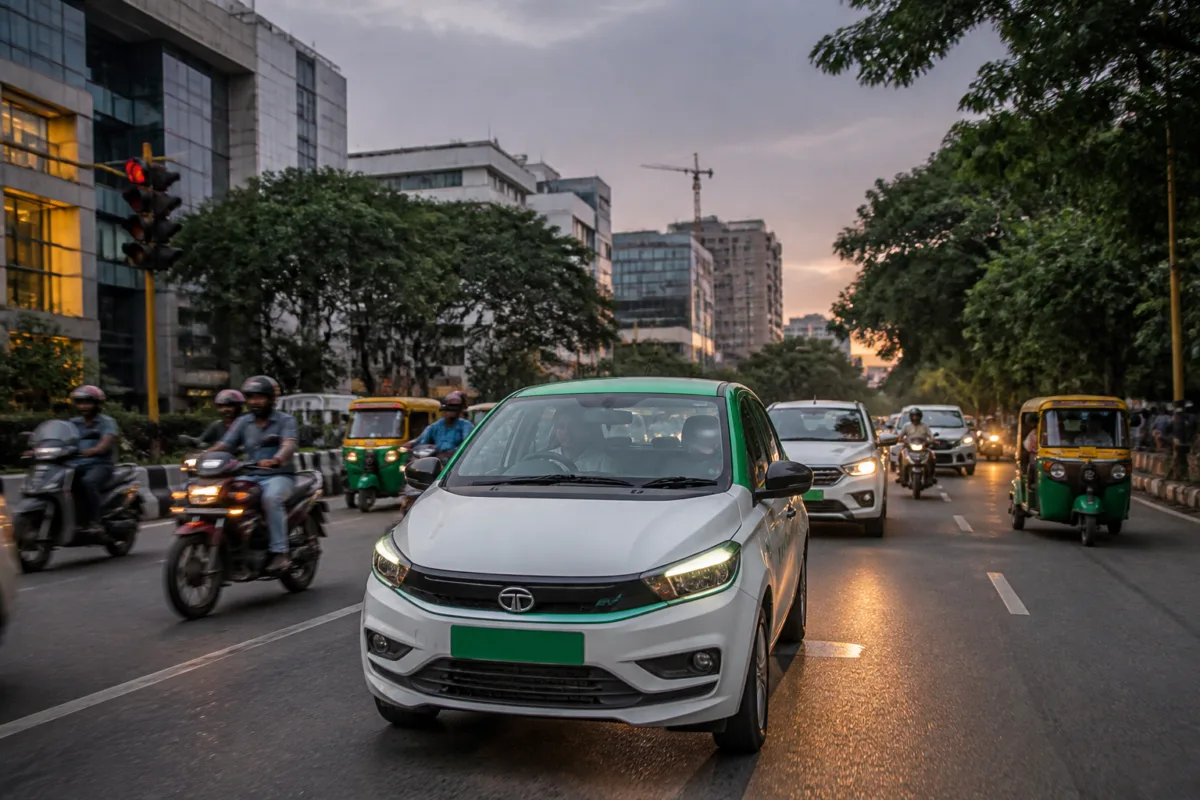
Green SM’s proposed entry into Bengaluru is being presented as a contest over taxi fares, but the dispute is fundamentally about who bears the cost of the city’s transition to electric mobility. Transport associations say a company-backed electric fleet charging substantially less than existing notified fares could undermine independent cab and autorickshaw operators. The company disputes the fare figure at the centre of the controversy, while the Karnataka government has paused further registrations pending a decision.
The immediate disagreement concerns reports that Green SM could offer rides at around Rs 8 per kilometre, compared with the Karnataka government’s notified rate of Rs 24 per kilometre for smaller taxis. Green SM has described reports that it charges Rs 8 per kilometre as inaccurate and unfounded, saying fares are available through its official website and communication channels and are shown in the app before a customer confirms a booking.
That disagreement matters because the two sides are not comparing equivalent operating models. Existing drivers typically purchase or finance individual vehicles and carry the cost of equated monthly instalments, insurance, permits, fuel and maintenance. The transport federation representing them says Green SM could benefit from corporate capital, bulk vehicle purchases, an in-house app and fleet-management systems. If those advantages allow a fleet operator to offer lower fares, independent operators may be forced to reduce prices without having the same financial capacity or operating scale.
The Karnataka government has already intervened in the registration process. Transport Minister Byrathi Suresh said Green SM had secured registration for 100 taxis in Bengaluru, but the Transport Department directed regional transport officials not to register additional Green SM vehicles until further orders. Suresh said the government had received information that the company planned to register 10,000 electric taxis and charge between Rs 8 and Rs 10 per kilometre. He said the issue would be discussed with Chief Minister D K Shivakumar before a decision was taken.
The episode reveals a regulatory gap at the intersection of electric mobility and urban transport. Karnataka’s February 2024 notification sets taxi fares according to vehicle cost. Cars costing up to Rs 10 lakh have a minimum fare of Rs 100 for the first 4km, followed by Rs 24 per kilometre. Cars priced between Rs 10 lakh and Rs 15 lakh carry a minimum fare of Rs 115 for the first 4km and a subsequent rate of Rs 28 per kilometre. For cars above Rs 15 lakh, the minimum fare is Rs 130 for the first 4km, followed by Rs 32 per kilometre.
The notification also provides for a waiting charge of Re 1 per minute and a 10% additional charge for journeys booked between midnight and 6am. However, Nataraj Sharma, president of the Federation of Karnataka State Private Transport Associations, said there were no state regulations specifically governing e-taxi fares. That distinction is central to the dispute: a general taxi fare framework exists, but the report indicates uncertainty over how it applies to a new fleet model built around electric vehicles and app-based operations.
For the government, the decision is therefore not limited to whether another operator should be allowed to enter the market. It involves determining whether a large electric fleet can operate under the existing fare structure, whether its licences and permissions comply with applicable rules, and whether its pricing model creates an uneven competitive position. The associations have asked the state to disclose the permissions and licences granted to Green SM, conduct an independent assessment of the economic impact, cap the company’s fleet and audit licence compliance and fares.
The numbers used in the dispute also show why the issue has quickly moved beyond an industry complaint. The associations claim that nearly eight lakh families in Bengaluru depend on the passenger transport sector for their livelihood. The report does not independently establish that estimate, but it identifies the scale of the economic constituency that believes it could be affected by a rapid shift towards corporate electric fleets. For drivers who have bought vehicles through loans, a fare reduction is not simply a change in the price paid by passengers; it can directly affect the ability to meet fixed monthly obligations.
At the same time, the proposed entry has found support among some commuters. Passengers have argued that another operator could improve cab availability and give customers greater choice. Some social media users cited complaints about autorickshaw drivers refusing rides or not operating meters, and said increased competition could help address those problems. Their position highlights the other side of the regulatory question: protecting existing operators cannot be separated from the quality, reliability and affordability of the service available to urban residents.
Bengaluru’s mobility market is thus being pulled in two directions. Existing operators want protection from a price structure they believe they cannot match. Commuters want more dependable service and may welcome lower fares. Green SM is seeking to expand electric cab operations into Bengaluru and Chennai as part of a wider plan covering six Indian states and territories; it is already operational in Delhi-NCR and Hyderabad. The company has not accepted the fare claim that has driven the protests, making the precise basis of the proposed pricing an unresolved part of the debate.
The institutional challenge is to regulate outcomes rather than rely only on the identity of the operator. A fleet cap, as requested by the associations, would address the speed and scale of entry but would not by itself settle the question of fares. An audit could establish whether permissions and licences are in order, while a fare review could clarify how the 2024 notification applies to electric taxis. The report does not indicate that the government has adopted any of these measures; it records them as demands from transport associations.
The disagreement also exposes the uneven economics of decarbonising urban transport. Electric vehicles can be promoted as a cleaner alternative, but the transition does not automatically distribute its benefits equally. A company operating a coordinated fleet may have access to capital and technology that an individual driver does not. Independent operators, meanwhile, may continue to carry vehicle finance and operating costs on a vehicle-by-vehicle basis. Whether the transition expands access to clean mobility or displaces existing livelihoods will depend partly on how the state manages this difference in scale.
For commuters, the fare question cannot be assessed only by comparing Rs 8 with Rs 24. The final price depends on the fare displayed at booking, the first-kilometre or minimum-fare structure, waiting charges, night-time charges and the availability of vehicles. The supplied report confirms that Green SM says its app displays fares before booking, but it does not establish the company’s final Bengaluru fare structure or how that structure would be evaluated against Karnataka’s notification.
The next stage of the dispute will therefore be administrative. The Transport Department has paused further Green SM registrations, while the transport minister has said the government will consult the chief minister and consider the interests of local drivers before deciding whether registrations can resume. Until those discussions establish the applicable fare and licensing framework, Bengaluru’s electric taxi debate remains less a settled market challenge than a test of whether the city’s transport rules can keep pace with new operating models.

