


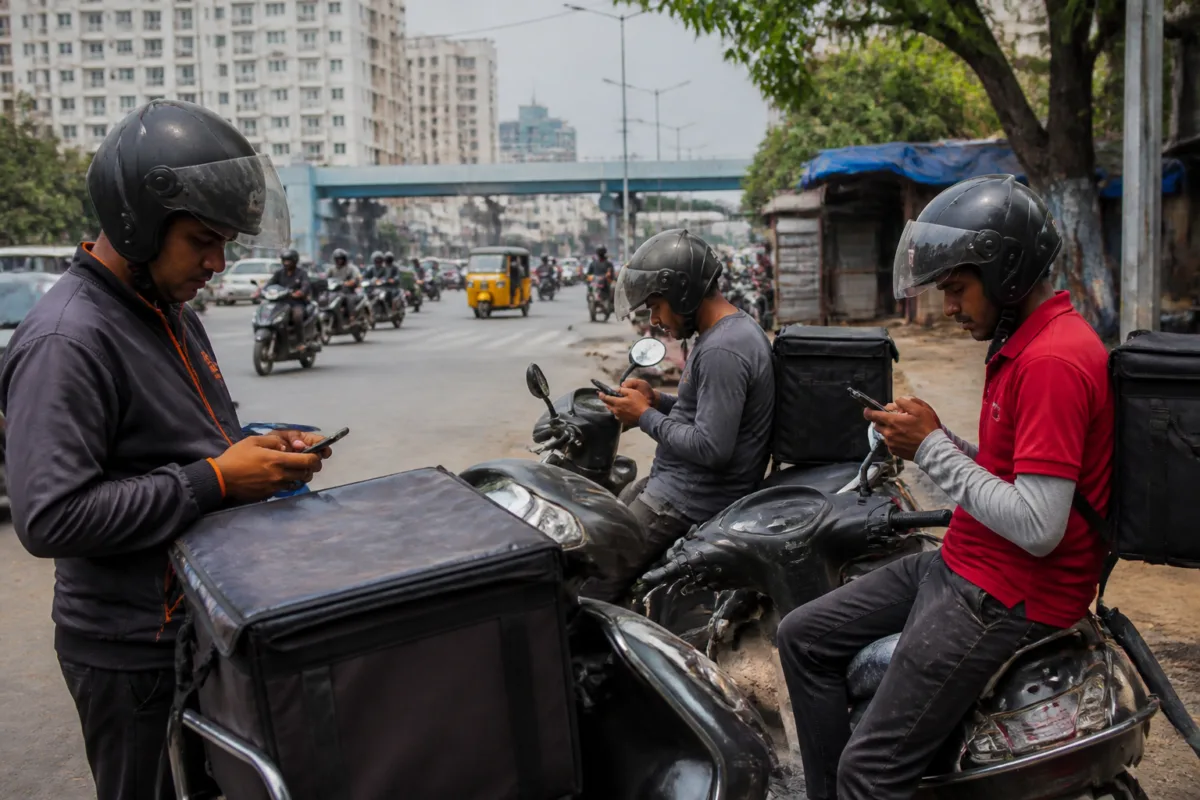
Gig workers in Hyderabad face opaque payment systems, unpredictable work allocation, unrealistic delivery deadlines and difficulty reaching platform representatives when disputes arise, according to a study by the International Labour Organisation (ILO). The findings raise questions about how Telangana will implement its Platform Based Gig Workers Act, 2026, particularly its provisions on grievance redressal and welfare.
The report, titled “Building an Understanding of Access to Grievance-Handling and Labour Dispute Resolution Mechanisms for Platform Workers in India”, was published on October 18. It examines the experiences of ride-hailing, delivery and home-service workers across three categories of platform work.
The study found that existing grievance mechanisms often fail to resolve concerns when complaints require human intervention. Workers reported relying on fellow workers and WhatsApp groups to understand deductions, penalties and earnings because automated platform systems did not always provide adequate explanations or access to a person.
In Hyderabad, ride-hailing workers described a lack of transparency in the allocation of rides and incentives. Some said only a small proportion of riders received incentives, while others remained idle for more than an hour as fellow workers received consecutive assignments. One delivery worker said riders sometimes worked for up to 48 hours during festivals in the hope of earning incentives, without knowing how assignments were distributed.
Delivery workers also raised concerns about deadlines that did not reflect actual travel conditions. One worker said platforms expected deliveries to be completed within seven or eight minutes even when navigation applications indicated that the journey would take at least 10 minutes. Delays caused by customers who did not answer calls or were unavailable could also affect workers’ performance scores.
The concerns extended to home-service work. Workers reported receiving assignments far from their homes and facing restrictions on cancelling bookings, including during emergencies. One worker said their hub had been shifted to Manikonda, 12 km from their home, while assignments were often located even farther away.
These issues connect platform management systems with the wider urban environment. Traffic, distance, weather and customer availability can directly affect delivery and service times, yet workers said their performance was assessed through targets and scores that did not always account for those conditions. The ILO recommends that algorithms consider traffic, severe weather and worker safety when making decisions that affect workers.
The report also recommends human oversight in cases involving account deactivation, effective appeal mechanisms and advance communication about changes to payment structures. For Telangana, the implementation challenge will be to ensure that statutory grievance mechanisms are accessible and responsive rather than dependent only on complaint channels controlled by platforms.
The Hyderabad findings come from a qualitative study involving five focus group discussions with ride-hailing workers, two with delivery workers and one individual interview with a home-service worker. The ILO cautions that the findings reflect the experiences of the participants and are not representative of all platform workers.
That limitation does not remove the governance issue identified by the study. As platform-based services become embedded in urban travel, food delivery and household services, the quality of grievance systems can affect both worker security and the reliability of services used by city residents. The effectiveness of Telangana’s new framework will depend on whether workers can obtain explanations, challenge decisions and seek human review when automated systems fail to account for real-world urban conditions.

