


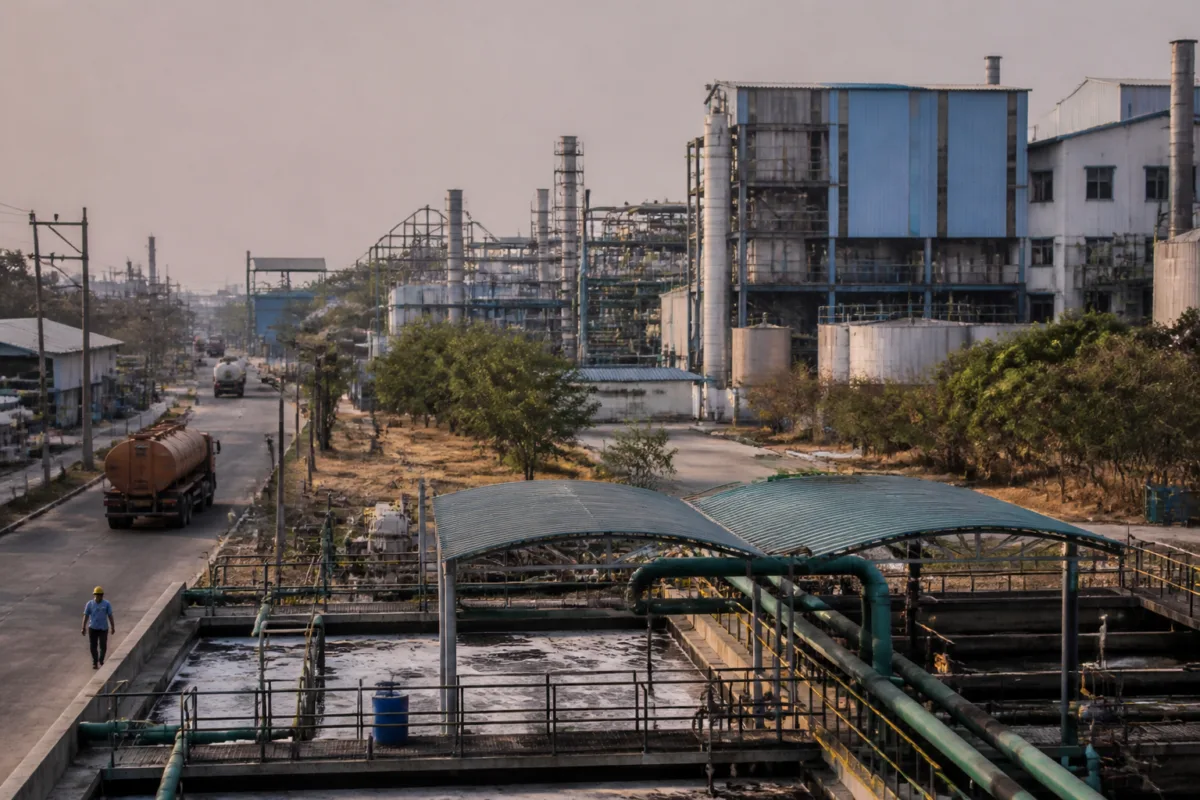
Hyderabad pharmaceutical MSMEs are facing rising costs for effluent treatment, hazardous-waste disposal and emissions control as the city’s drug-manufacturing clusters come under pressure to demonstrate cleaner production. The challenge is particularly acute for smaller units, which must meet pollution-control requirements while managing imported raw-material dependence and tight working capital.
The industrial belts of Patancheru, Bollaram, Pashamylaram and Jeedimetla remain important centres for active pharmaceutical ingredients, bulk drugs and intermediates. According to a Deccan Chronicle report, manufacturers in these areas are dealing with higher expenditure on effluent-treatment plants, zero-liquid-discharge systems and emission controls.
The pressure has an environmental as well as an industrial dimension. The report cites studies that have raised concerns about pharmaceutical pollution in the Patancheru-Bollaram belt, including antibiotic residues, hazardous solvents and heavy metals. Antibiotic residues in wastewater can contribute to antimicrobial resistance, adding a public-health concern to the existing challenge of managing industrial effluent.
Pharmaceutical manufacturers are required to comply with pollution-control regulations, obtain statutory consents and meet prescribed effluent-discharge and monitoring requirements. Several smaller manufacturers use common effluent-treatment plants, where wastewater is treated before disposal or reuse. Effluent with high dissolved-solids content requires more intensive treatment, increasing operating costs for participating units.
Suresh Gupta, a member of a Hyderabad MSME bulk-drug manufacturers’ group, told Deccan Chronicle that small units were not opposed to cleaner manufacturing but could find the cost of modern treatment infrastructure prohibitive. He said a modern effluent-treatment or zero-liquid-discharge facility could cost more than the working capital of an entire unit. Gupta called for subsidised common treatment infrastructure, faster approvals and longer payment cycles from large buyers.
The financial exposure is not limited to capital expenditure. Gupta said common effluent-treatment plant charges, hazardous-waste disposal expenses and monitoring costs were rising faster than product prices. He also warned that a compliance failure could halt production at a small active-pharmaceutical-ingredient unit and affect dozens of workers.
That makes shared infrastructure a significant issue for Hyderabad’s industrial planning. Common treatment facilities can reduce the need for every small manufacturer to build a separate high-cost system, but their effectiveness depends on treatment capacity, operating standards, monitoring and the quality of waste sent into the network. The report does not provide performance data for individual facilities, so the scale of this gap cannot be assessed from the available account.
Environmental-health researcher Dr Sridevi said clean manufacturing would be critical to the sector’s long-term competitiveness. In her assessment, Hyderabad’s next competitive advantage should be the ability to demonstrate that it can manufacture at scale while managing effluent safely. She described a plant that meets production targets without demonstrating safe effluent management as carrying a hidden liability.
The sector is also dealing with dependence on imported key starting materials and intermediates, particularly from China. The report links that dependence to profitability and supply-chain resilience. Life-sciences investment adviser Ravi Menon said domestic manufacturing would need to focus not only on expanding capacity but also on building a reliable and cost-competitive supply chain. He argued for a shift from volume-led generics towards high-value, low-waste chemistry.
For Hyderabad, the issue is becoming more complex as residential areas expand towards older industrial estates. The city must balance employment and industrial output with the need to control pollution risks and maintain public confidence in areas where manufacturing and homes are increasingly close to one another.
The report points to a structural problem rather than a single compliance incident: smaller manufacturers are expected to meet increasingly demanding environmental requirements, while their treatment and monitoring costs continue to rise. Whether Hyderabad can retain its pharmaceutical manufacturing base without transferring those costs to workers, neighbouring communities or the environment will depend on the quality of common treatment infrastructure, regulatory implementation and the sector’s ability to make cleaner production commercially viable.

