


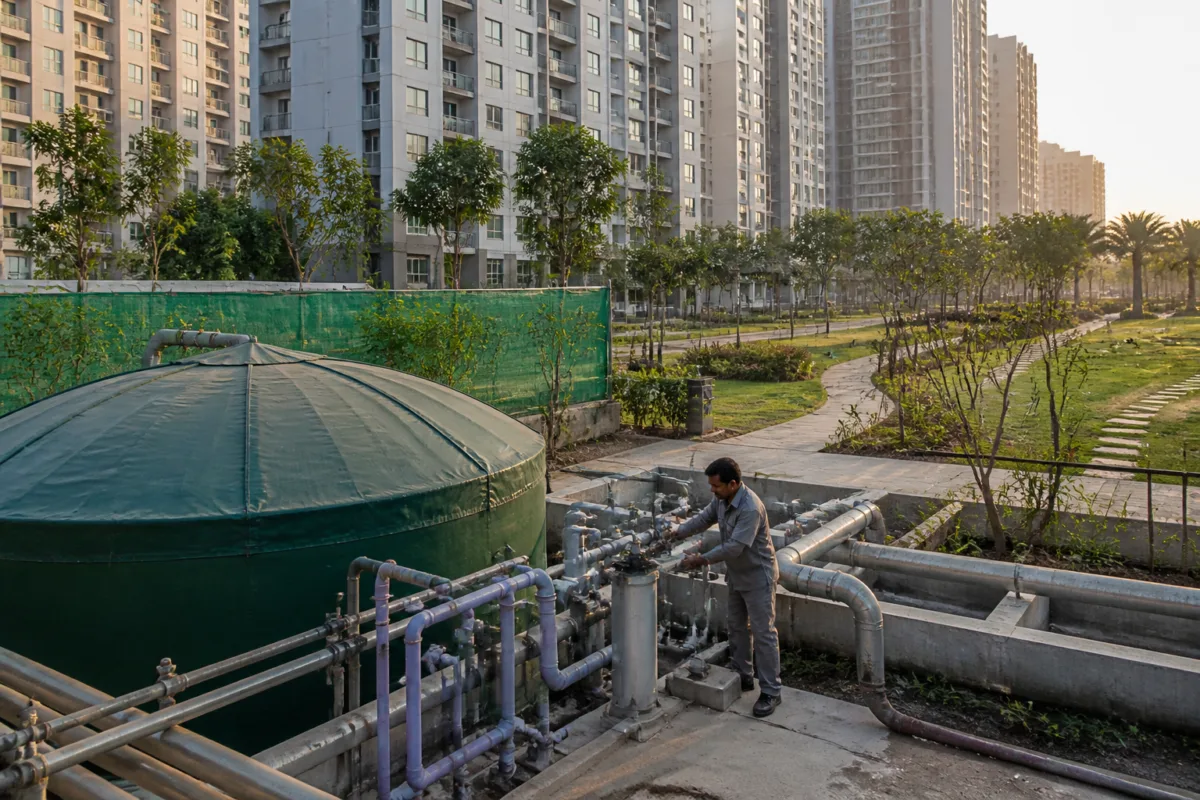
Residential communities in Hyderabad’s Cyberabad region have proposed exchanging surplus treated wastewater with the Hyderabad Metropolitan Water Supply & Sewerage Board (HMWSSB) for drinking-water supplies or rebates on tanker charges, according to a Times of India report.
The proposal comes from gated communities and resident welfare associations in Kondapur, Gachibowli, Tellapur, Kollur, Osman Sagar, the Financial District, Puppalguda and Narsingi. Together, around 150 gated communities and several hundred other residential societies in these areas are reported to generate nearly 200 million litres per day (MLD) of treated wastewater through sewage treatment plants.
Communities already reuse an estimated 40% to 50% of this water for flushing, gardening, landscaping and related non-potable purposes. Residents say much of the balance is discharged into drains because individual societies lack sufficient demand, storage or distribution infrastructure.
Their proposed arrangement would involve HMWSSB collecting the surplus treated water and using it for non-domestic purposes, including maintaining public parks, roadside greenery and construction activity. In return, communities would receive drinking water, a reduction in tanker charges or support in meeting part of their local water shortfall.
The Federation of Gated Communities Cyberabad has suggested that participating communities could receive support for 25% to 30% of their drinking-water shortfall in exchange for an equivalent volume of treated wastewater. Dr Ravi Shanker, the federation’s president, said his community, Aparna Towers in Kondapur, generates around 200,000 litres of treated wastewater each day, of which approximately 90,000 litres is reused and 110,000 litres remains unused.
Resident groups in Tellapur, Kollur and Osman Sagar have also sought a pipeline network to collect treated wastewater from large communities and use it for roads and green spaces. E Ramana, president of the United Federation of RWAs – Cyberabad, said HMWSSB currently charges Rs 500 per tanker and that residents had asked for the rate to be reduced to Rs 400 or less for communities supplying treated wastewater.
The proposal could create a local reuse network linking large residential developments with public or institutional non-potable demand. However, it would require more than a commercial exchange. Collection pipelines, storage facilities, pumping arrangements, water-quality monitoring and clear responsibility for operations would all need to be established before treated wastewater could be moved between communities and public sites.
Quality assurance is also central to the proposal. M Santhosh, executive director, Cyberabad, HMWSSB, told the newspaper that the board had earlier offered an incentive of Rs 25 per kilolitre for treated wastewater. He said the incentive was being increased and that a water-for-water exchange model was likely to be discussed at the board level. Communities would need certification from the Environment Protection Training and Research Institute, while third-party testing would be conducted to verify that the treated water meets prescribed quality standards.
The reported conditions indicate that any citywide arrangement would depend on consistent treatment performance at individual sewage treatment plants. It would also need a system for measuring the volume and quality of water supplied by each community, determining eligible uses and addressing failures in treatment or delivery.
Examples cited in the report show the scale of the potential surplus. Residents of Rajapushpa Eterna in Narsingi said about 25% of their treated wastewater remains untapped. My Home Avatar in Puppalguda, with 2,700 apartments, reportedly generates 1.4 million litres of treated water, of which about 900,000 litres is reused for podium cleaning, green-space maintenance and vehicle washing.
The proposal therefore places Hyderabad’s water challenge within a broader infrastructure question: whether decentralised wastewater treatment in large residential developments can be connected to the city’s public water-management system. At present, the reported water-for-water exchange remains under consideration, and the article does not indicate that HMWSSB has formally approved the arrangement or begun construction of the proposed collection networks.

