


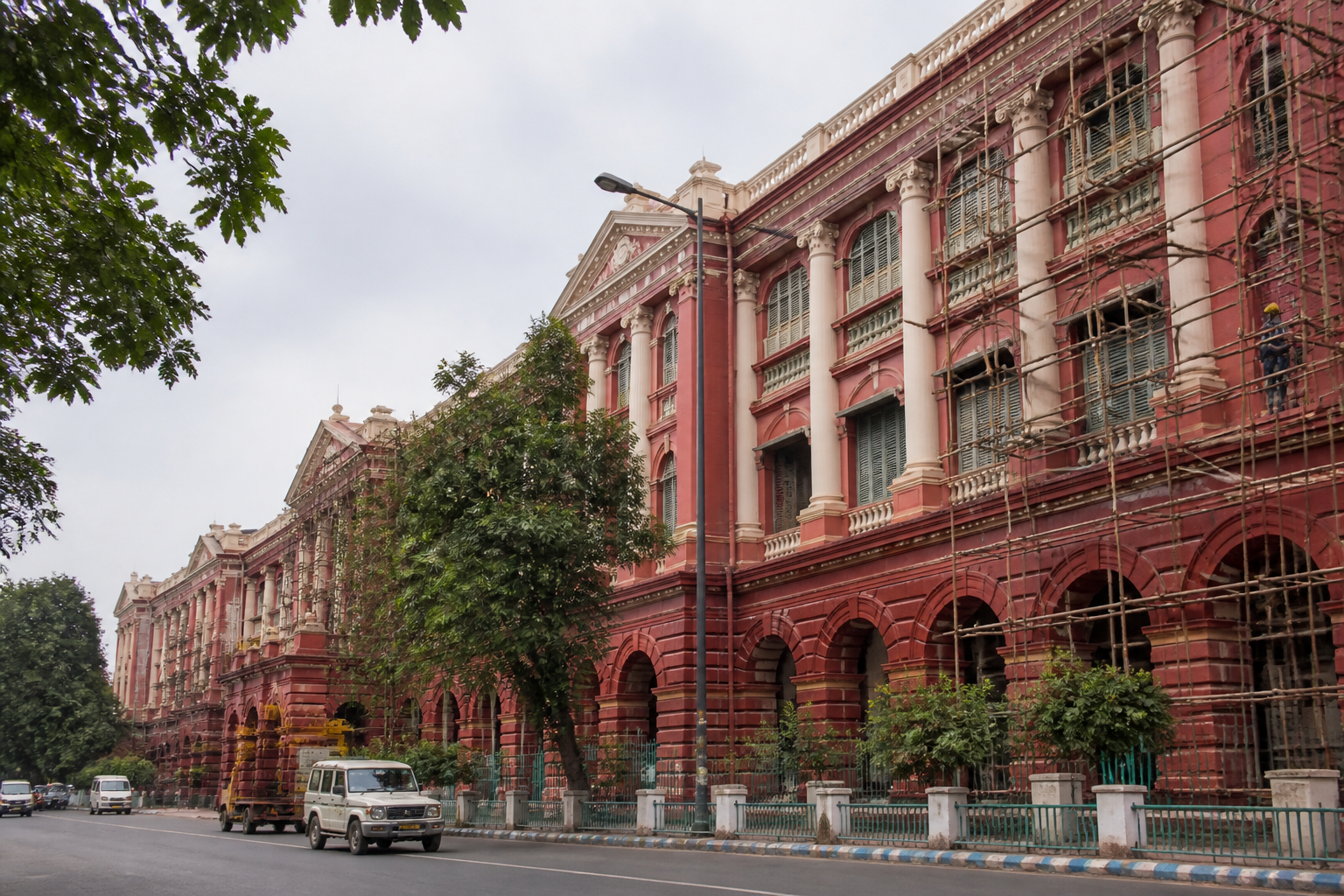
The proposed return of West Bengal ministers’ offices to Kolkata’s Writers’ Building is more than a change of address for the state government. It places a nearly 250-year-old administrative complex at the centre of two linked questions: how historic public buildings can remain functional, and whether restoration can be carried out without further damaging the architectural features that give the building its institutional value.
According to The Indian Express, Chief Minister Suvendu Adhikari and five other ministers are expected to move their offices to the second floor of the building. The ministers named in the report are Public Works Minister Ajay Poddar, Panchayat Minister Dilip Ghosh, Tourism Minister Shankar Ghosh, Health Minister Sharadwat Mukherjee, and Urban Development and Municipal Affairs Minister Agnimitra Paul. The report also says that the offices of the chief secretary and the police chief are expected to be located there.
The proposal is not yet presented as a completed administrative shift. The report says restoration work is under discussion, and that the Adani group may undertake work estimated at Rs 120 crore through a corporate social responsibility initiative. Discussions between the government and the group were described as ongoing. Poddar met officials regarding the restoration work on Saturday and had visited the building earlier in the week, according to the report.
That distinction matters. A decision to place senior ministers and officials in a historic building requires more than repairing visible surfaces. It involves making an old structure suitable for contemporary offices, security arrangements, public access, utilities and everyday administrative use. The material supplied in the report does not establish the detailed scope of the proposed work, the conservation standards to be followed, the funding agreement, or the timeline for occupation. Those details will determine whether the move becomes a careful example of adaptive reuse or another phase of alteration in a building already marked by repeated renovations.
Writers’ Building has served as a government workplace for much of its history. It was built in 1777 as an office for the East India Company’s junior clerks. From 1937 to 1947, it housed the provincial government of the state. After Independence, it functioned as the West Bengal secretariat until 2013. The building once accommodated 34 departments and around 6,000 employees, underlining the scale at which the complex operated before the secretariat moved elsewhere.
In October 2013, the state government shifted the secretariat from Writers’ Building to Nabanna. The older building did not become completely vacant: parts of the home and hill affairs, agriculture, Public Works, law and judicial affairs, and parliamentary affairs departments continued to function from it. The reported plan therefore represents a partial return of core administrative activity rather than a straightforward restoration of the pre-2013 arrangement.
The history of the shift also explains why the current proposal carries administrative significance. Moving a secretariat is not merely a real estate decision. It changes where files, officials, public appointments, ministerial meetings and departmental coordination take place. Returning some offices to Writers’ Building could restore its role as a visible centre of government, but the supplied report does not say whether the building will again house departments at anything close to its earlier capacity.
The most immediate institutional concern is the relationship between restoration and use. Public Works officials told The Indian Express that several original architectural features, including European tiles, were damaged during previous renovations. This detail is important because it shows that the building’s conservation problem is not limited to age or neglect. Earlier attempts to adapt the premises for changing administrative needs have themselves affected historic elements.
A new restoration programme would therefore need to reconcile two different requirements. Government offices require functional changes, including modern services and secure working environments. Heritage restoration requires that interventions respect original materials, spatial character and architectural details. The report does not provide the proposed conservation methodology, identify the agency responsible for approving it, or explain how the government intends to balance these requirements.
The proposed corporate social responsibility route adds another layer to the institutional picture. The reported estimate of Rs 120 crore indicates that the work is expected to be substantial, but the source does not establish whether this figure is final or what it includes. Nor does it specify the legal or financial structure through which the Adani group may participate. These unresolved questions are significant because the quality of a public restoration project depends not only on the amount committed, but also on procurement, oversight, technical supervision and accountability for long-term maintenance.
The building’s administrative future is also connected to the responsibilities of the departments expected to work there. The reported list includes the Urban Development and Municipal Affairs, Public Works and Panchayat portfolios, along with health and tourism. Their presence would place several departments with direct links to public services, infrastructure and state administration inside a complex whose own restoration and operational requirements remain under discussion. The report does not indicate how the offices will be configured or whether the second-floor arrangement is intended as a permanent or interim measure.
The political commitment behind the move is clear from the statement cited in the report. State BJP president Samik Bhattacharya said on May 5, a day after the election results, that it had been the party’s old commitment to run the government from Writers’ Building. The statement establishes the proposal’s political context, but it does not by itself settle the building’s technical or administrative readiness. The current process, as described by the report, is still centred on restoration discussions and official visits.
This is why the Writers’ Building proposal should be read as a test of heritage governance as much as a return to a historic administrative address. The building has already passed through several institutional phases: colonial office, provincial government headquarters, post-Independence secretariat and, after 2013, a partially occupied government property. Each phase has required the structure to absorb new demands. The damage to original tiles reported by Public Works officials shows the cost when adaptation is not fully aligned with conservation.
The evidence currently available confirms three things. First, senior ministers and officials are expected to occupy offices in the building. Second, restoration work is being actively discussed, with a possible Rs 120-crore CSR-funded intervention involving the Adani group. Third, the building’s earlier renovations damaged some original features, making conservation a central part of the proposed return. The evidence does not yet establish the final project agreement, restoration design, completion date, or operational plan.
Those missing details will shape the significance of the move. The next milestones are likely to be the government’s decision on the restoration arrangement, the disclosure of the project scope and conservation process, and confirmation of when the ministerial and senior administrative offices will begin functioning from Writers’ Building. Until then, the proposal remains a consequential administrative plan whose success will depend on how the state manages the tension between active government use and the protection of a historic public building.
