


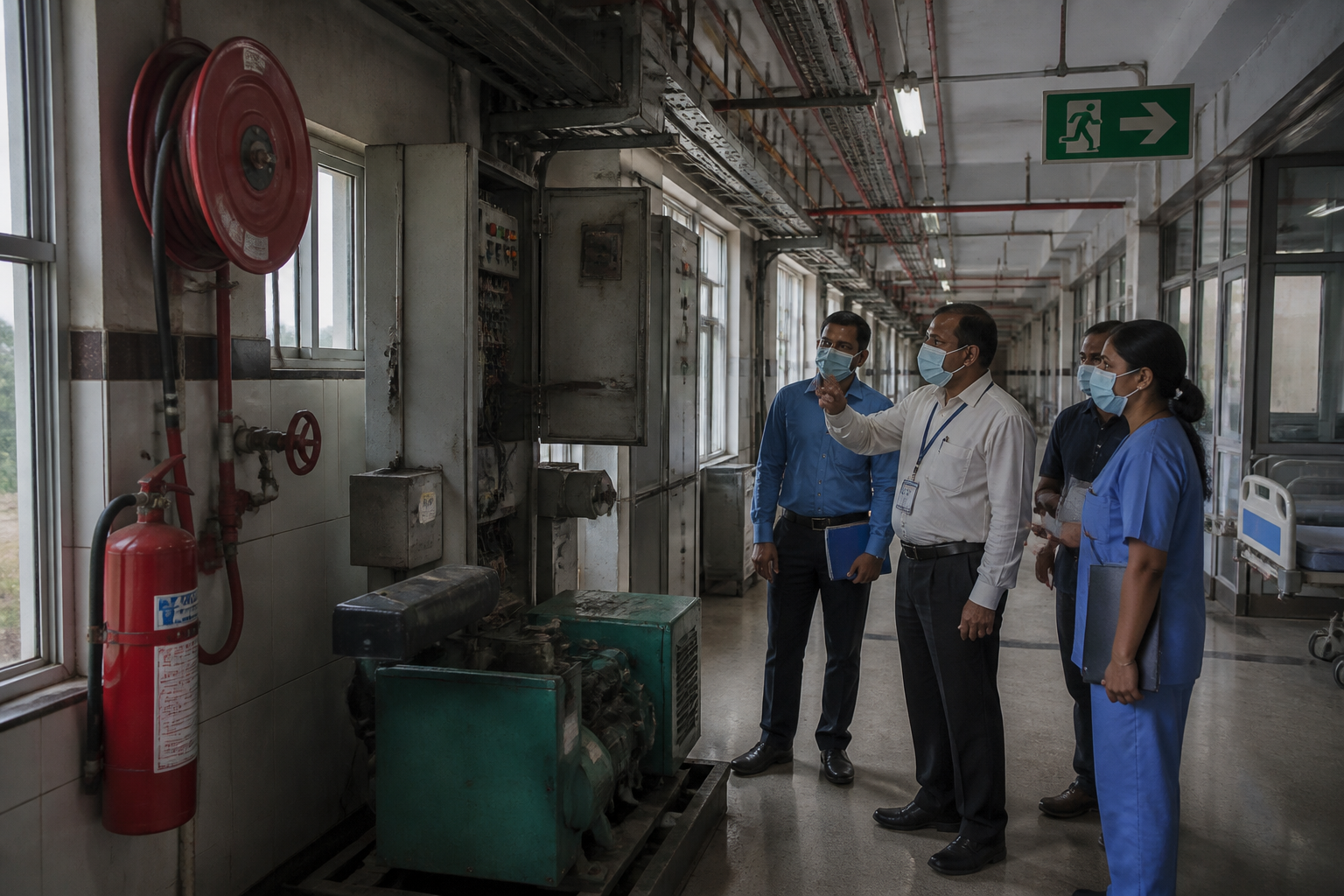
The deaths of three infants at the Rajiv Gandhi Institute of Medical Sciences have brought renewed attention to a safety inspection system that Telangana’s health department set up a year ago but has not visibly followed through on. The episode is not only about one neonatal facility. It raises a larger administrative question: whether government hospitals have the money, monitoring systems and institutional accountability needed to keep critical infrastructure operational after inspections identify problems.
According to a report by Deccan Chronicle, a committee comprising doctors and an additional director-rank officer was formed to inspect government medical colleges and hospitals across the state. The teams were asked to examine fire safety, mechanical systems, infrastructure and medical equipment, including expiry dates. They were also expected to interact with students to understand problems inside the institutions. The health secretary was assigned a government medical college for inspection.
The reported purpose of the exercise was therefore broader than a one-time compliance check. It covered the physical systems that allow a hospital to function safely: electrical installations, fire protection, mechanical equipment, biomedical devices and emergency preparedness. It also included a feedback mechanism involving students, suggesting that the inspections were intended to capture operational problems that may not be visible in administrative records.
Yet the report says the deaths at RIMS have prompted questions over what happened after the committee was constituted. Some minor issues identified during inspections were reportedly brought to the notice of Health Minister Damodar Rajanarsimha. A report on Gandhi Hospital had also pointed to several leakages. The supplied report does not establish whether the committee submitted a consolidated state-wide report, which recommendations were formally accepted, what deadlines were set or whether any institution was subsequently reinspected.
That gap between inspection and action is central to the story. An inspection can identify a risk, but it does not remove the risk. The outcome depends on whether the finding is recorded, assigned to a responsible authority, funded, repaired and independently checked. In a hospital, this chain is particularly important because electrical systems, fire exits, backup power, medical equipment and critical-care units are not separate administrative concerns. A failure in one can affect the functioning of others during an emergency.
What the hospital safety inspections were meant to cover
The inspection brief described in the report included fire safety, mechanical issues, infrastructure and equipment. Equipment checks were also to include expiry dates. These areas are closely connected to the everyday operation of government hospitals, particularly facilities serving patients who require neonatal and intensive care.
The Telangana Junior Doctors Association has called for safe and adequate electrical infrastructure, regular safety audits, functional special newborn care units and neonatal intensive care units, adequate fire-safety systems and emergency exits, backup power, sufficient bed capacity and adequate doctors, nurses and other healthcare personnel. It also sought regular inspection and maintenance of electrical, fire-safety and medical equipment, as well as disaster-preparedness and emergency-response protocols in critical-care areas.
The list shows that the associations are not treating safety as a single fire-compliance issue. They have linked physical infrastructure to clinical capacity. A neonatal unit requires functioning equipment, reliable power, suitable space, trained staff and emergency procedures. The supplied report does not identify the precise cause of the infant deaths, and it would be incorrect to infer that any one infrastructure failure caused them. What it does establish is that the deaths have triggered demands for a review of several systems that are essential to safe neonatal care.
This distinction matters for public accountability. Hospitals need a clear separation between an incident investigation and a routine safety audit. An incident investigation asks what happened in a particular case. A safety audit asks whether similar risks exist elsewhere, whether previous defects remain unresolved and whether the institution can respond to a foreseeable emergency. The report indicates that doctors’ associations are calling for both a review of safety systems and better maintenance of critical-care infrastructure.
The funding problem behind maintenance
The Telangana Government Doctors Association has attributed delays in maintaining medical and biomedical equipment, electrical systems and fire-safety measures to delays in releasing Aarogyasri funds to government hospitals. It has also said that the delays are affecting the procurement of materials required for emergency use. The association has urged the government to release pending funds immediately and provide adequate maintenance funding for special newborn care units, neonatal intensive care units, intensive care units and operation theatres.
This is an important institutional link in the report. Aarogyasri is presented here not simply as a reimbursement mechanism but as a source of funds that government hospitals say they need for operational maintenance. If payments are delayed, the pressure can extend beyond accounts departments. It can affect the replacement or repair of equipment, the upkeep of electrical and fire-safety systems and the availability of emergency-use materials.
The report does not provide the amount of pending Aarogyasri funds, the period for which payments were delayed or a department-wise breakdown of maintenance expenditure. It also does not state whether all the reported infrastructure concerns were caused by funding delays. Those details would be necessary to measure the scale of the problem and to distinguish a budget shortfall from procurement delays, contract failures, weak supervision or other administrative causes.
Still, the funding allegation points to a recurring difficulty in public infrastructure management: capital expenditure may create a hospital or equip a unit, but safe operation depends on recurrent spending. Repairs, testing, replacement, calibration, inspections and emergency supplies require continuing administrative attention. When these costs are treated as secondary to construction or expansion, facilities can retain the appearance of capacity while their supporting systems deteriorate.
Why inspection findings often fail to become repairs
The reported inspection process involved multiple levels of the health administration, including doctors, an additional director-rank officer and the health secretary. That structure suggests that the state recognised the need for oversight. But the report does not show how findings were converted into enforceable work orders or who was responsible for closing each defect.
For an inspection system to function, it needs more than a committee and a report. Each finding normally requires a risk classification, an accountable officer, a funding source, a completion date and a follow-up inspection. Critical defects should be distinguishable from minor maintenance issues, and hospitals should be able to demonstrate that emergency systems have been tested rather than merely installed.
The reference to leakages at Gandhi Hospital illustrates why even apparently minor defects require an administrative response. A leakage may not itself constitute an immediate clinical emergency, but it can indicate weaknesses in building maintenance and may affect electrical systems, equipment rooms or patient areas depending on its location. The report does not specify the nature or severity of the leakages, so their consequences cannot be determined from the available material. The broader issue is whether such observations are tracked until resolution.
The same principle applies to equipment expiry dates. Identifying expired equipment is only the first step. Hospitals must remove or replace it, ensure that essential functions remain covered and record who authorised the replacement. In neonatal and intensive-care settings, the failure of a single device may place additional pressure on other equipment and staff, although the supplied report does not identify any such incident at RIMS.
The accountability question for Telangana hospitals
The reported demands from T-JUDA and TGGDA place responsibility on the state government to respond across several departments and levels of administration. The health department must address the inspection process and hospital management. Financial authorities must process or release pending Aarogyasri payments if the association’s claim is confirmed. Hospital administrations must maintain equipment and safety systems. Fire-safety and engineering requirements may also involve other authorities, depending on the facility and the nature of the defect.
This division of responsibility can become a weakness if no single authority is required to certify that a hospital is safe after an inspection. A committee may document a problem, while a hospital waits for funds, a procurement process remains pending and a technical agency assumes that another department will act. The supplied report does not identify a formal state-wide mechanism for closing inspection findings. That missing information is itself significant because it determines whether the committee was an accountability instrument or only a diagnostic exercise.
The immediate demands made by the doctors’ associations include a review of electrical and fire-safety systems, functional neonatal facilities, emergency exits, backup power, adequate beds and sufficient clinical staff. They also seek disaster preparedness and emergency-response protocols for critical-care areas. These demands combine infrastructure, staffing and procedure, indicating that hospital safety cannot be measured through building compliance alone.
The deaths at RIMS have therefore shifted attention from the existence of inspections to their consequences. The key evidence currently available is that a committee was formed, inspections were expected to cover multiple safety areas, some issues were reportedly communicated to the health minister, and doctors’ associations are now demanding urgent corrective action while linking maintenance problems to delayed Aarogyasri funds. What remains unclear is the precise condition of the inspected facilities, the status of the committee’s recommendations, the amount of funds pending and the findings of any official inquiry into the infant deaths.
Those unanswered questions will determine whether Telangana’s response addresses the immediate incident or repairs the system that allowed known risks to remain unresolved. The next measurable steps are the release of any pending hospital funds, publication or communication of inspection findings, completion of safety repairs and a documented review of neonatal and critical-care facilities. Until those steps are recorded, the state’s inspection framework remains difficult to assess as an operational safety system rather than an administrative exercise.
