


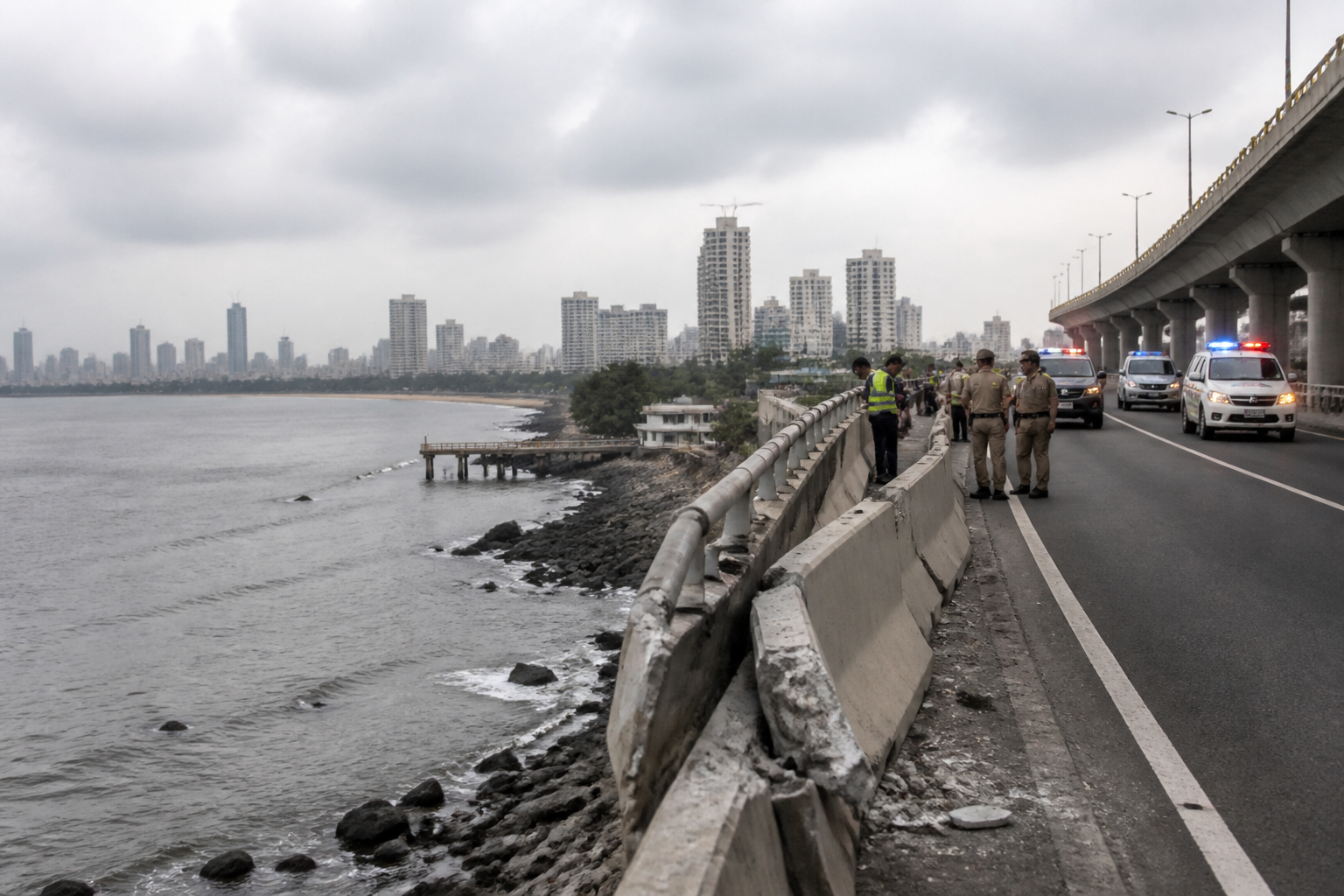
The Mumbai Coastal Road crash that killed three young men and injured another has raised a difficult road-safety question: what happens when repeated encounters with the enforcement system do not prevent a later, fatal episode of dangerous driving? The available account does not establish that earlier cases caused the crash or that any authority could have predicted it. It does, however, record a sequence of police complaints, notices and allegations involving the same driver before the BMW plunged from a flyover near Lotus Jetty.
According to a report by The Times of India, Shanay Gajjar, 21, was driving the BMW when it travelled on the northbound carriageway from Marine Drive towards Haji Ali early Sunday. The vehicle plunged about 70 feet from the Coastal Road flyover. Gajjar and passengers Dhairya Sheth, 17, and Aditya Jaskania, 19, died. Aditya Oswal, 23, was injured and hospitalised. All four were from Ahmedabad.
Police identified speeding as a feature of the incident through CCTV footage. The impact was severe: one victim was thrown around 20 feet from the car, another was found outside it, and police said Gajjar was still partly inside the vehicle with his leg on the accelerator. Tardeo police registered a case on Monday under provisions relating to causing death by negligence, rash driving and dangerous driving.
The immediate facts matter because the Coastal Road is not simply an ordinary city street. It is a high-speed urban corridor connecting major parts of south Mumbai, with flyovers, ramps and controlled carriageways that can compress the time available for other road users and enforcement personnel to respond to unsafe driving. The supplied report does not provide the road’s speed limit, the vehicle’s exact speed, the condition of the carriageway or details of its safety barriers. Those gaps limit what can be concluded about the infrastructure itself.
What the record does show is a prior pattern of police attention. In March, Gamdevi police registered a case against Gajjar after a complaint alleging dangerous driving and endangering the lives of others. The complaint was filed by Omkar Shirke, who said a speeding BMW had passed dangerously close to him on March 28. Shirke later located the car near Mahalaxmi temple and questioned the driver, who, according to the report, gave evasive replies.
The case included Section 184 of the Motor Vehicles Act, concerning dangerous driving, and Sections 125 and 281 of the Bharatiya Nyaya Sanhita, concerning an act endangering life or personal safety and rash driving on a public way. Police issued a notice to Gajjar. The report does not state the final status of that case or whether any licence-related action followed.
A second episode was recorded by Bandra police in August. Police alleged that Gajjar and three friends had been involved in a confrontation after partying at a pub on the night of August 19-20. The case included allegations of obstructing a public servant and violations under the Maharashtra Prohibition Act. Police said the group argued with officers after being asked to leave and later caused a disturbance at Bandra police station and Bhabha Hospital.
The report also says the four were served notices and allowed to leave, while a chargesheet had not been filed in that case at the time of publication. A police officer said the group refused medical examination and blood tests, and that a medical officer recorded the refusal. These are allegations and procedural facts reported by the newspaper; they are not findings of guilt.
The enforcement chain before the crash
The significance of the earlier cases lies less in treating them as proof of a direct connection and more in examining how urban road-safety enforcement operates across separate incidents. A complaint about dangerous driving may be handled by one police station, an alleged alcohol-related confrontation by another, and a later fatal crash by a third. The supplied account names Gamdevi, Bandra and Tardeo police stations, illustrating how responsibility can be distributed across the city’s policing structure.
That distribution does not by itself demonstrate an institutional failure. It does raise questions about continuity: how notices are tracked, how information from separate cases is shared, what consequences follow repeated alleged violations, and whether outstanding proceedings remain visible when the same person is involved in a later incident. The source report does not provide answers to those questions, nor does it say that the police ignored any legal requirement.
The distinction between registration of a case and a final legal outcome is central. A police case records an allegation and begins a process; it does not establish guilt. Similarly, a notice, a refusal of medical testing or the absence of a chargesheet at a particular point does not, by itself, establish that the authorities acted unlawfully or that a later crash was preventable. A responsible reading of the sequence must preserve those distinctions.
A road-safety issue beyond one vehicle
The crash also shows how road safety has several layers. The first concerns driver behaviour: speed, impairment, vehicle control and compliance with traffic rules. The second concerns enforcement: detection, investigation, notices, prosecution and follow-up. The third concerns road design and operation, including speed management, barriers, visibility and emergency response. The supplied material gives evidence mainly about the first two layers and very little about the third.
CCTV footage reportedly showed the BMW speeding, but the report does not state the estimated speed or whether speeding was the only factor. It also does not establish whether alcohol was involved in the crash. The earlier Bandra case included an allegation that the group was under the influence of alcohol, but that earlier allegation cannot be transferred to the fatal incident without evidence. This is precisely where public discussion can move faster than the documented record.
The urban governance question is therefore not simply whether one driver behaved dangerously. It is whether the city’s enforcement system can maintain a coherent record of risk across locations and incidents while respecting due process. That requires clear information about the status of cases, the action taken under the Motor Vehicles Act, and the legal authority available when dangerous driving is alleged repeatedly. None of those wider administrative details is provided in the report, so they remain matters for official clarification rather than conclusions.
The crash has also exposed the human cost of high-speed movement through a dense metropolitan area. The victims were young, the journey involved a prominent south Mumbai corridor, and the collision occurred on a flyover where the fall magnified the consequences of losing control. The case illustrates how a road built to improve connectivity can become the setting for severe harm when vehicle speed and control fail. It does not, on the evidence supplied, establish that the Coastal Road’s design caused the accident.
The next stage is legal and procedural. Tardeo police have registered a case against Gajjar under provisions relating to negligence and dangerous driving, but the report does not state the full investigative status, the findings of any forensic examination or the outcome of the case. The earlier Bandra matter had not resulted in a chargesheet at the time of publication, while the March case was described through the original complaint and police action.
The documented record therefore confirms a fatal crash, earlier police cases and multiple allegations of dangerous conduct. It does not confirm a causal link between the earlier cases and the crash, establish alcohol involvement in the fatal incident, or prove that a different enforcement decision would have prevented the deaths. Those are the boundaries within which the case should be assessed. The developments to watch are the police investigation, the legal status of the earlier matters and any official information about road conditions, speed enforcement and safety measures on the Coastal Road.

