


Berger Paints’ expansion plan is more than a defensive move by India’s second-largest paintmaker. It is a response to a broader shift in the country’s built environment, where urbanisation, residential construction, commercial real estate and public infrastructure are drawing new competitors into a market long dominated by established brands.
The Kolkata-based company plans to strengthen its presence in weaker markets, launch a luxury paint line, expand its exclusive retail network and invest ₹20 billion in manufacturing facilities in West Bengal and Odisha. Chief Executive Officer Abhijit Roy described the strategy as an “insurgent act” during an interview reported by Economic Times.
The immediate pressure comes from the entry and expansion of businesses backed by billionaires Kumar Mangalam Birla and Sajjan Jindal. Birla Opus and Jindal’s JSW Dulux are competing through aggressive pricing, putting pressure on Berger Paints and market leader Asian Paints. Brokerage PL Capital said in a September 16 note that the newer rivals were gaining ground.
This competition matters to cities because paint is not simply a consumer product added at the end of a construction project. It is an input that moves through a large urban supply chain involving manufacturers, distributors, dealers, painters, builders, architects, contractors and property owners. Changes in pricing, distribution and product positioning can influence how housing projects, commercial buildings and refurbishment work are executed across different markets.
Berger’s response focuses first on geography. The company is strengthening teams in Mumbai and Pune in western India, as well as Chennai and Bengaluru in the south. These markets are among the locations where the company sees room to improve its position. The strategy indicates that national market share is not being treated as a uniform measure: a company may have a strong overall presence while still facing distribution or brand challenges in specific metropolitan regions.
The company plans to add as many as 250 mostly exclusive outlets every year, taking the total to 2,500 by March 2029. That expansion would give Berger greater control over how products are displayed, sold and supported at the local level. It also reflects the importance of physical access in a category where customers often depend on dealers, painters and contractors to compare products and decide what to use.
The distribution push is being accompanied by incentives for painters, builders and architects. This is significant because decisions about paints are not made only by the final household or property owner. Professionals who specify, recommend or apply products can shape demand across residential and commercial projects. Berger’s approach therefore attempts to influence several points in the construction chain rather than relying only on consumer advertising.
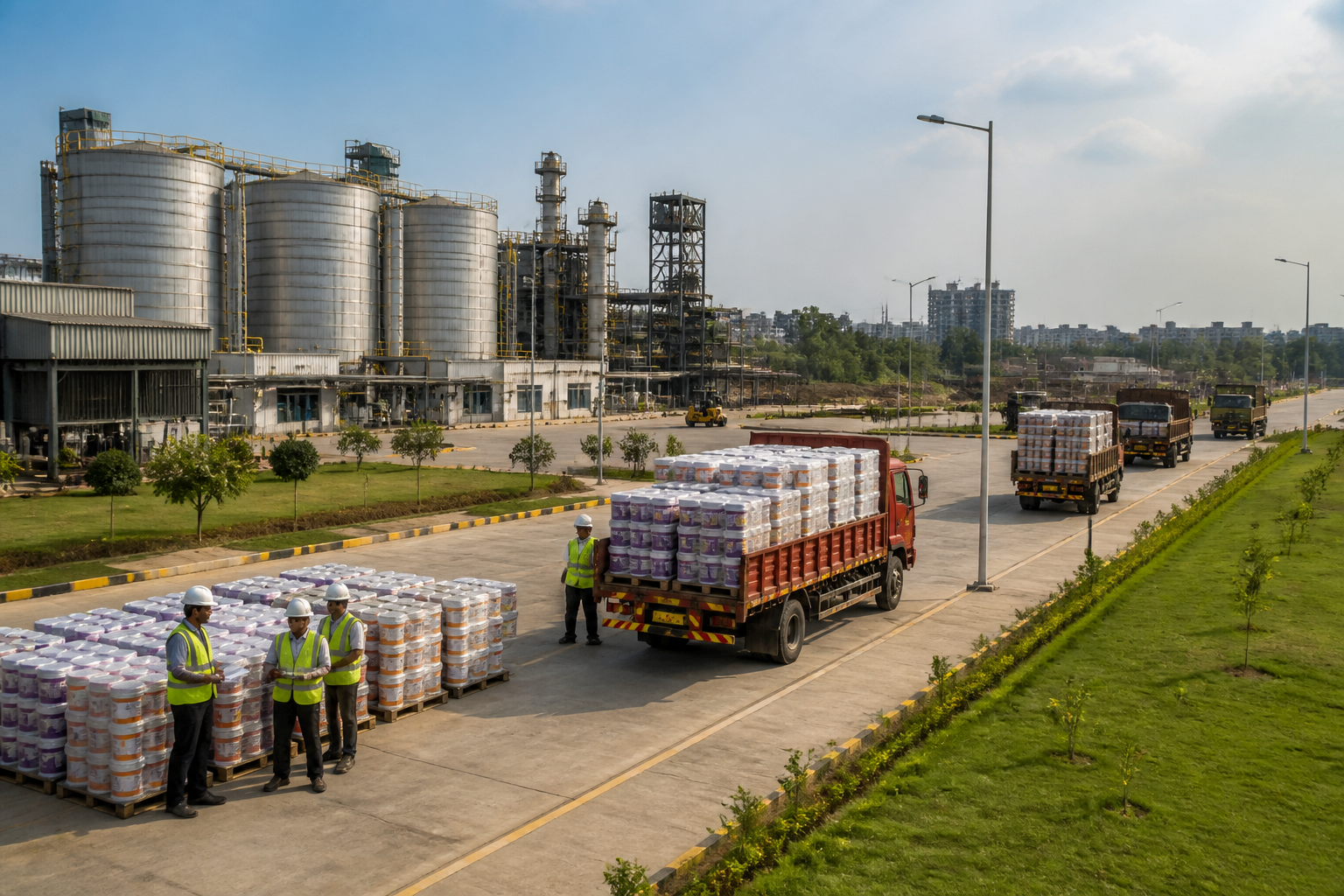
The second major part of the strategy is manufacturing capacity. Berger plans to invest ₹20 billion in facilities in West Bengal and Odisha, with the projects scheduled to be built by 2029 and 2030. The eastern location connects the company’s industrial expansion to its Kolkata base while also creating additional production capacity for a sector expected to grow alongside construction and property development.
The supplied report does not specify the plants’ individual capacities, employment numbers, product mix or exact commissioning dates. Those details will determine how materially the investment changes Berger’s supply network. What is established is that the company intends to add manufacturing facilities in eastern India over the next several years, alongside its retail and market-strengthening programme.
The company’s current position explains the urgency. Berger has nearly 20% of the revenue share among publicly listed peers, while Asian Paints controls more than 50% of the market, according to the report. Berger’s shares have fallen about 16% this year, compared with a 10% decline in the benchmark measure, and the company was valued at ₹525.4 billion, or about $5.5 billion.
These figures describe a business under pressure, but not one retreating from the market. Roy said that maintaining the company’s 20% market share would represent a solid baseline performance. If market conditions align with its plans, Berger will seek an additional 0.5% nationally across categories. The distinction between holding share and gaining share is important: it shows that the company is balancing defence in existing markets with selective growth.
The competitive pressure is also affecting margins. Aggressive discounts by newer rivals have reduced pricing power for both Berger Paints and Asian Paints. The challenge is not limited to the retail shelf. Lower prices can affect the economics of distribution, manufacturing and professional incentives, particularly when companies are simultaneously investing in outlets, new products and production facilities.
Raw material costs add another layer of uncertainty. The report says higher raw material prices have affected the outlook for listed paint companies, while a surge in crude prices linked to the conflict in the Middle East has further clouded the sector’s prospects. Crude prices matter because the paints industry is exposed to petrochemical-linked inputs, although the supplied material does not quantify the effect on Berger’s costs or margins.
Berger is attempting to protect growth by moving into higher-value products as well. The planned luxury paint line would give the company a stronger presence in a segment where customers may place greater weight on finish, performance and brand positioning. The report does not provide the proposed product range, launch date or expected price points, so the commercial effect of the new line remains to be established.
The company’s expansion comes as the Indian paints sector is projected to grow from an urban and real estate base. The IMARC Group expects the sector to grow by about 5% to $11.8 billion by 2030, supported by urbanisation, rising disposable incomes and growth in both commercial and residential real estate. These drivers create demand, but they do not guarantee that every incumbent will benefit equally. Growth can be captured by companies with stronger distribution, more competitive prices, better local availability or products suited to changing construction and renovation needs.
The connection with infrastructure is also becoming more important. Roy expects an additional boost for industrial paints from the country’s infrastructure buildout. Industrial coatings serve a different part of the built environment from household decorative paints, but both depend on construction activity and investment cycles. The company’s strategy therefore spans the painted surfaces of homes and commercial properties as well as the industrial assets associated with infrastructure expansion.
Demand is also being linked to the festival season through Diwali in November. Roy expects festive demand to lift full-year volume growth slightly to 8%, after a slow start to the year and despite higher raw material prices. The forecast is a company expectation, not an independently established outcome, but it shows how the business is timing its near-term sales strategy around a period when household renovation and consumption may increase.
For cities, the larger question is whether paint-sector competition will translate into wider availability and lower costs or primarily redistribute market share among large manufacturers. The evidence supplied so far confirms a race involving pricing, exclusive outlets, professional incentives, luxury products and manufacturing investment. It does not yet establish how much of any savings will reach consumers, whether smaller dealers will gain or lose bargaining power, or how the new plants will change regional supply chains.
The institutional structure of the sector is similarly dispersed. Manufacturers make capital-allocation decisions, but distribution is mediated through dealers and exclusive outlets. Painters, builders and architects influence product selection, while residential and commercial developers generate large project demand. Infrastructure agencies and industrial customers create another channel for coatings. Berger’s strategy is consequently aimed at a network rather than a single customer group.
The company is controlled by the Dhingra family through UK Paints India, which owns 64.56% of Berger Paints, according to the report. The ownership structure provides context for the company’s long-term investment decisions, while the planned spending in West Bengal and Odisha shows that the response to competition is not limited to short-term discounting or marketing.
What remains uncertain is whether expansion can restore pricing power while maintaining volumes. Berger is investing in capacity and distribution at a time when competitors are using discounts to gain ground and raw material costs are clouding margins. Its stated aim of defending approximately 20% market share, with a possible 0.5% increase, places execution at the centre of the strategy.
The next indicators will be the pace of outlet additions, the launch and reception of the luxury range, progress on the West Bengal and Odisha facilities, performance in Mumbai, Pune, Chennai and Bengaluru, and the company’s ability to reach its projected 8% full-year volume growth. Together, these developments will show whether Berger’s expansion becomes a durable response to India’s changing urban materials market or mainly a costly defence of its existing position.
