


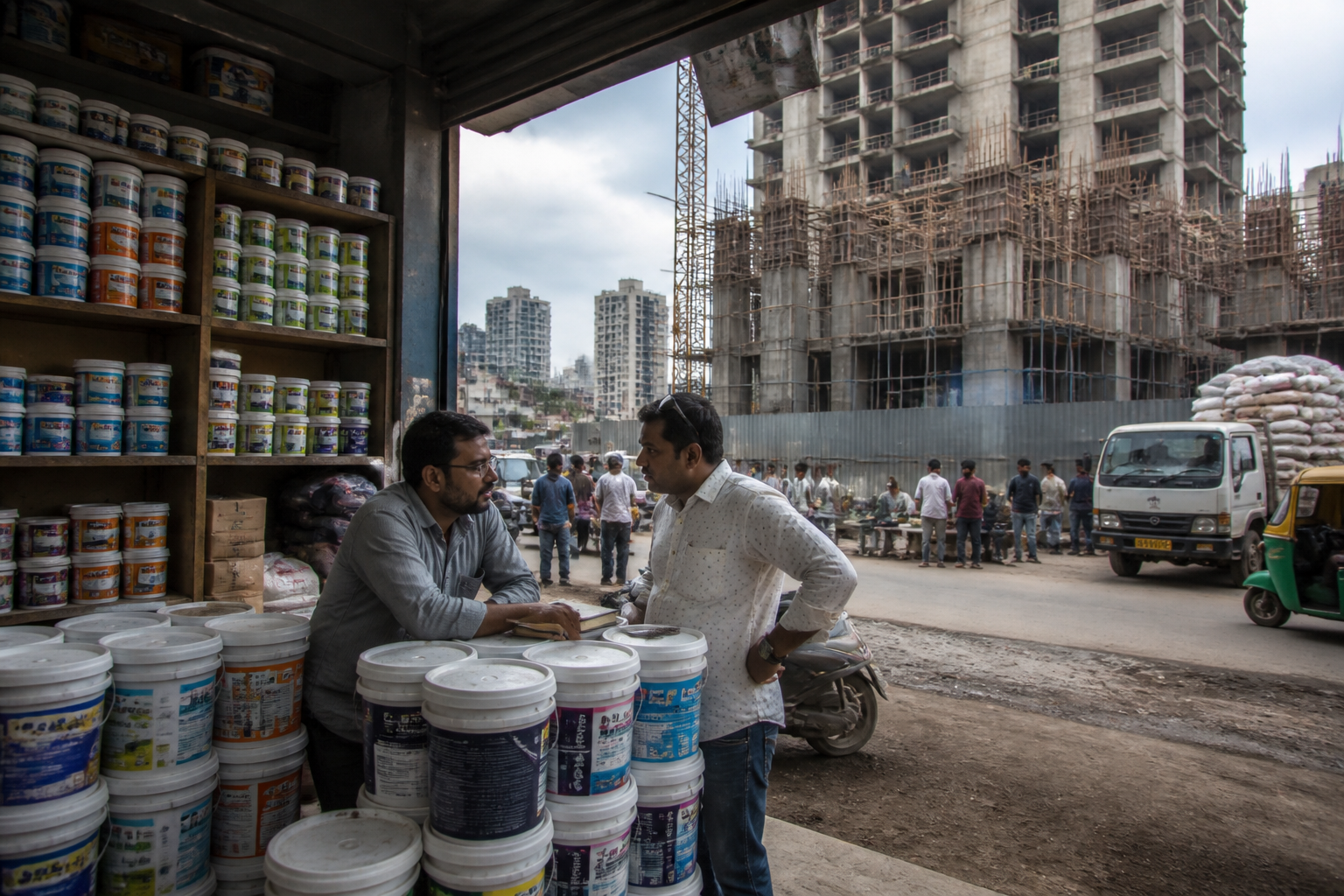
Berger Paints’ expansion strategy is a response to a deeper shift in India’s construction materials market: established manufacturers are being forced to defend distribution networks, regional market share and margins as new, well-funded competitors use aggressive pricing to enter a sector tied closely to housing, commercial construction and infrastructure spending.
The Kolkata-based company, India’s second-largest paintmaker, is strengthening its teams in Mumbai, Pune, Chennai and Bengaluru, according to Chief Executive Officer Abhijit Roy. These are not marginal markets. They are among the country’s largest urban economies, with significant residential construction, redevelopment, commercial real estate and infrastructure activity. Berger’s decision to concentrate resources in these cities shows that competition in paints is increasingly being fought at the level of local sales networks and professional relationships, rather than only through national advertising.
The company plans to add as many as 250 mostly exclusive outlets each year, taking the total to 2,500 by March 2029. It also intends to launch a new luxury-paints line and is offering incentives to painters, builders and architects. Together, these measures point to the structure of the paints business. The product is purchased by property owners, but demand is heavily influenced by contractors, applicators, architects, developers and retailers who shape material choices across construction and renovation projects.
This makes distribution a strategic urban infrastructure of its own. A paint manufacturer can have production capacity and a recognised brand, but still lose ground if its products are not easily available near construction sites, if painters are unfamiliar with them or if builders receive better commercial terms from a competing supplier. Berger’s focus on weaker markets therefore reflects a push to rebuild the network through which materials move from factories to neighbourhood retailers and, ultimately, to homes, offices and public-facing commercial spaces.
The immediate competitive pressure comes from Birla Opus and JSW Dulux. Kumar Mangalam Birla and Sajjan Jindal have brought substantial financial strength into a sector long dominated by Asian Paints and Berger. Asian Paints controls more than half of the market among the companies cited in the report, while Berger has nearly 20 per cent revenue share among publicly listed peers. Brokerage PL Capital said in a September 16 note that the newer rivals were gaining ground.
The significance of this contest extends beyond corporate rankings. Paints are a relatively visible component of the built environment, but the sector also reflects the pace and composition of construction activity. A strong residential market creates demand for interior and exterior finishes, while commercial projects and infrastructure generate requirements for industrial coatings and protective applications. As developers and contractors manage tighter budgets, pricing and supplier incentives can influence the choice of materials used across large project pipelines.
Berger’s planned investments of ₹2,000 crore in manufacturing facilities in West Bengal and Odisha by 2029 and 2030 show how the competitive response is also altering the geography of production. The company is expanding in eastern India while trying to improve its presence in western and southern cities. This combination links manufacturing capacity with market access: factories provide scale and regional supply, while urban sales teams and outlets are needed to convert that capacity into volume.
The investment also illustrates the distinction between nominal market growth and profitable growth. The paints sector is expected to expand by about 5 per cent to $11.8 billion by 2030, according to the IMARC Group, with urbanisation, rising disposable incomes and growth in residential and commercial real estate supporting demand. Yet new capacity and aggressive discounts can make it harder for companies to translate higher volumes into stronger earnings.
Both Berger Paints and Asian Paints have faced margin pressure after newer rivals introduced aggressive discounts. Berger’s shares have declined about 16 per cent this year, compared with a 10 per cent fall in the broader national benchmark, while the company was valued at ₹52,540 crore, or about $5.5 billion, according to the report. These figures indicate that investors are treating the competitive shift as a structural challenge rather than a short-term sales campaign.
Raw-material costs add another layer of uncertainty. The report said that a Middle East conflict-led rise in crude prices had clouded the outlook for listed players including Kansai Nerolac Paints and JSW Dulux, formerly Akzo Nobel India. Paint production depends on a range of chemical and petroleum-linked inputs, so changes in crude prices can affect margins even when construction demand remains intact. Companies must therefore balance lower prices for customers with input costs that they may not be able to pass on immediately.
Berger’s response is built around several levers: a wider distribution footprint, incentives for influential intermediaries, a premium product line, new manufacturing facilities and greater attention to industrial paints. None of these measures operates independently. A new luxury range requires access to affluent urban consumers and architects; exclusive outlets require sustained local demand; and manufacturing investments require sufficient utilisation over time. The strategy is consequently a coordinated attempt to defend the company’s position across different parts of the construction value chain.
The regional focus is particularly important. Mumbai and Pune combine large residential markets with redevelopment, commercial construction and industrial activity. Chennai and Bengaluru have strong links to housing, offices, manufacturing, technology-led commercial development and infrastructure expansion. The report identifies these cities as weaker markets for Berger, but it does not provide city-level market shares or explain whether the weakness stems from distribution, brand preference, pricing or competitor relationships. That missing detail matters because the same national strategy may produce different results in cities with different development patterns and contractor networks.
Berger’s target of retaining its roughly 20 per cent market share is itself a measure of the pressure facing established firms. Roy described holding that share as a “solid baseline performance” and said the company would seek an additional 0.5 per cent nationally across categories if market conditions aligned with its plans. The modest nature of that target suggests that the immediate priority is not rapid national expansion at any cost, but preventing further erosion while rebuilding in selected urban markets.
The company expects the festival season through Diwali in November to support demand and lift full-year volume growth slightly to 8 per cent after a slow start and higher raw-material prices. This seasonal pattern is relevant to the construction economy because painting and finishing work is often linked to home improvement, property handovers and renovation cycles. However, the supplied evidence does not establish how much of the anticipated growth will come from new construction, repainting or industrial applications.
Industrial paints provide a separate growth channel connected to the country’s infrastructure buildout. Roads, bridges, factories, ports, rail facilities and other infrastructure assets require protective coatings, and their demand is linked to project execution rather than only household income. Berger’s expectation of an additional boost from infrastructure therefore places the company within a broader investment cycle in which construction materials manufacturers benefit when public and private capital expenditure translates into completed projects.
The institutional structure behind this market is dispersed. Developers and contractors determine specifications and procurement; architects can influence premium and performance requirements; painters often guide product selection at the point of application; retailers control local availability; and manufacturers manage production, pricing and technical support. Berger’s decision to incentivise all three professional groups named by Roy—painters, builders and architects—recognises that market share depends on coordination across these layers.
For cities, the immediate consequence of this competition is likely to be felt through the supply and pricing of finishing materials rather than through a visible new infrastructure asset. More outlets can improve access to products in expanding neighbourhoods, while competition may give builders and property owners more choice. But the supplied report does not establish whether discounts are being passed through to homebuyers or whether they are primarily being absorbed within company and distributor margins. It also does not provide evidence on product performance, environmental standards or the impact of the planned manufacturing facilities on local employment and industrial land use.
What the evidence does confirm is that India’s paints industry is being pulled in two directions. Urbanisation and real estate growth are expanding the underlying demand base, while new entrants are intensifying the fight over how that demand is divided. Established companies are responding with capacity, outlets, premium products and professional networks. The outcome will depend not only on the size of the market by 2030, but on which companies can secure the local relationships and distribution systems that convert urban construction activity into repeat sales.
Berger’s next milestones are its planned outlet expansion, the launch of its luxury-paints range, the strengthening of teams in the four identified cities and the development of manufacturing facilities in West Bengal and Odisha. Its performance through the November festival period and its ability to maintain margins amid discounts and raw-material volatility will show whether the strategy is stabilising its position or merely slowing the advance of newer competitors.
