


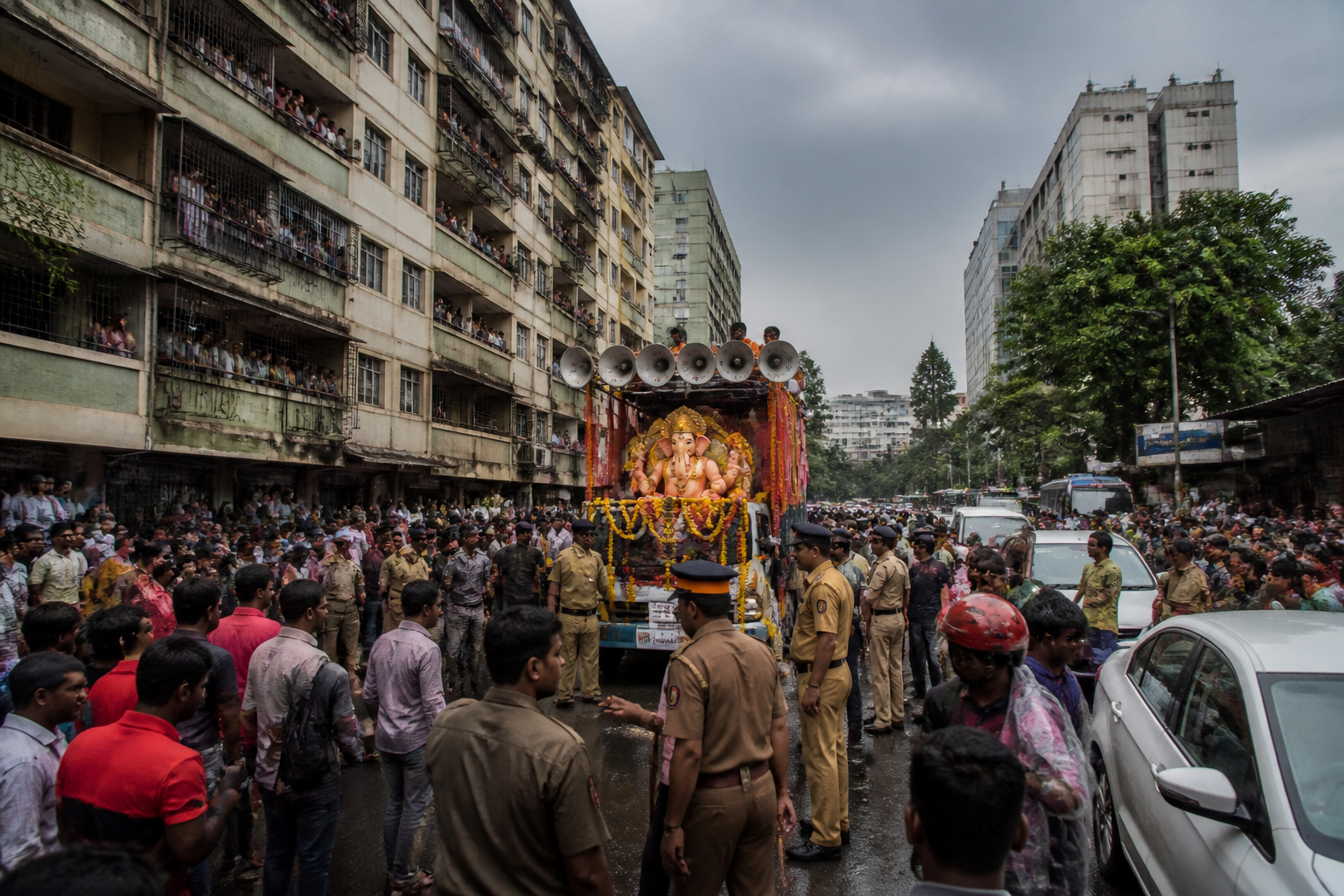
The Bombay High Court’s intervention on festival noise in Mumbai is not simply about loudspeakers, firecrackers or Ganpati processions. It exposes a more difficult urban governance problem: the city already has permissions, decibel limits and enforcement powers, but the machinery meant to apply them on the ground remains uneven and, in some places, unavailable.
The court, hearing a suo motu public interest litigation on noise pollution during festivals, said authorities must measure sound levels at Ganpati pandals and processions and take action under the law. The bench of Justice Girish Kulkarni and Justice Neela Gokhale indicated that such action could include confiscating sound systems, requiring deposits from mandals and forfeiting those deposits when violations occur. It also indicated that the use of highly toxic and polluting firecrackers on public roads during festivals could be prohibited, along with noise-making metal cylinders used during processions.
The distinction between what the court said orally and what will become enforceable through its written order is important. The report states that the court’s order was expected to be made available later that night. Firecrackers, as the state advocate general told the bench, were not generally banned, although permission was not granted for their use. Processions could be allowed as an exception, but mandals also required police permission for sound systems and had to comply with noise pollution rules.
That legal framework places responsibility across several institutions. The Brihanmumbai Municipal Corporation is responsible for permissions to erect pandals, while the police authorise processions and loudspeakers. The advocate general, Milind Sathe, told the court that the BMC and police issue more than 25,000 permissions during Ganeshotsav. That figure describes the scale of the administrative task: enforcement is not limited to a handful of large public events but extends across thousands of temporary structures, processions and sound systems operating through a dense city.
The court’s concern was that permission cannot be treated as the end of regulation. It must be linked to continuing measurement and immediate intervention. The bench said authorities should maintain recordings and visual meter readings of on-site noise levels using decibel meters. Mandals were also expected to display loudspeaker permissions, with consequences potentially following when they failed to do so.
This is where Mumbai’s noise-control challenge becomes an institutional one. The court was told that police officers should be tasked with preventing excessive noise at the site rather than relying primarily on prosecution after the event. The distinction matters in a city where a procession can pass residential buildings, hospitals, housing complexes and traffic queues before a complaint is processed. A fine imposed later does not undo the exposure experienced by residents, patients, workers or people trapped in vehicles.
The applicable limits cited before the court underline the gap between formal regulation and festival practice. In residential areas, the upper sound limit during the day is 55 decibels, according to the report. Senior counsel Aspi Chinoy argued that firecrackers could not operate within such a limit. The court also referred to the existing restriction on loudspeakers in public places after 10 pm. These rules are not new, but the proceedings suggest that their effectiveness depends on whether officials can measure violations and act while the event is taking place.
The evidence presented about equipment is especially revealing. Advocate Vinay Deshmane, referring to a 2009 public interest litigation, told the court that the state had invested almost Rs 99 lakh in decibel-reading meters for police stations, but that most police stations did not have them. The report does not establish the present inventory of functioning meters across Mumbai or Maharashtra. It does, however, identify a recurring administrative failure: a regulation can exist on paper while the enforcement instrument required to implement it is absent or not operational.
The court described this as a problem of preventive governance. Its observations stressed that the state should not first allow thousands of citizens to be affected and then rely only on a fine. The bench also said it wanted the machinery to be functional and that citizens and organisers had responsibilities towards fellow residents. In that framing, noise is not merely a question of individual preference or festival etiquette. It is a public administration issue involving monitoring, permissions, police deployment and the protection of people who may not be participating in the event.
The proceedings also broadened the question beyond Ganeshotsav. Lawyers representing petitioners from Pune and Thane argued that the court’s directions should apply across festivals, and the bench accepted that suggestion. That matters because a city-wide enforcement system designed only around one festival would leave the underlying governance problem intact. The issue before the court is whether the state can apply common standards to processions, loudspeakers, musical bands, firecrackers and other noise-producing instruments across different occasions.
The state’s existing orders show how this balance is currently managed. The advocate general referred to a Mumbai order issued on September 4 that prohibited assemblies of more than five people, processions, loudspeakers, amplifiers, musical bands and the bursting of firecrackers in processions between September 9 and 23, subject to permissions from zonal deputy commissioners of police, the BMC and supervisory officers. He also referred to a Nagpur police commissioner’s order prohibiting modified sound systems with DJs and laser beams during festivals from September 4 to November 1. The court asked why similar restrictions could not be implemented in Mumbai and the rest of Maharashtra.
This exchange points to the difference between a temporary restriction and a durable enforcement framework. An order can define a period, identify prohibited activities and create an exception process. But the daily operation of that framework still depends on who checks sound levels, whether meters are available, how evidence is recorded, which officer can stop a violation and what penalty follows. The court’s proposed deposit mechanism for loudspeakers would add a financial condition to permissions, but its effectiveness would still depend on reliable detection and documented violations.
The urban consequences described in the proceedings are immediate and spatial. Lawyers told the court that noise enters homes and makes it difficult for residents to remain indoors when processions pass. The bench referred to people in adjoining buildings, hospitals, housing complexes and motorists stranded in traffic. Mumbai’s density compresses these uses into the same streets: a public procession, a residential building, a medical facility and a congested road can all be affected by one event. This makes enforcement a question of managing shared urban space rather than simply regulating a sound system.
The court did not present its concern as opposition to processions. Its oral observations said that processions were not being prevented, but that organisers had to follow norms, particularly when passing hospitals or housing complexes, and should proceed slowly in such locations. The emphasis was on regulation and compliance. That is significant because it places the responsibility for reconciling cultural activity with public health on both organisers and the state machinery that grants permissions.
The court also raised the possibility that manufacturers should disclose the decibel levels of individual firecrackers on their packaging. The report does not say that such a labelling requirement has been ordered. It records the suggestion as part of the wider discussion about how citizens and authorities can understand the risks associated with products that create noise and air pollution. Similarly, the court’s statements about banning firecrackers on public roads reflect its stated position during the hearing; the precise legal effect depends on the written order and subsequent implementation.
The central question now is whether the proceedings produce a system that can work at street level. That system would require clear permissions, visible authorisations, functioning decibel meters, contemporaneous recordings, officers empowered to intervene and penalties that are enforceable rather than merely declaratory. The report shows that each element already exists in partial form: the BMC and police issue permissions, sound limits apply, restrictions after 10 pm are recognised, and authorities have issued temporary orders. The difficulty lies in connecting these elements into consistent prevention.
For Mumbai, the court’s intervention therefore shifts attention from the existence of rules to the capacity of institutions to enforce them. The pending written order, the treatment of firecrackers and metal cylinders, the proposed deposits for sound systems, and the availability of working measuring equipment will determine whether the hearing remains an expression of concern or becomes an operational change. The next test will be whether authorities can document and control noise during festivals without waiting for affected citizens to seek relief after the damage has already occurred.
