


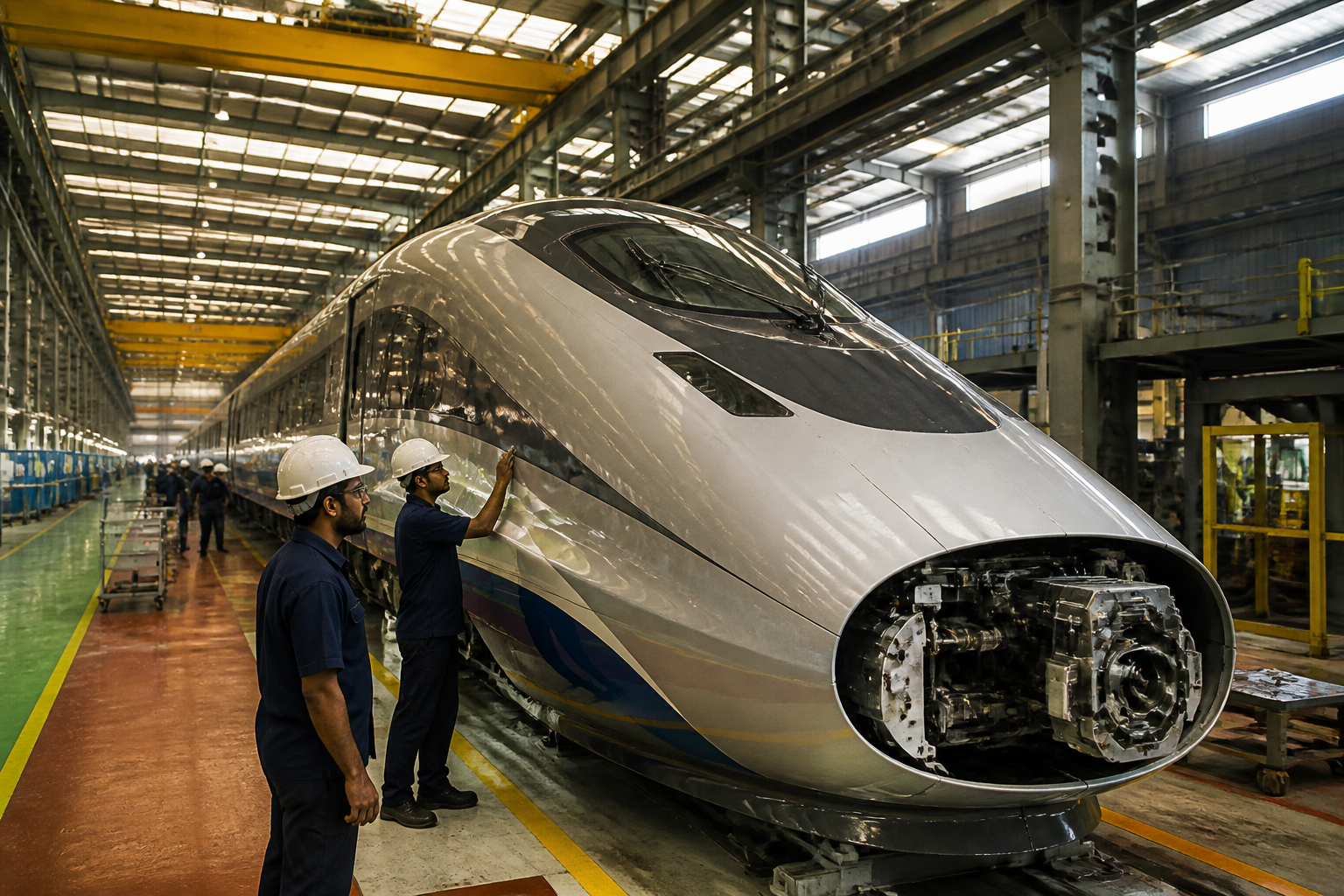
India’s bullet train programme is moving beyond the construction of a single corridor. Indian Railways is developing an indigenous high-speed train capable of a design speed of 350 kmph by 2030, even as the country prepares to test the first B28 train sets for the Mumbai-Ahmedabad High-Speed Rail corridor. The parallel push exposes the real challenge before India’s high-speed rail ambitions: building not only tracks, but an entire domestic system of trains, signalling, engineering and specialised manufacturing.
The immediate project is the 508-km Mumbai-Ahmedabad corridor, whose revised cost has crossed Rs 2 lakh crore, according to details reported by the Times of India from the railway ministry’s Cabinet proposal. The project was earlier estimated at Rs 1.1 lakh crore in 2015. The nearly Rs 1 lakh crore increase is to be met through additional budgetary support, according to the report.
That escalation changes the context in which India is attempting to create an indigenous high-speed rail industry. The project is no longer only a flagship transport link between Mumbai and Ahmedabad. It is also becoming the test bed for domestic rolling stock, train control technology and the institutional capacity required to deliver future corridors.
The first domestically manufactured train sets for the corridor will be B28 trains being made by BEML. Their design speed is 280 kmph, but their maximum operating speed will be 249 kmph. BEML has secured contracts for 32 such trains, including a separate Rs 5,400 crore contract for 15 trains. Two prototype train sets are expected to be ready for trial runs in the first quarter of 2027.
The distinction between design speed and operating speed is important. High-speed rail is not defined simply by the maximum capability of a train. Track geometry, signalling, train separation, power supply, weather conditions, station approaches and safety systems determine how fast a service can actually operate. For the Mumbai-Ahmedabad corridor, the trains’ operating speed will therefore be lower than their design speed, even though the technology is being developed for substantially higher performance.
The corridor is scheduled to be completed by December 2030. A smaller section is expected to open in 2027, allowing the railway system to begin testing operations before the full route is ready. This staged approach could provide operational experience, but the supplied report does not establish the exact section to be opened or the final service pattern.
## India bullet trains and the manufacturing challenge
The proposed B35 train, with a design speed of 350 kmph, represents a second and more demanding step. The railway ministry has begun work on the train after Japan communicated in December 2024 that production of its existing E5 series would be phased out. Japan’s next-generation E10 series is scheduled to enter production in 2030 and is expected to be ready for operations by 2034, according to the report. The possibility of deploying E10 trains in India will be examined once they become available.
The timing places India’s domestic programme alongside a major transition in Japan’s high-speed train technology. India’s stated objective is not merely to assemble imported equipment, but to develop a train capable of matching the 350 kmph design speed of Japan’s next-generation E10. Whether the B35 reaches that target will depend on engineering work that goes well beyond the production of conventional railway coaches.
High-speed trains must remain stable at speed, combine structural strength with low weight, and maintain passenger comfort during rapid acceleration, braking and changes in air pressure. Their wheels, suspension, body shells and control systems must work as a coordinated system. The railway ministry is also developing the Bharat Train Control System, or BTCS, for managing speed, train spacing and safety.
The proposed BTCS follows the broad approach of China’s indigenous CTCS system, which is used across conventional and high-speed networks. Developing a domestic train control system alongside the trains could reduce dependence on imported technology over time. It also creates a more complex implementation task: rolling stock, signalling, track and operations must be certified and integrated as one safety-critical network.
BEML has established the Aditya High-Speed Rail Complex in Bengaluru to manufacture the B28 trains. The manufacturing process is expected to account for Indian heat and dust conditions, unlike systems designed primarily for the colder operating environments of Japan and Europe. This is not a cosmetic adaptation. Climate, dust, maintenance conditions and passenger demand affect the durability and reliability of equipment across the entire railway system.
## The cost of building the corridor
The Mumbai-Ahmedabad project’s revised financial structure shows why high-speed rail is a more demanding infrastructure investment than a conventional line upgrade. Land acquisition costs have more than tripled to around Rs 19,700 crore. Infrastructure expenditure has risen by nearly 50% to more than Rs 1 lakh crore, while the cost of trains and signalling systems has increased by around 100% compared with the 2015 estimate, according to the report.
Excluding the cost of future Japanese trains, the project works out to approximately Rs 399 crore per kilometre. This figure does not represent only the price of rails or trains. It reflects the cost of assembling a specialised corridor with dedicated infrastructure, land, signalling, stations, power systems and high-speed operating standards.
The increase also shows how project estimates change as a corridor moves from a broad proposal to detailed implementation. Land acquisition, civil works, systems and rolling stock become more expensive as designs are finalised and contracts are awarded. The additional budgetary support means that the cost risk is being absorbed substantially through public finances, making delivery and utilisation important governance questions even though the supplied material does not provide ridership or revenue projections.
For cities along the route, the effects will extend beyond travel time. High-speed rail stations can influence land development, interchange planning and regional economic relationships, but the report does not specify the final station-area development framework or the extent of integration with local transport systems. Those details will determine whether the corridor functions as a connected metropolitan and regional network or primarily as a fast intercity service.
## A national manufacturing strategy
The Budget has announced seven additional high-speed rail corridors: Mumbai-Pune, Pune-Hyderabad, Hyderabad-Bengaluru, Hyderabad-Chennai, Chennai-Bengaluru, Delhi-Varanasi and Varanasi-Siliguri via Patna. The travel times cited in the report range from 48 minutes for Mumbai-Pune to 3 hours 50 minutes for Delhi-Varanasi.
These proposals create a potential domestic market for high-speed train sets. If indigenous manufacturing succeeds, future corridors could draw on a common national production and maintenance ecosystem rather than relying entirely on imported trains. It could also give Indian firms experience in specialised engineering, precision manufacturing and safety certification.
However, the B28 and B35 programmes remain at different stages. B28 prototypes are expected for trials in 2027, while the 350 kmph B35 is targeted for 2030. The available information confirms the development ambition and the institutional steps already announced, but it does not establish whether the B35 will enter passenger service by 2030 or identify its final procurement and certification pathway.
The distinction matters because a train’s design speed is only one part of a high-speed rail system. Domestic capability must also cover testing, maintenance, spare parts, software, signalling, emergency procedures and long-term operations. The proposed BTCS indicates that the railway ministry is approaching the programme as a wider technology platform rather than a standalone train purchase.
## What the project now represents
The Mumbai-Ahmedabad corridor has become a measure of India’s ability to deliver capital-intensive urban and regional infrastructure while developing domestic technology at the same time. Its revised cost indicates the financial scale of that ambition. Its B28 trains and proposed BTCS indicate the breadth of the technical system being built around it.
The central question is no longer only when India’s first bullet train will run. It is whether the country can convert one corridor into a repeatable high-speed rail capability without allowing cost escalation, fragmented systems or weak integration with local transport to undermine the wider network. The evidence currently confirms progress on manufacturing contracts, prototypes, project funding and technology development. It also confirms that the full corridor remains scheduled for December 2030, while several critical outcomes—including the performance of the B35 and the operating model for future corridors—remain to be established through trials, approvals and implementation.

