


India’s exports to China rose 38.71% to $9.61 billion between April and August, according to commerce ministry data cited in the report, with electronics and engineering goods emerging as important contributors. The increase is a positive signal for Indian manufacturing, but it also exposes a deeper structural contradiction: Indian firms are gaining access to one of the world’s most competitive markets while the country remains heavily dependent on China for critical industrial and electronic supplies.
That contradiction matters beyond trade statistics. Export growth is ultimately shaped by the strength of manufacturing ecosystems, the availability of components, the ability of firms to scale production and the capacity of industrial regions to support increasingly complex supply chains. The supplied evidence does not identify which cities or industrial clusters are driving the new shipments. It does, however, show that India’s manufacturing opportunity is developing within a relationship where imports from China remain far larger than exports in the opposite direction.
## The export surge is concentrated in higher-value manufacturing
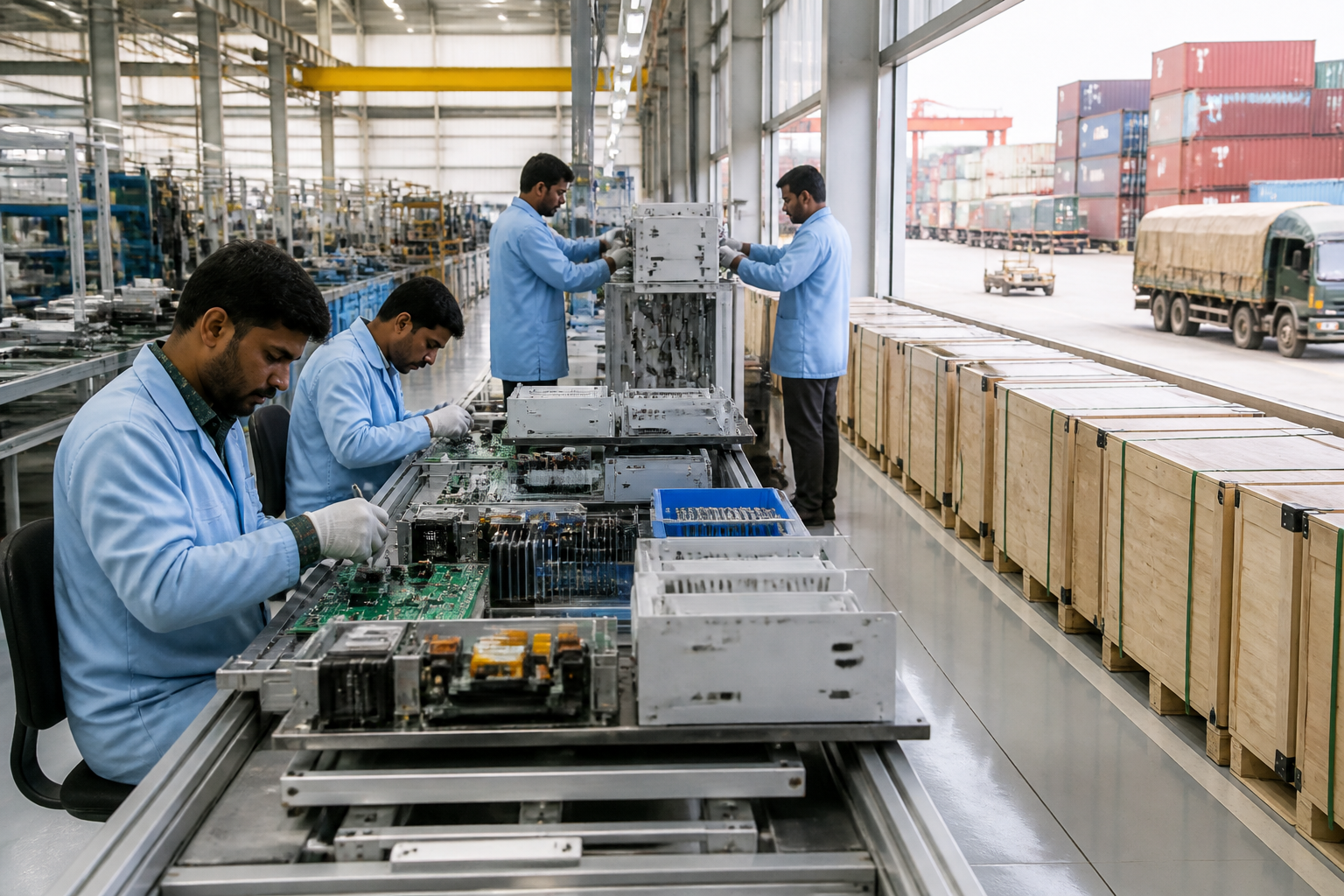
Electronics exports to China rose more than 15% during the April-August period compared with the previous year. The increase follows a sharp rise in the previous financial year, when India’s electronics exports to China tripled to $3.18 billion. Printed circuit board assemblies, smartphones, display modules and telecom equipment were among the products associated with that growth.
Industry executives attributed part of the demand to the global expansion of artificial intelligence and data centres. Rajoo Goel, secretary general of the Electronic Industries Association of India, said the need for high-end equipment connected to AI-related products and data-centre expansion was encouraging electronics exports from India to China.
This is important because it places India’s export growth within a wider technology supply chain rather than a narrow commodities story. The available evidence points to demand for equipment and electronic products, but it does not establish how much of the value is created in India, how much depends on imported components or which stages of production are being carried out domestically.
That distinction is central to understanding the urban and industrial implications. A rise in export value does not automatically mean that domestic manufacturers have captured the full value of the product. The long-term benefit depends on whether Indian firms move from assembling or shipping finished products towards producing components, sub-assemblies, design capabilities and specialised machinery.
## Engineering goods widen the manufacturing base
The increase is not limited to electronics. Engineering exports to China rose about 21% in the five-month period, with machinery and parts, auto components and hand tools among the products contributing to the growth.
Pankaj Mohindroo, chairman of the Indian Cellular and Electronics Association, said the increase indicated that Indian manufacturing was gaining credibility in global value chains. His assessment points to a broader question about the type of industrial capacity India is building. Electronics can generate export growth, but durable manufacturing depth requires a network of component suppliers, engineering firms, logistics providers and skilled workers.
The supplied report does not provide employment numbers, plant-level investment figures or a geographic breakdown of production. It is therefore not possible to conclude how widely the export gains are being distributed across industrial regions. What the figures do establish is that both electronics and engineering products contributed to a broader increase in Indian shipments to China.
The commerce ministry data cited in the report show that engineering goods accounted for 20.73% of export growth to China during April-August. Electronic goods contributed 15.4%, followed by petroleum products at 13.55%, organic and inorganic chemicals at 10.53% and iron ore at 9.97%.
The mix suggests that India’s export relationship with China is not being reshaped by a single sector. At the same time, the prominence of engineering and electronic goods gives the increase a manufacturing dimension that is more consequential than a temporary rise in one commodity category. Whether this becomes a sustained trend will depend on the ability to expand production and retain more value within domestic supply chains.
## China remains a dominant source of industrial dependence
The export improvement is set against a much larger imbalance. India imported $131.6 billion worth of Chinese goods in the year ended March, accounting for almost 17% of total imports. That figure substantially exceeded India’s exports to China.
A separate study by the Koan Advisory Group and the Institute of Chinese Studies, cited by ANI, put India’s trade deficit with China at $112.1 billion in 2025-26. Electrical machinery and electronic equipment accounted for $43.1 billion, or about 38%, of that deficit. The study also found that China accounted for at least 80% of India’s imports across 71 eight-digit tariff lines in 2025-26.
These figures show why a rise in exports cannot be read as evidence that the trade relationship has become balanced. India may be increasing shipments in selected manufacturing categories while remaining dependent on Chinese imports for the machinery, electronics and components needed by domestic producers.
For industrial cities and manufacturing regions, this creates a two-sided condition. Export-oriented firms can benefit from stronger external demand, but their operations may remain vulnerable to imported inputs and concentrated supply chains. The report does not quantify that vulnerability at the city or company level, but the import data indicate that dependence is particularly deep in electrical machinery and electronic equipment.
India’s share of exports to China also remains limited. China accounted for 4.4% of India’s exports in the year ended March, up from just over 3% a year earlier. By comparison, the United States accounted for almost one-fifth of India’s exports. The increase towards China is therefore meaningful in growth terms, but it has not made China India’s principal export destination.
## The data itself reveals a measurement problem
There is uncertainty over the precise composition of the electronics increase. Chinese customs data do not show a comparable rise in printed circuit boards arriving from India. Instead, much of the increase is recorded under smartphones and other telecom products.
Industry executives told Bloomberg News that differences in how India and China classify goods may make it difficult to determine exactly what is driving the growth. This limitation matters because trade data are often used to assess whether a country is moving up the manufacturing value chain. If the same products are classified differently by the exporting and importing countries, sectoral comparisons can produce an incomplete picture.
The evidence therefore supports two conclusions at once. First, Indian electronics shipments to China have grown strongly according to the figures cited in the report. Second, the precise product composition and domestic value contribution remain less certain than the headline growth rate suggests.
That uncertainty should be kept in view when assessing manufacturing progress. Export figures can show that goods are crossing borders, but they do not alone reveal the extent of domestic design, component production, technology ownership, labour intensity or imported-content dependence. The supplied material does not provide those measures.
## Trade engagement is now tied to supply-chain questions
The export increase comes as India and China resume discussions on trade concerns and bilateral engagement after relations reached a multi-decade low. Commerce secretary Rajesh Agrawal said the two sides were examining the structural trade imbalance, supply-chain issues and ways to build trust in bilateral trade.
Agrawal described the discussions as initial efforts in which both sides would work to address concerns in the trade space. That institutional framing is significant because the challenge is not simply to sell more goods to China. It is also to determine how supply chains can become more resilient, how market access can improve and how Indian producers can develop stronger capabilities in components, sub-assemblies and finished products.
The report identifies this as the next task for Indian exporters. Mohindroo said the objective should be to sustain exports, expand across components, sub-assemblies and finished products, and deepen Indian design and component capabilities.
Those priorities connect trade policy with the physical and institutional requirements of industrial growth. Manufacturing expansion requires firms that can supply one another, workers with relevant skills, reliable production systems and access to markets. The supplied report does not detail the infrastructure, land, power, logistics or labour conditions supporting the companies involved, so no conclusion can be drawn about the performance of particular industrial locations.
What can be established is that India’s export growth is occurring before the country has resolved its dependence on Chinese industrial inputs. That makes the current trend an early test of whether export expansion can develop into deeper manufacturing capability rather than remain limited to selected product categories.
## The bigger urban-economic question
For India’s cities and industrial regions, the central question is not whether exports to China rose in the first five months through August. They did. The more important question is whether the increase will produce a broader domestic production ecosystem capable of supporting higher-value manufacturing.
The available evidence shows a sharp increase in exports, stronger performance by electronics and engineering goods, and continued exposure to a large trade deficit. It also shows that the composition of electronics exports is not fully clear because Indian and Chinese customs data do not align neatly.
The next developments to monitor are whether shipments continue to grow, whether exports expand from finished products into components and sub-assemblies, and whether trade discussions produce measurable changes in market access or supply-chain conditions. Until those indicators become clearer, India’s China export surge is best understood as an important manufacturing signal, but not yet proof that the underlying industrial imbalance has been reversed.
