


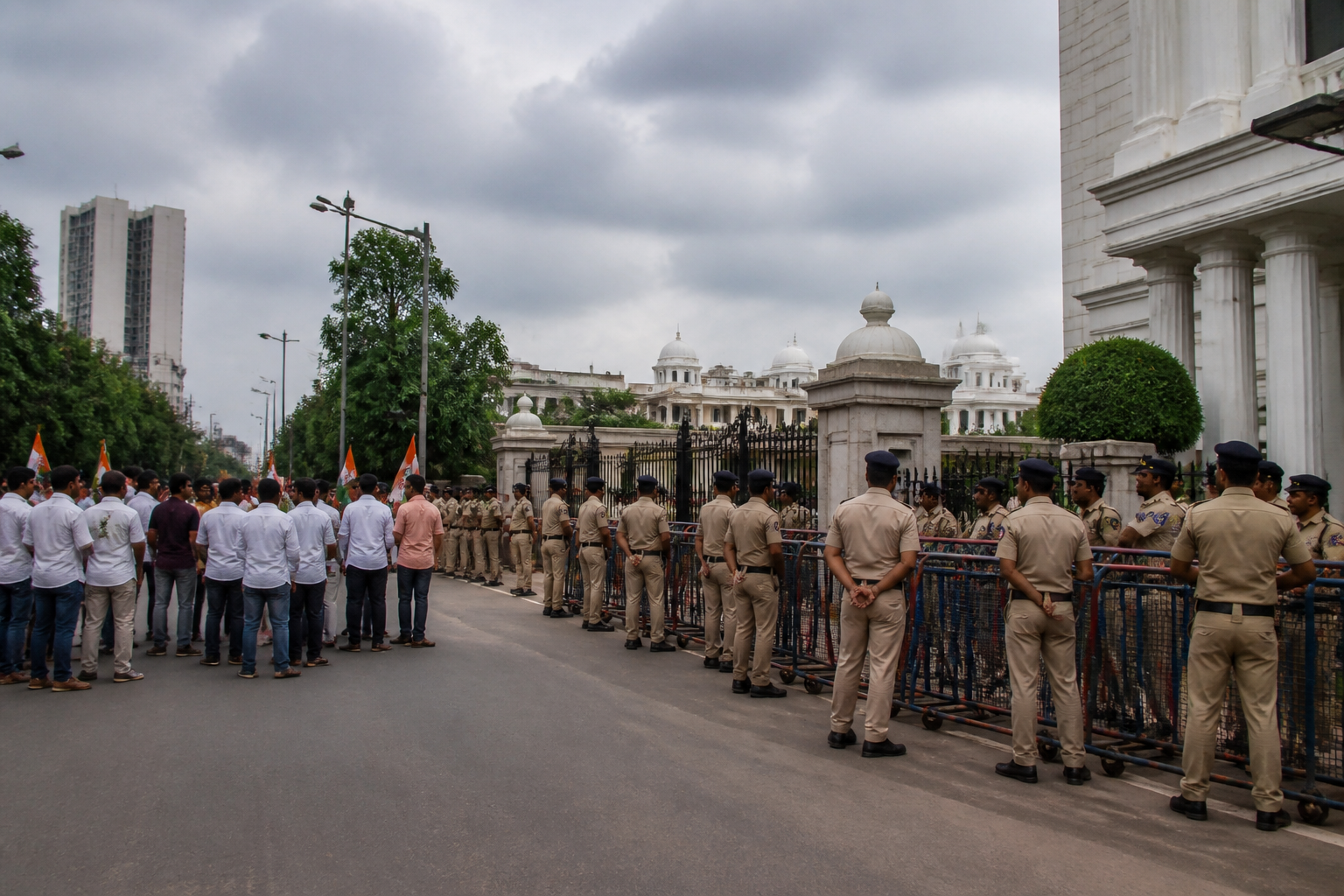
Recent police action against Bharat Rashtra Samithi leaders, aides and functionaries in Telangana has developed into more than a series of political confrontations. The accompanying court interventions have placed the use of preventive measures, criminal cases and arrest procedures under scrutiny, raising a basic governance question: how should the state balance public-order concerns with the right of an Opposition party to organise, travel and dissent?
The latest episode involved Mahesh Manikya Mudiraj, the public relations officer of BRS working president K.T. Rama Rao. Mudiraj appeared before Saifabad police for questioning in connection with a case related to the September 7 incident at the Assembly gate. While he was at the police station, Bolarum police took him to their station in connection with a separate case alleging obstruction of police duties at a check-post on September 8, when BRS leaders were proceeding towards the Erravelli residence of BRS president and former Chief Minister K. Chandrashekhar Rao.
The sequence matters because it illustrates how one episode of political mobilisation can generate multiple police proceedings across jurisdictions. The Telangana High Court had directed police to follow the procedure under Section 35(3) of the Bharatiya Nagarik Suraksha Sanhita in the earlier case. Bolarum police later served Mudiraj a notice under the same provision and released him. Police alleged that he had obstructed officials from performing their duties at the check-post.
Section 35(3) has become central to the dispute because it concerns the procedure to be followed when police require a person to appear for questioning without immediately arresting them. In the reported cases, the court’s intervention did not determine the political dispute between the Congress government and the BRS. It instead focused attention on whether statutory safeguards were being followed before coercive action was taken.
That procedural dimension is significant for urban governance. Hyderabad and other Telangana districts are not only political settings; they are administrative spaces where roads, government offices, hospitals, Assembly precincts and residential areas become sites of competing public activity. When police impose preventive restrictions or detain political actors before a visit or protest, the immediate justification is generally law and order. But the administration must also establish that the restriction follows a lawful process and is proportionate to the risk identified.
The report describes a similar controversy involving BRS social media convener Manne Krishank. The Telangana High Court directed police not to arrest him in connection with a case over a social media post and instructed them to follow the procedure under Section 35(3) of the BNSS. The court also directed him to cooperate with the investigation. The order, as reported, therefore placed obligations on both sides: police were required to follow the prescribed procedure, while the individual was required to participate in the investigation.
A separate case involving BRS MLCs T. Madhusudhan Reddy, also known as Tatha Madhu, and N. Naveen Kumar Reddy further widened the legal dispute. The two had been arrested over alleged derogatory remarks against Assembly Speaker Gaddam Prasad Kumar. The Nampally court rejected the police remand plea and granted them bail on personal bonds. The case was registered under provisions of the Bharatiya Nyaya Sanhita and the Scheduled Castes and the Scheduled Tribes (Prevention of Atrocities) Act.
These cases are different in their allegations, legal provisions and procedural stages. Treating them as one unified legal pattern would go beyond the evidence in the report. But taken together, they show how political conflict can move quickly between public-order decisions, criminal investigation and judicial review. Each transition creates a new institutional responsibility for the police, courts and political actors.
The BRS has used the sequence to allege that the Congress government is deploying police cases, arrests and preventive action to pressure the Opposition. The party has also said that the action is no longer limited to senior leaders but extends to aides, PROs and other functionaries. These are political allegations, not judicial findings established in the supplied report. They nevertheless form an important part of the dispute because they describe how the Opposition interprets the administration’s enforcement choices.
Police, according to the report, have generally cited law-and-order concerns and the need to prevent untoward incidents. That explanation places the emphasis on prevention rather than punishment. Preventive action is intended to stop a possible disruption before it occurs, but its use also creates a difficult evidentiary problem: authorities must act on an anticipated risk, while the affected person may argue that the restriction was imposed without sufficient grounds.
Telangana has reported similar preventive measures at various points during 2026. In April, BRS cadres in parts of Adilabad and Nirmal were placed under house arrest ahead of Chief Minister A. Revanth Reddy’s tour. Similar preventive detentions were reported in Kumram Bheem Asifabad in June and Suryapet in August before the Chief Minister’s visits. Police described those actions as preventive.
In August, BRS leaders T. Harish Rao, P. Sabitha Indra Reddy and Talasani Srinivas Yadav were placed under house arrest before their proposed visit to the Telangana Institute of Medical Sciences Hospital at Sanathnagar. Police said the action was precautionary and intended to prevent any untoward incident. The reported use of such measures across different districts suggests that the issue is not confined to one police station or one confrontation, although the supplied material does not establish a single statewide directive governing all the actions.
The pattern became most visible during the September 7 and 8 Assembly-related events. BRS legislators, including K.T. Rama Rao and Harish Rao, were arrested after a confrontation with police at the Assembly gate. Police subsequently registered multiple cases and took preventive measures against BRS leaders amid protests and tensions surrounding the session. On September 8, police also prevented KTR, Harish Rao and other BRS leaders from proceeding towards K. Chandrashekhar Rao’s Erravelli residence.
The dispute over Erravelli also illustrates the administrative challenge of regulating movement during politically charged gatherings. Police detained the leaders, while the BRS alleged that Congress workers were being allowed to proceed towards the same area. The supplied report does not provide an independent determination of whether the two groups were treated differently. That unresolved claim is one reason the controversy has remained political rather than being settled by a common factual account.
The institutional roles are distinct. The police are responsible for maintaining public order and investigating alleged offences. The executive government carries political responsibility for the broader administrative environment in which those decisions occur. Courts assess whether police action complies with statutory procedure and constitutional safeguards. Political parties, meanwhile, seek to mobilise supporters and challenge the government, but their activities remain subject to laws governing public order and criminal conduct.
The reported court interventions show that procedure can become the immediate point of accountability even when the underlying dispute is political. The High Court’s directions on Section 35(3), its protection from arrest for Krishank and the Nampally court’s rejection of the remand plea do not resolve whether the allegations themselves are true. They do, however, demonstrate that arrest and remand are not automatic consequences of a police case. The courts retain a role in testing whether the next coercive step is legally justified.
The evidence supplied also shows a repeated movement between preventive policing and criminal proceedings. House arrest or detention before a political visit is described as a precautionary measure. A confrontation at the Assembly gate is followed by criminal cases. A social media post results in an investigation where arrest protection is sought. Alleged obstruction at a check-post leads to questioning and a notice under the BNSS. These are separate events, but together they create a governance environment in which political activity is frequently managed through policing mechanisms.
The data available in the report is limited but revealing in its chronology. Preventive action was reported in Adilabad and Nirmal in April, Kumram Bheem Asifabad in June, Suryapet in August and Sanathnagar during the same month. The September 7-8 Assembly events were followed by several cases and detentions. This sequence establishes recurrence across at least four months and multiple locations, but it does not provide the number of people detained, the duration of each detention, the number of cases that resulted in charges or the final outcome of the individual investigations.
Those missing figures matter. Without them, it is not possible to measure whether preventive action has expanded, whether it has reduced disruptions or whether courts have rejected a significant share of police requests. It is also not possible from the supplied material to compare the treatment of BRS workers with that of ruling-party supporters in similar circumstances. The allegations of unequal enforcement therefore remain claims requiring documentary and comparative evidence.
The larger urban question is how public institutions manage political conflict in densely populated administrative settings. Assembly precincts, hospitals, roads and residential areas are shared spaces. Restrictions imposed there can affect traffic, public access, policing resources and the functioning of government beyond the immediate political actors. At the same time, using public-order powers too broadly can convert ordinary political contestation into a repeated cycle of detention, case registration and litigation.
What the reported events confirm is a widening dispute over the boundary between preventive policing and political restriction in Telangana. What remains unsettled is whether the individual police actions were necessary, proportionate and consistently applied. The next points to monitor are the progress of the investigations, compliance with the courts’ directions under Section 35(3) of the BNSS, further remand or bail proceedings and any official explanation for the repeated preventive measures reported across the state.

