


Telangana’s drinking water crisis is no longer only a question of how much water remains in reservoirs. It is a test of whether the State’s interconnected system of dams, tanks, groundwater sources, lift irrigation schemes and urban supply networks can protect drinking-water access when rainfall fails. A report by Telangana Today says several reservoirs are approaching dead-storage levels, groundwater has fallen sharply and Hyderabad’s surrounding supply systems are being forced to draw on residual reserves.
The immediate trigger is a deficient southwest monsoon. Telangana received 554.2 mm of rainfall against a normal 688.1 mm, according to data from the India Meteorological Department. Rainfall was deficient in June and August, while cumulative rainfall until September 20 remained 19 per cent below normal. The deficit has reduced inflows into reservoirs at the point in the year when the State would ordinarily be building reserves for the drier months ahead.
The report places the situation within the Krishna river basin, where live storage in major and medium projects has fallen to about 160 TMCft, compared with nearly 333 TMCft during the same period last year. The comparison is significant because it shows that the concern is not limited to one weak reservoir or one local supply line. The available buffer across a wider water system is substantially lower than it was a year earlier.
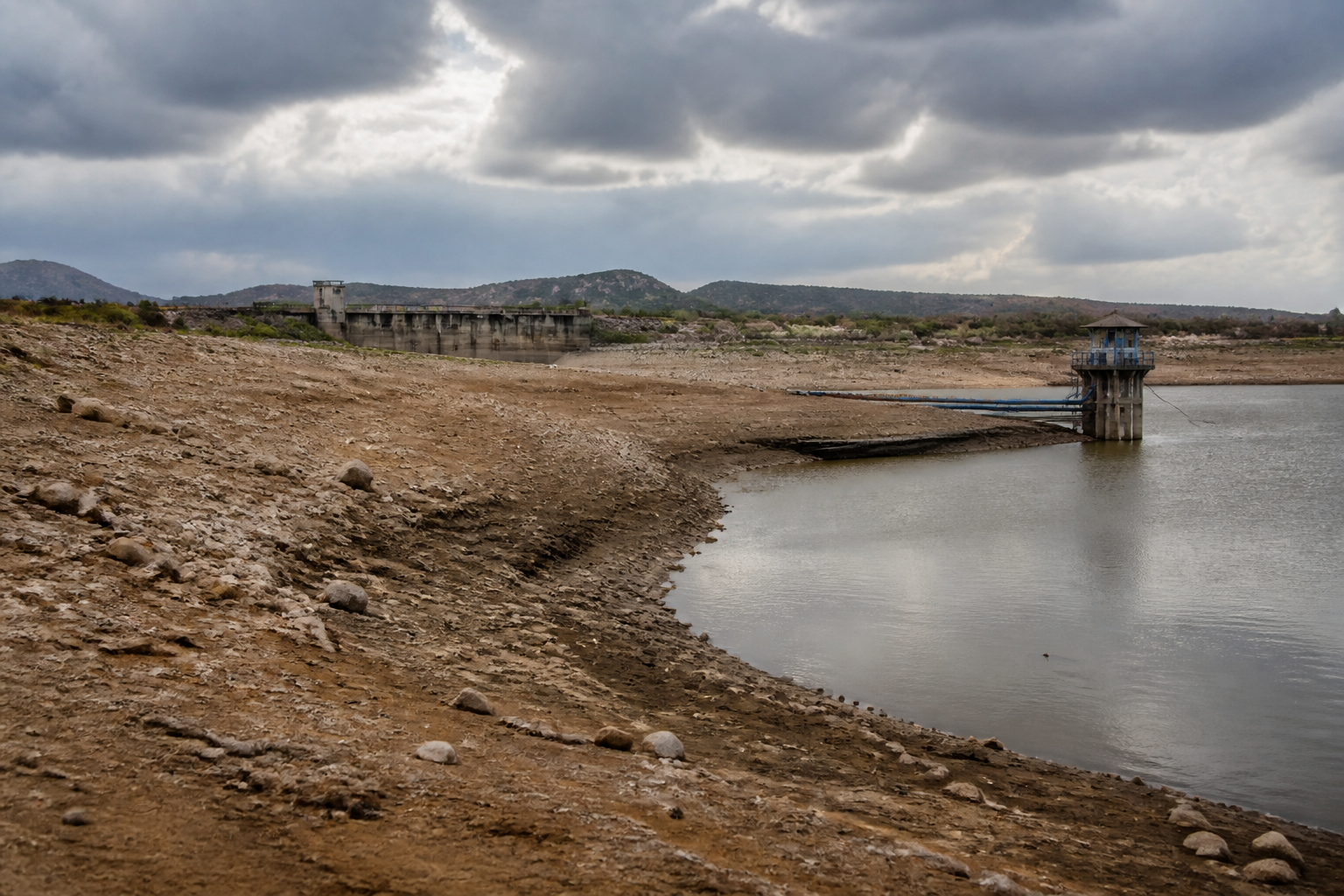
Singur illustrates the pressure at the supply-system level. The reservoir in Medak district normally holds about 17 TMCft at this stage, but the report says it has only around 4 TMCft. The available water is described as being at dead-storage levels, while the Manjeera has virtually dried up. Emergency intake wells at Singur are being used to draw residual water and sustain Mission Bhagiratha supplies.
That arrangement reveals an important feature of urban water security: a city’s supply does not depend only on the water visible in a major reservoir. It depends on whether intake points can continue drawing water, whether pipelines and treatment systems can operate, and whether connected sources retain enough volume and quality for extraction. When a reservoir reaches dead storage, the problem becomes operational as well as hydrological. Water may technically remain in the system, but accessing and distributing it becomes more difficult.
The reported pressure on Hyderabad is also linked to conditions beyond the city’s municipal boundaries. Key reservoirs in the erstwhile Medak and Mahabubnagar districts are part of the wider network that supports drinking-water and irrigation needs. The report says Srisailam and Nagarjunasagar, which are important to Telangana’s water security, are carrying substantially less water than last year. This makes the capital’s drinking-water position dependent on regional storage and inflows rather than on urban infrastructure alone.
Groundwater adds another layer of vulnerability. The State’s average groundwater level has declined from 5.78 metres below ground level in August last year to 7.87 metres this year, a fall of more than two metres. Groundwater can act as a buffer when surface water is scarce, but declining levels indicate that this reserve is also under pressure. The figures suggest that Telangana is not simply facing a shortage in one category of source; both surface storage and subsurface reserves are weakening at the same time.
The condition of the State’s tanks is similarly important. According to the report, around 40 per cent of Telangana’s 44,034 tanks are holding less than one-fourth of their capacity. Tanks are dispersed across the rural and peri-urban landscape and can support local irrigation, groundwater recharge and, in some systems, drinking-water security. Their depletion therefore reduces the number of smaller local buffers available when larger reservoirs cannot meet demand.
The link between irrigation and drinking water is central to the emerging conflict over allocation. The report attributes part of the pressure to the failure to lift adequate water through existing lift irrigation schemes, while warning that drinking water may have to take precedence over irrigation in the coming months. This is not merely a choice between two sectors. It is a question of how water is moved, stored and prioritised across a system where irrigation infrastructure and urban supply networks operate within the same hydrological limits.
In a water-stressed year, the order in which authorities plan and implement measures becomes consequential. The report says contingency planning began in July after repeated warnings of deficient rainfall and the El Nino impact, but that the measures had not acquired the scale required for a State-wide water emergency. The gap identified here is institutional: warnings may be available months before a crisis becomes visible, but preparedness depends on converting those warnings into reservoir operations, source mapping, emergency intake arrangements and clearly prioritised allocations.
The report also notes that the India Meteorological Department’s Hyderabad centre forecast continued monsoon activity, including heavy rain and thunderstorms across several districts through September. That forecast provides the possibility of further inflows, but it does not change the reserves already reported in the affected systems. The immediate water position remains shaped by actual rainfall, runoff and reservoir capture rather than by the existence of a forecast alone.
For Hyderabad, the key issue is whether the city’s supply architecture has enough redundancy. Singur’s emergency intake wells show one form of adaptation: authorities can attempt to reach residual water when normal intake conditions deteriorate. But the need for such measures also indicates that routine infrastructure is nearing its operating limits. The supplied report does not establish the duration for which these emergency arrangements can sustain Mission Bhagiratha supplies, nor does it provide a city-level water-demand or reserve estimate. Those are important gaps in assessing the scale of the urban risk.
The available evidence does establish a broad pattern. Reservoir storage in the Krishna basin is well below last year’s level, Singur’s storage is sharply reduced, the Manjeera is nearly dry, tanks are depleted across a large share of the State, and average groundwater levels have fallen by more than two metres. Together, these indicators point to a system with fewer layers of protection against a prolonged dry period.
The larger urban question is whether water planning is being organised around individual projects or around the full chain that connects rainfall to household supply. Reservoirs, tanks, groundwater, lift schemes, treatment facilities and distribution networks are often administered through different institutions and programmes. A failure or shortage in one part can quickly affect the others, particularly when a major urban centre depends on sources located outside its immediate administrative area.
Telangana’s current position therefore deserves to be monitored through operational milestones rather than rainfall headlines alone. The next indicators are actual inflows into key reservoirs, the functioning of emergency intake wells, groundwater movement, tank storage and the scale of any formal shift from irrigation allocations towards drinking-water protection. The report confirms a serious contraction in available reserves; what remains uncertain is whether upcoming rainfall and contingency measures will restore enough storage before the next critical drinking-water months.
