


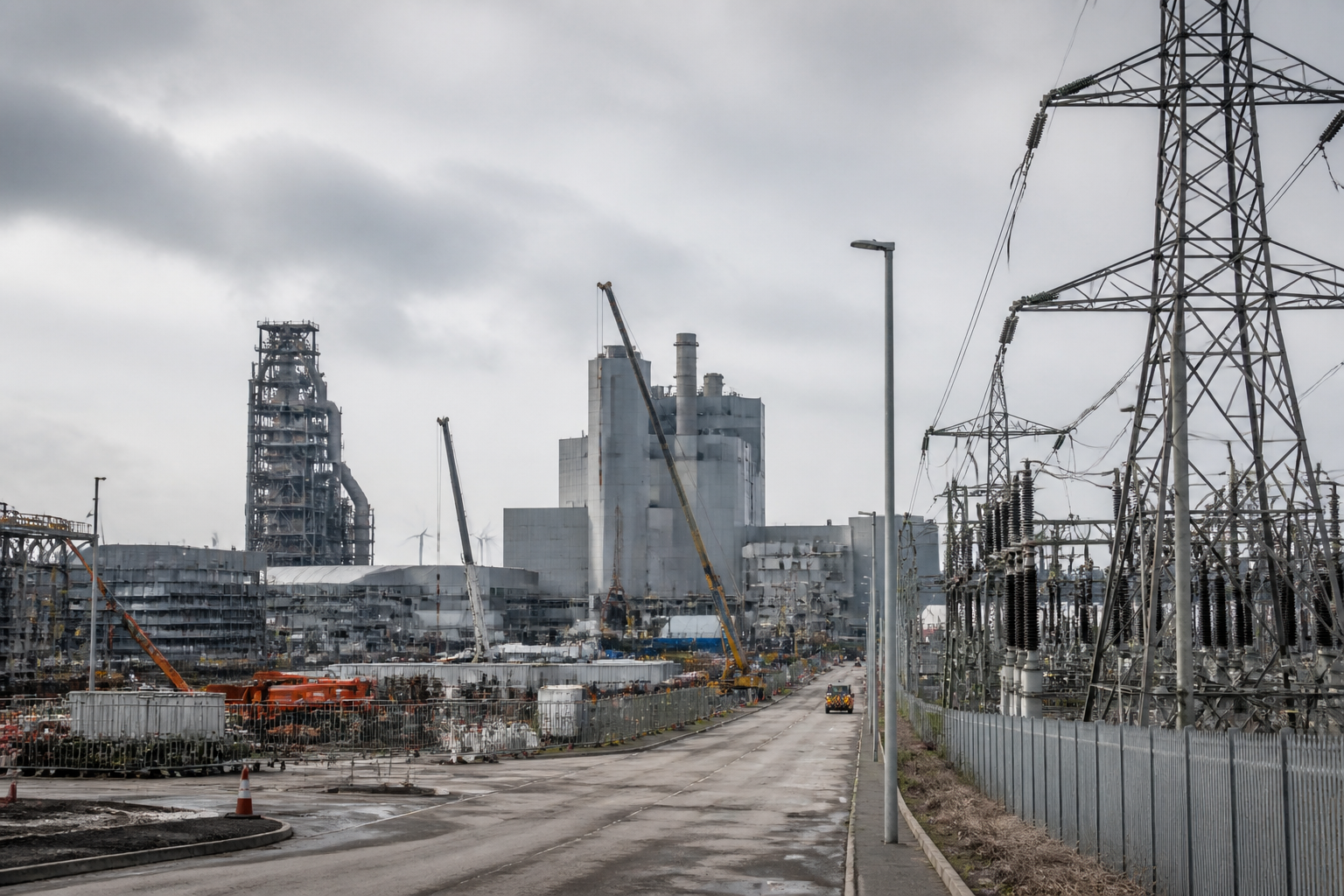
Tata Steel’s delayed electric arc furnace project at Port Talbot is becoming a test of whether industrial decarbonisation can move at the same speed as the electricity infrastructure needed to support it. The company says construction of the 3.2 million tonne facility itself is not delayed, but access to the power required to operate it remains unresolved, prompting discussions with the UK government.
Tata Steel CEO TV Narendran said the company was seeking a discussion with the UK government on the issues affecting timely implementation of the project. Speaking on the sidelines of the 53rd National Management Convention organised by the All India Management Association, Narendran said there was no delay from Tata Steel in the construction of the facility.
The distinction is important. The project’s physical construction and its connection to the electricity system are separate parts of the same industrial transition. A furnace can be built on schedule, but it cannot replace an existing production system without a reliable and sufficiently large power connection. In Port Talbot, the electricity network has emerged as a critical project dependency.
The electric arc furnace is being developed at an estimated investment of £1.25 billion. Tata Steel UK is expecting to secure access to electricity for the 3.2 million tonne furnace by 2029, according to Narendran’s earlier remarks cited in the report. The proposed facility is therefore not only a manufacturing asset but also a large new load on the power system, requiring network planning, connection approvals and new electrical infrastructure.
In May 2024, Tata Steel signed a connection offer with the Electricity System Operator, now responsible for coordinating elements of Britain’s electricity system. Under that agreement, National Grid is to build new electrical infrastructure capable of powering the furnace by the end of 2027. The difference between the infrastructure construction milestone and the expected electricity-access date underlines the importance of the remaining connection process, although the supplied material does not establish the precise cause of the gap between those dates.
The project is backed by £500 million in government support and is intended to reduce site-level carbon dioxide emissions by 90 per cent, equivalent to 5 million tonnes annually. Those figures give the project a significance beyond Tata Steel’s own production plans. The replacement of an existing steelmaking process with an electric arc furnace is tied to the wider effort to reduce emissions from heavy industry, but the reported delay shows that decarbonisation depends on more than equipment selection or capital investment.
It also depends on public and regulated infrastructure being ready when private construction reaches the point of operation. Electricity connections for large industrial facilities require coordination among the project company, the network operator, the system operator and government. The Port Talbot project therefore illustrates an institutional issue common to large urban and industrial developments: the timeline of the visible asset can be controlled by one organisation, while the infrastructure that makes it usable is delivered through several others.
Narendran said Tata Steel was in conversation with the UK government about what could be done and about the company’s concerns. Asked whether Tata Steel had sought fresh funds from the government, he did not deny the possibility but said it was too early to say where the discussions stood. The statement indicates that the company is seeking engagement on the project’s implementation challenges, but the supplied report does not confirm any new funding commitment or a revised government package.
The project’s financial structure already combines corporate investment and public support. Tata Steel has put the overall investment at £1.25 billion, while the project is being built with £500 million of government support. The available material does not specify whether the additional discussion concerns the existing support, a potential revision to project terms, electricity-connection costs, compensation for delay or another element of implementation. Those details remain important to understanding who bears the cost of the infrastructure bottleneck.
The carbon-reduction target also makes the electricity connection central to the project’s public purpose. Tata Steel says the facility is intended to cut site-level carbon dioxide emissions by 90 per cent, or around 5 million tonnes annually. That target is linked to the functioning of the electric arc furnace, not simply to its construction. Until the required power supply is available, the project’s emissions-reduction outcome remains dependent on a future network milestone.
The dates reported so far show a chain of linked commitments. Tata Steel signed the connection offer in May 2024. National Grid’s new electrical infrastructure was expected to be capable of powering the furnace by the end of 2027. Tata Steel subsequently indicated that it expected access to electricity by 2029. The material supplied does not explain whether the 2029 expectation reflects commissioning, final connection work, operational testing or another stage, so the dates should not be treated as interchangeable milestones.
That lack of clarity is itself relevant to major infrastructure delivery. Projects are often described through a single completion date, even though construction, grid connection, commissioning and commercial operation can occur at different times. For a high-load industrial facility, each stage may involve a different institution and a different approval or investment decision. Public reporting on the Port Talbot project has so far established the broad sequence, but not all the operational details behind it.
Narendran also said international markets were still struggling, while demand in India was rising and steel prices had begun moving up over the previous six to eight weeks. He attributed part of the pricing context to coking coal prices, which he said had increased by 50 to 60 US dollars per tonne. These comments provide the company’s broader market context, but they do not resolve the specific power-connection issue facing the UK project.
For cities and industrial regions, the Port Talbot case raises a larger question about the sequencing of the green transition. Replacing carbon-intensive industrial equipment requires not only new machinery but also new networks, public funding and administrative coordination. Where any one of those elements moves more slowly, the climate benefits associated with the project can also be delayed.
The confirmed facts establish that Tata Steel’s furnace construction is not being delayed by the company, that the electricity connection remains a concern, and that the company is discussing the matter with the UK government. They also establish the scale of the proposed facility, its investment, its government support, the planned electrical infrastructure and its emissions target. What remains unclear is the exact reason for the delay in securing power, whether the government discussions will alter funding or timelines, and how the 2027, 2029 and subsequent operating milestones will be reconciled. Those are the developments that will determine whether the Port Talbot project can convert its planned industrial investment into the emissions reduction it promises.

