


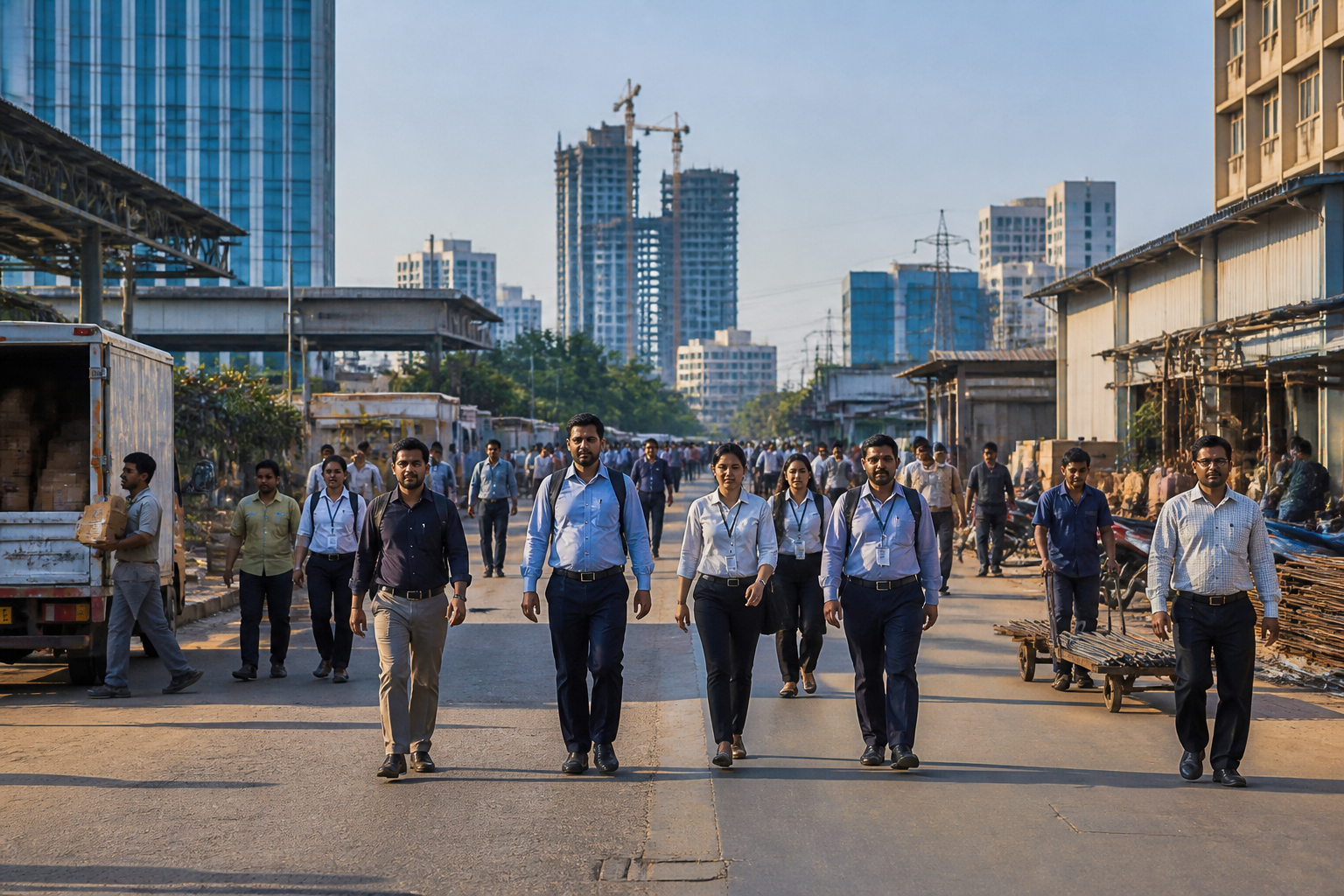
India economic growth is no longer being presented only as a question of how quickly the economy expands. Chief Economic Adviser V Anantha Nageswaran has argued that its larger test is whether expansion produces better jobs, higher wages and greater economic security for ordinary Indians. That argument places the distribution of growth, rather than growth alone, at the centre of the country’s economic transition.
Speaking at a keynote address at an AIMA event, Nageswaran said growth would lead to meaningful transformation only when its gains were shared fairly between workers and businesses. He described fairness not as an act of charity, but as a condition for a healthy and sustainable market economy. In his formulation, workers and companies are not opposing sides of an economic bargain: capital must earn a fair return, while workers must receive a meaningful share of the prosperity created through their work.
That distinction matters for cities because urban economies depend on the relationship between employment, household purchasing power and business activity. The source report does not provide city-level wage, employment or consumption data. It does, however, present a framework in which the strength of a market is connected to whether households have enough income to buy the goods and services that businesses produce. Workers are therefore not only suppliers of labour; they are also the customers on whom the market ultimately depends.
Nageswaran warned that businesses could pursue returns in ways that undermine this cycle. Holding down wages, delaying payments to suppliers and retaining the difference as profit may appear workable for a period, he said, but becomes self-defeating when customers exhaust their savings. The alternative he outlined was to reduce real costs and improve productivity rather than relying primarily on lower labour costs or delayed payments.
This argument shifts the debate from a simple conflict between labour and capital to the structure of production itself. A business can increase its ability to pay workers and suppliers when it lowers the cost of operating, improves productivity and captures value through more efficient activity. Nageswaran said competitive economies are not necessarily those that pay workers the least. They are those that make workers more productive, strengthen suppliers and allow both to share in the value they help create.
The urban relevance lies in the institutional conditions that determine those costs. Nageswaran identified cheaper power, affordable land and lower compliance burdens as areas where governments can make it easier for economic activity to occur. These are not marginal administrative concerns. They shape where businesses locate, how much they spend before hiring, and whether formal economic activity can expand.
Affordable land is particularly significant for economic activity in and around cities, although the source does not identify specific land markets or development projects. The cost and availability of land influence the location of workplaces, production facilities, logistics operations and service businesses. Similarly, the price and reliability of power can affect operating costs across commercial and industrial activity. The CEA’s remarks place these factors within the government’s role of lowering the cost of doing business.
That role is different from directly creating lasting employment. Nageswaran said governments do not themselves create lasting jobs. Their task, he argued, is to make it easier for economic activity to take place, with businesses generating employment through that activity. This places responsibility across several institutions: governments must shape the regulatory and infrastructure environment, while businesses must invest, improve productivity and share the value generated by workers and suppliers.
The distinction also clarifies what a growth number can and cannot show. Nageswaran said India’s medium-term annual growth outlook was increasingly settled, with even cautious forecasts placing it at around 6.5 to 7 per cent. He also referred to 7.8 per cent growth in the first quarter despite headwinds from the West Asia crisis. These figures describe the increase in the size of the economy. They do not, by themselves, establish how that increase is distributed across workers, firms, households or locations.
For that reason, the CEA separated growth from transformation. Growth measures how much larger the economy becomes each year. Transformation concerns the character of that growth: who benefits, how many workers move from insecure employment into productive and stable jobs, and whether households experience an improvement in their standard of living. The reported remarks do not quantify any of these outcomes, but they identify them as the measures that should accompany headline expansion.
This distinction is important for urban policy because cities often concentrate both opportunity and insecurity. The source does not provide evidence on informal employment, housing costs, commuting burdens or household expenditure, so no specific conclusion can be drawn about those pressures from the speech alone. But the framework is relevant to any assessment of whether economic expansion is improving the everyday economic security of people who live and work in urban areas.
The policy measures cited by Nageswaran since the government returned to office in June 2024 include an employment-focused first Budget, trade agreements intended to open foreign markets, efforts to reduce compliance requirements, fiscal consolidation, stronger banking-sector balance sheets and improved access to credit. The source report does not detail the design, scale or measurable outcomes of these measures. It presents them as part of a policy direction intended to connect economic growth with employment and productive activity.
Each measure operates through a different institutional channel. Trade agreements are intended to expand market access. Compliance reduction can lower administrative friction for businesses. Stronger banking-sector balance sheets and improved access to credit can support financing, although the supplied material does not establish how credit has reached particular firms or sectors. Fiscal consolidation concerns the management of public finances, while an employment-focused Budget signals the stated priority of linking public policy with job creation.
The central question is whether these interventions reduce the real cost of productive activity without weakening the bargaining position of workers or suppliers. Nageswaran’s remarks suggest that competitiveness should not be built primarily on suppressed wages or delayed payments. Instead, it should come from lower operating costs, stronger productivity and a wider sharing of value. That is a policy proposition, not evidence that the transition has already occurred.
The speech also raises a measurement problem. A country can record strong output growth while leaving unanswered questions about the quality and stability of employment, the movement of wages and the purchasing power of households. The source provides the growth figures cited by the CEA, but not the complementary indicators needed to assess whether workers are receiving a larger share of economic gains. It therefore supports a distinction between the scale of growth and its social and economic distribution, but not a verdict on the current distribution.
For businesses, the argument presents workers and consumers as connected rather than separate categories. A worker whose income rises can also become a more capable customer. A supplier paid on time can maintain operations and participate in a more stable production chain. The source does not offer company-level examples or data to test this proposition, but it makes the purchasing power of households part of the definition of a healthy market.
For governments, the implication is that job creation depends partly on decisions that may not be described as employment policy: power pricing, land access and compliance design. These areas sit within broader infrastructure, planning and administrative systems. Their effect is indirect but potentially significant because they influence the costs businesses face before employment expands. The supplied material does not establish which reforms have had the greatest effect or how outcomes vary between cities and regions.
The larger urban question is therefore not simply whether India will continue to grow at a relatively high rate. It is whether the institutions that enable growth can also make its benefits visible in household security and productive employment. Nageswaran’s formulation makes fairness an accounting question—who receives what from the wealth being created—rather than only a moral claim.
What the reported remarks establish is a policy argument: growth becomes transformation when it produces better jobs, higher wages and wider economic security, supported by lower costs of doing business and greater productivity. What remains unestablished in the supplied material is how these outcomes are currently distributed across workers, businesses, cities and households. Those are the indicators that will determine whether India’s growth is merely enlarging the economy or changing the conditions in which urban residents live and work.

