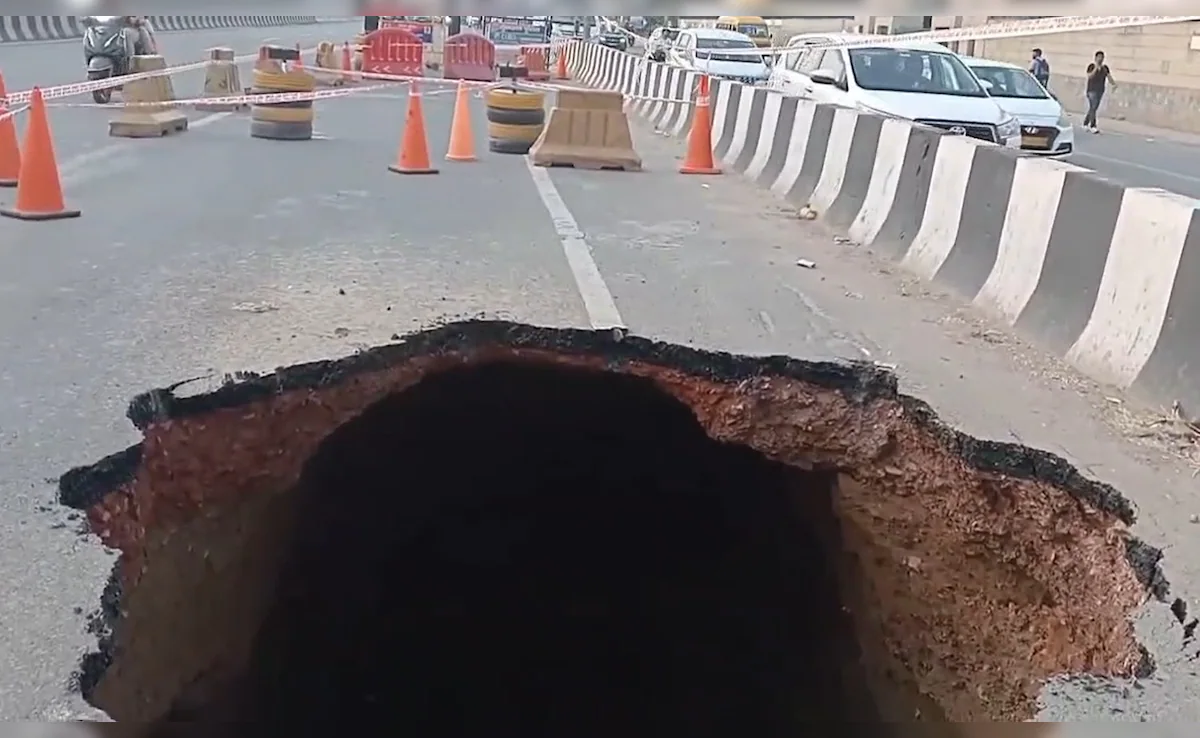
A fresh road collapse along Gurugram’s Sohna corridor has once again exposed the vulnerabilities hidden beneath one of the National Capital Region’s busiest transport routes, intensifying concerns over ageing sewer infrastructure and the long-term sustainability of rapid urban expansion. The latest cave-in, reported on Wednesday, forced authorities to barricade a section of the arterial highway after a large crater opened near a previously damaged stretch. The incident marks yet another disruption on the high-value corridor connecting residential clusters, commercial zones and fast-growing urban sectors in southern Gurugram.
Officials associated with the highway and civic network said the recurring failures are linked to an ageing underground master sewer line that has remained structurally compromised for years. Urban planners note that repeated cave-ins on the same corridor reflect a broader governance challenge in Indian cities, where road expansion projects often move faster than underground utility upgrades. The Sohna Highway collapse has also reignited questions around coordination between multiple infrastructure agencies responsible for roads, drainage and sewage systems. While sections of the sewer network were transferred to metropolitan authorities in recent years, experts say rehabilitation efforts remained fragmented, delaying comprehensive repairs despite repeated warnings from engineers. City infrastructure specialists point out that deteriorating underground pipelines pose both economic and environmental risks.
Besides disrupting traffic movement in a major business corridor, sewer failures can weaken soil stability, increase groundwater contamination risks and accelerate surface damage during intense rainfall events. The problem has persisted despite earlier technical recommendations to rehabilitate the damaged sewer line using trenchless restoration technology, commonly adopted in dense urban environments to minimise excavation and reduce traffic disruption. However, only partial strengthening measures were reportedly completed, leaving the main damaged sections vulnerable. Since late 2023, the corridor has witnessed multiple sinkholes of varying scale, including collapses near residential and mixed-use developments. Residents in surrounding sectors say repeated road closures, diversions and safety concerns have become increasingly common, affecting daily commuting patterns and emergency access. Urban development analysts argue that the incident highlights the hidden costs of infrastructure-led growth without parallel investment in resilient utility systems.
Gurugram, like several rapidly expanding NCR cities, has experienced accelerated real estate growth over the past decade, but ageing drainage and sewer networks have struggled to keep pace with population density and surface construction. The latest Sohna Highway collapse also arrives as weather volatility across north India increases pressure on urban infrastructure. Heavy rainfall episodes, fluctuating groundwater conditions and expanding built-up surfaces are making older underground networks more susceptible to structural failure. Authorities are expected to undertake repairs and reassess the long-pending rehabilitation plan for the damaged sewer line. Infrastructure experts say future urban transport projects in rapidly growing cities will increasingly require integrated planning that prioritises underground resilience alongside road expansion to prevent recurring civic disruptions and public safety risks.