


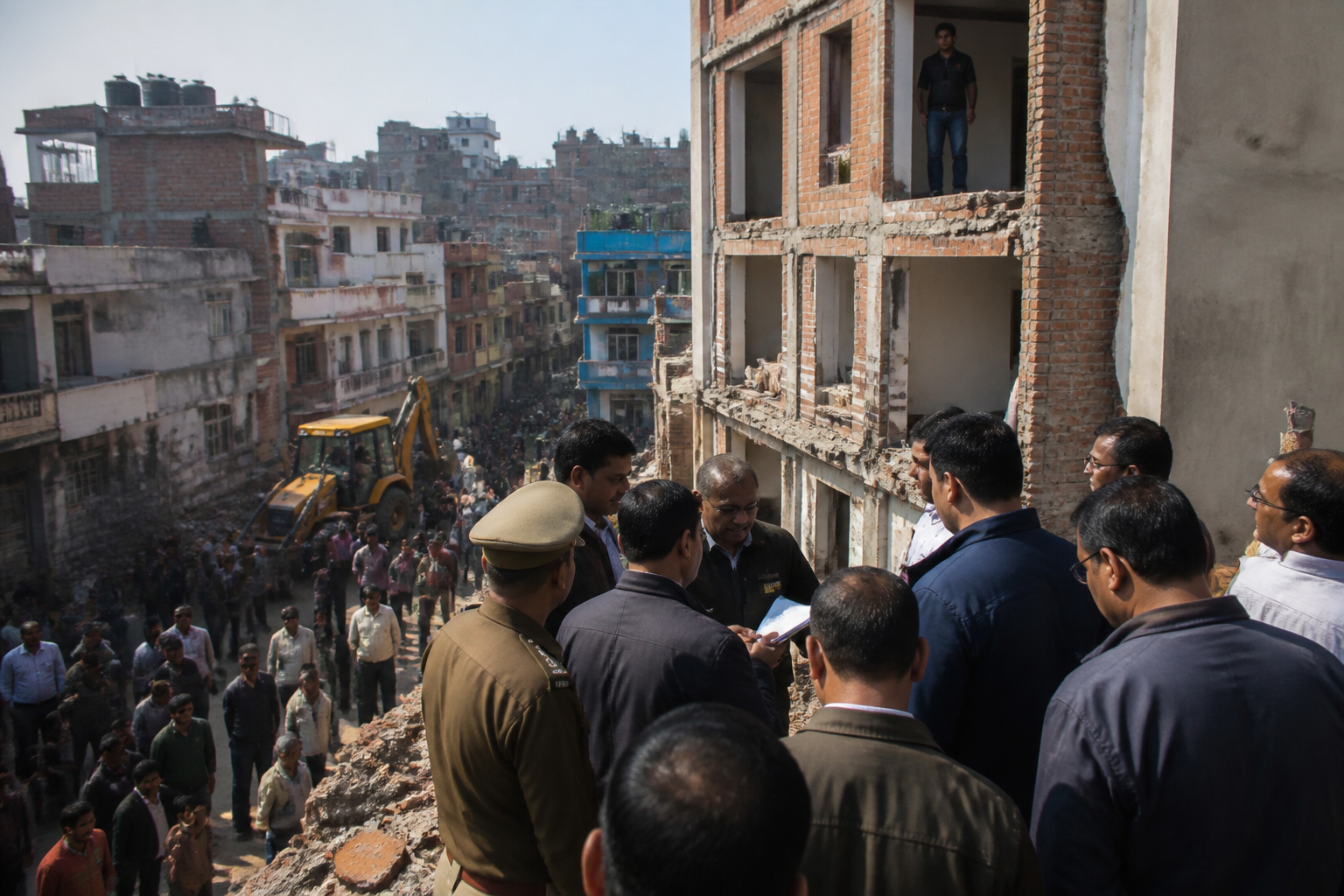
Two deadly incidents in Delhi have brought the city’s building-safety system under scrutiny again. The Malviya Nagar B&B fire killed 23 people, while the collapse of a five-storey building in Satya Niketan killed seven, including five students and two labourers. The locations and immediate causes were different, but both incidents involved questions about unauthorised alterations, changing building use, structural risk and delayed enforcement.
The pattern is important because the danger did not arise only from an unexpected technical failure. In both cases, buildings appear to have moved away from their sanctioned or intended use over time. A licensed six-room B&B in Hauz Rani allegedly became a 25-room hotel spread across four floors, a basement and an improvised rooftop facility. The Satya Niketan property, meanwhile, had been converted into tightly packed student accommodation, with about 15 rooms and around 45 residents in a 55-square-yard plot.
The evidence presented in the report points to a recurring urban-governance problem: rules may exist, but responsibility becomes fragmented when a building is altered, commercialised or occupied beyond its approved capacity. Owners, operators, contractors, inspectors, municipal departments, licensing authorities and utility agencies can each occupy a different part of the regulatory chain. When the chain fails, accountability often becomes visible only after deaths occur.
The Hauz Rani fire illustrates how this fragmentation works. The property was more than two decades old when it was purchased by Lovkesh Bajaj, who told police that the previous seller had suggested modifications, including larger rooms and other alterations. Investigators found a single entry and exit point, a locked terrace and an absence of basic fire-safety systems. The chargesheet filed by Delhi Police alleged that the property had been expanded illegally to increase commercial returns.
The fire broke out at around 8:35 am, when sleeping guests were inside. Combustible material helped spread the flames, while dense smoke moved through the central staircase, which also served as the principal route in and out. The incident killed 23 people, including foreign nationals and members of an Indian family, and injured 20 others.
A subsequent magisterial inquiry widened the focus beyond the owner and management. It examined the roles of Delhi Police, the Municipal Corporation of Delhi, the tourism department and BSES Rajdhani Power Ltd. According to the report, the MCD had issued stop-work notices and sought police assistance, while also asking the power company to disconnect electricity. The alleged unauthorised construction nevertheless continued.
The inquiry also questioned the B&B licensing process. It alleged that the inspection committee failed to properly record the building’s configuration, overlooked the absence of a fire no-objection certificate and did not flag inadequate ventilation in several rooms. The police were criticised for failing to act effectively on municipal notices, while the power company was faulted for not acting on the request to disconnect electricity. These findings suggest that the failure was not confined to one decision or one department.
The Satya Niketan collapse has raised a similar set of questions in a different setting. According to the FIR, the owners allegedly added four floors despite knowing that the foundation could not bear the additional load. Further work was under way when the building collapsed. The property had been leased to a paying-guest operator, Hostel Daze, and was being used as student accommodation.
Investigators are examining basement work, water accumulation and possible structural weakness. The building reportedly dated to the 1970s, with some repairs undertaken in 1990. Civic officials said it stood on a nine-metre right of way notified as a commercial street in 2007 and that the basement had been constructed around that period. The basement was built with load-bearing walls rather than reinforced-concrete columns. Investigators are examining whether work on one of those walls contributed to the collapse.
The specific cause remains under investigation. That uncertainty matters. The MCD commissioner told the newspaper there was no confirmation of construction activity at the site, even as officials were suspended in response to local allegations and the ongoing inquiry. The mayor also said the building had not been classified as dangerous, although work was being carried out in the basement. The case therefore raises a difficult question for any inspection regime: what information was available before the collapse, and was it sufficient to trigger intervention?
Five MCD South Zone officials were suspended after the incident. Three of them had also been posted in the zone when the Hauz Rani fire occurred. Their suspension has made the timing of accountability part of the public debate. The issue is not only why action followed the Satya Niketan deaths, but whether earlier warnings, notices or inspection findings should have produced action before another tragedy.
The corporation responded with a fresh enforcement drive. It issued show-cause notices to five buildings and a demolition notice to another in the South Zone. Several nearby buildings received vacation notices, and one was declared dangerous under Section 348 of the Delhi Municipal Corporation Act. A new survey of dangerous buildings in unauthorised colonies was also ordered, with junior engineers across all 12 zones asked to identify structures that had outlived their structural life or had become dilapidated.
The scale of the inspection challenge is visible in the numbers. The MCD building department had surveyed more than 30 lakh houses across Delhi as part of a pre-monsoon exercise and declared only 51 structures dangerous. Yet Satya Niketan, Hauz Rani and Said-ul-Ajaib—areas associated with fatal fires or collapses—had not been identified as dangerous during earlier surveys. The MCD says such surveys rely on visual inspections and complaints. That approach may identify visible deterioration, but it may not reveal a building’s accumulated risk from extra floors, altered layouts, changed occupancy or concealed structural work.
The distinction between a visibly dangerous building and a building that has become unsafe through gradual modification is central to Delhi’s problem. A structure may not show obvious signs of imminent collapse while still carrying loads or accommodating uses that were never part of its approved design. Similarly, an establishment may continue to appear operational even when its exits, ventilation, fire systems and occupancy levels no longer match its licence.
The regulatory framework described in the report does not leave basements and structural alterations entirely unregulated. Permission for a basement is granted by the concerned urban local body, and the basement forms part of the sanctioned building plan. Construction must comply with applicable provisions of the Master Plan and building regulations. For plots up to 500 square metres, empanelled professionals have certification and inspection responsibilities, while the civic body retains a statutory monitoring role. Fire and structural-safety requirements also apply depending on the nature of the work.
The unresolved issue is therefore less the absence of rules than the visibility and enforcement of compliance. A basement built without permission, a load-bearing wall altered during repairs or additional floors added without approval may remain undetected until the consequences become unavoidable. The system’s reliance on post-incident inspections makes enforcement reactive, particularly in dense neighbourhoods where small plots are repeatedly adapted for commercial use.
The debate over resettlement colonies adds another layer. MCD officials attributed unchecked vertical expansion in places such as Satya Niketan to the absence of a clear redevelopment policy. They argued that these areas had not received the same redevelopment benefits available elsewhere and that buildings originally designed for limited development were being expanded over time. Similar concerns, officials said, exist in Madanpur Khadar, Mangolpuri and Trilokpuri, where plots may be as small as 25 square yards.
The DDA disputed the suggestion that the policy gap explains the problem, pointing to a provision in MPD-2047 for redevelopment of resettlement colonies through regeneration schemes. It also acknowledged that every development still requires a building plan sanctioned by the concerned local body. This exchange leaves the central administrative question unresolved: even where redevelopment pathways exist, which institution ensures that construction remains within approved limits while redevelopment is pending?
The consequences extend beyond individual buildings. Delhi Fire Service data cited in the report show more than 330 building-related calls between January 1 and September 6 this year. These incidents resulted in 30 deaths and 120 injuries. The corresponding period last year recorded 446 calls, 46 deaths or fatal incidents and 155 injuries. The figures include major collapses as well as complaints and precautionary calls involving cracks, falling bricks, roof collapses and other building-related concerns.
The report also cites government data showing that nearly 33,000 people died across India between 2020 and 2024 in incidents involving building collapses, fires and falls into pits and manholes. The broader pattern links building safety to urban maintenance, construction oversight and municipal capacity. Experts quoted in the report said accountability must operate at every level, while municipal authorities must conduct regular inspections of potentially dangerous buildings.
The immediate response in Delhi includes inspections of paying-guest accommodations, action against illegal construction, structural audits in major PG hubs and a survey of buildings with unauthorised fifth floors. The government has also considered alternative accommodation through universities, the MCD and the DDA, while officials were directed to prepare a database of students living in PGs. The lieutenant governor cautioned against indiscriminate sealing drives that could leave students without housing.
These measures address the aftermath, but the evidence in the two tragedies points to a longer cycle. Buildings are altered, occupancy changes, commercial pressures increase and enforcement notices may not produce timely action. After a death, inspections intensify, officials are suspended and demolition or vacation notices follow. The challenge is to determine whether the same level of institutional attention can operate before a building becomes a disaster site.
What the evidence confirms is that Delhi’s building-safety problem involves more than dangerous structures in the narrow sense. It includes unauthorised expansion, inadequate exits, licensing failures, weak inspection, uncertain responsibility and the conversion of small residential properties into high-density accommodation. What remains uncertain is the precise cause of the Satya Niketan collapse and whether earlier information could have prevented it. The developments to monitor are the ongoing investigation, structural audits, the treatment of suspended officials, enforcement of sanctioned plans and whether the proposed redevelopment and accommodation measures produce a system that acts before the next tragedy.
