


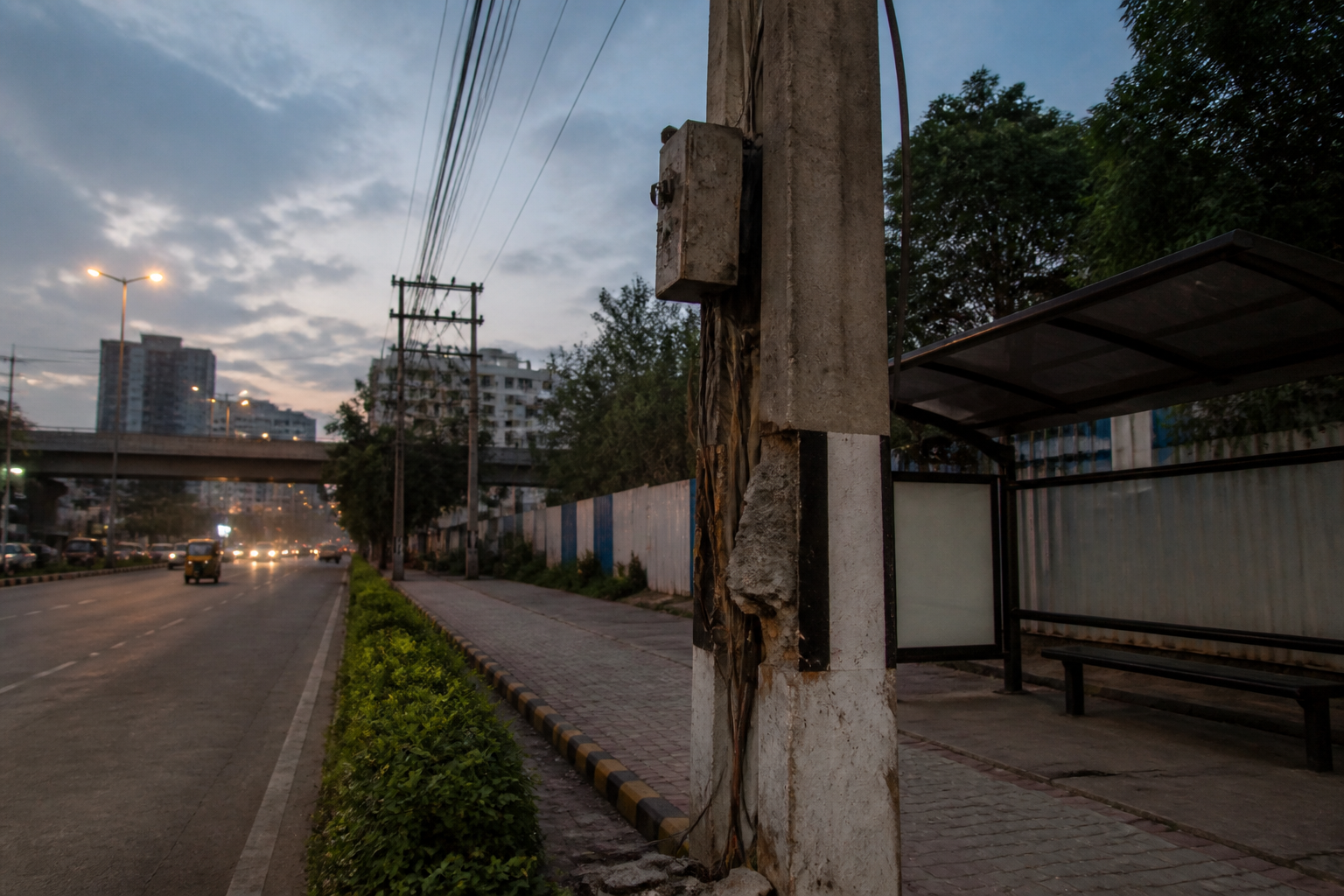
A woman’s death after coming into contact with wires allegedly used to draw electricity illegally in Thane has raised a basic but consequential question about how temporary public-space arrangements are created and monitored. The reported incident took place near a bus stop in Shastrinagar, where electricity was allegedly taken from a roadside pole to power a birthday celebration stage. The case has been registered with Vartak Nagar police against Harshad Chaudhary.
The incident was reported to have occurred at about 11 p.m. on August 27. Suvarna Dongre, 66, who lived in the Bhimnagar area of Vartak Nagar, had stepped out for a walk when she came into contact with hanging electrical wires near the Shastrinagar bus stop, according to the report. She collapsed at the spot. She was first taken to a private hospital and later shifted to the Chhatrapati Shivaji Maharaj Hospital of the Thane Municipal Corporation in Kalwa, where doctors declared her dead.
Police have said that electricity was allegedly stolen from a pole on the pavement to arrange power for a stage erected for Chaudhary’s birthday celebration. The wires remained suspended from the pole, and police investigators found that Dongre’s death followed her contact with them, the report said. A case was registered on September 2 after a complaint by Dongre’s son. Police also issued a notice to Chaudhary.
The immediate facts establish a chain involving a public electricity pole, an unauthorised connection, exposed wires and a fatal contact. They do not, however, establish several details that would be necessary for a complete account of the safety failure. The supplied report does not identify the electricity distribution agency responsible for the pole, say how long the wires had been in place, state whether anyone had previously complained, or explain whether the stage had received any permission for its location and electrical arrangements.
Those gaps matter because the incident was not reported as a failure inside a private property. The wires were attached to an electricity pole on a public pavement, close to a bus stop. That places the risk in a space used by pedestrians and public transport passengers. A roadside pole is part of the everyday urban interface: residents walk past it, vendors and event organisers may operate around it, and people may not be able to distinguish a sanctioned cable from an improvised and dangerous connection.
The case therefore illustrates how public-space safety can depend on several institutions and individuals at once. The person arranging the celebration may be responsible for the alleged illegal connection. The police are responsible for investigating the death and the alleged offence. The electricity utility would be relevant to questions about the pole, the supply and the detection or disconnection of an unauthorised connection. The municipal authority may be relevant because the stage was reportedly set up on or beside a pavement and near a bus stop. The supplied material does not say how these responsibilities were divided in this case or whether any agency had inspected the location.
This distinction is important. Establishing criminal responsibility for an individual is one part of the response. Preventing similar incidents requires understanding how an exposed live wire could remain in a public location and whether the danger was visible to authorities or members of the public before the death. The current report confirms that a police case has been filed and that a notice was issued, but it does not indicate whether the pole and surrounding area were subsequently inspected, made safe or subjected to an electrical audit.
The event also shows the risks created when temporary urban activities rely on improvised infrastructure. Birthday celebrations, religious events, local gatherings and other short-duration programmes often require lighting, sound systems and stage equipment. The report does not provide evidence about the permissions required for this particular celebration. It does, however, describe a temporary stage and a power connection drawn from a public pole. That combination places electrical safety alongside questions of pavement access, event management and public liability.
The difference between formal and informal infrastructure is not always visible to citizens. A cable that appears to be connected to a street pole may look like part of the authorised electricity network. If it is loose, low-hanging or exposed, pedestrians may not know whether it is live. The reported circumstances underline the importance of clear controls around temporary connections, particularly in places where people walk at night. The source material does not establish whether lighting conditions, visibility or prior warnings played any role in the incident, so those questions remain open.
The chronology reported by the newspaper is also significant. The death occurred on August 27, while the complaint was filed on September 2, and the police case was reported on September 9. The available account does not explain what happened between the incident and the complaint, whether the wires were removed immediately, or whether any preliminary inquiry preceded the registration of the case. Those details would help clarify the response of the authorities and the condition of the site after the death.
The case has been registered under the authority of Vartak Nagar police, but the supplied report does not specify the legal sections applied. It also does not contain a statement from the accused, the electricity provider, the municipal corporation or the organisers of the event. As a result, the available evidence supports reporting the alleged illegal connection and the police action, but not broader conclusions about negligence by a particular agency or a pattern across Thane.
For the city, the central issue is not only whether electricity was stolen. It is whether public infrastructure can be temporarily altered without a visible safety check and whether the agencies responsible for streets, electricity and policing can identify such hazards before they cause harm. The incident places that question in a specific setting: a pavement-side pole beside a bus stop, where an exposed wire allegedly became a fatal obstruction during an ordinary evening walk.
The supplied material confirms the death of Suvarna Dongre, the location and timing of the incident, the alleged use of a roadside pole for unauthorised electricity, the registration of a police case and the notice issued to Harshad Chaudhary. It does not yet establish the full sequence of the electrical connection, the responsibilities of other agencies, the status of the site after the incident or the outcome of the investigation. Those are the developments that will determine whether the case remains an individual criminal investigation or prompts a wider review of temporary electrical arrangements and public-space safety in Thane.
