


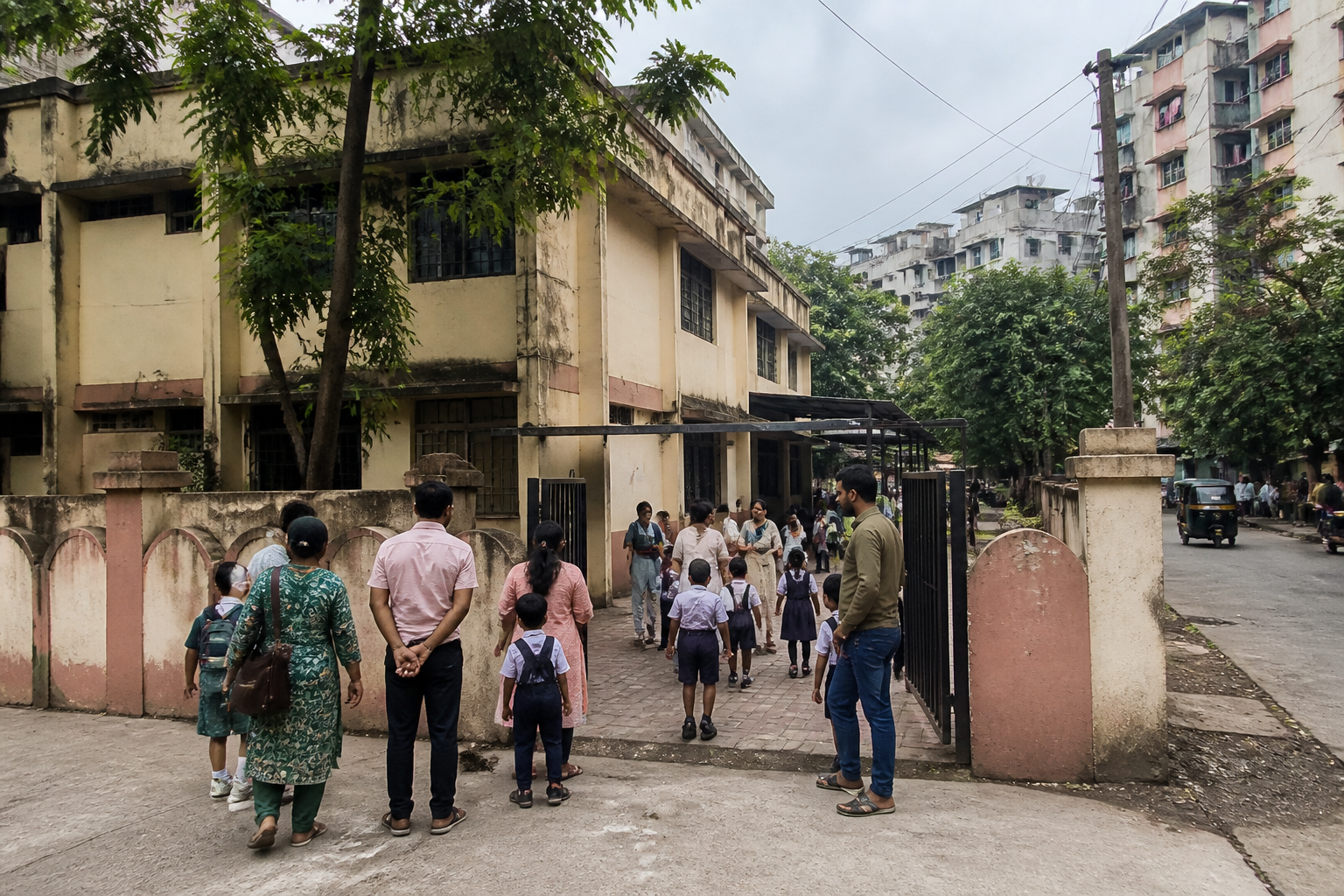
Mira Bhayandar school enrolment has fallen sharply at the start of the 2026-27 academic year, according to figures cited by Loksatta, raising questions about how the municipal education system is recording admissions and retaining families who depend on public schools. The Mira Bhayandar Municipal Corporation reported 5,042 enrolled students so far, compared with 9,613 students recorded in July last year. The reported difference is not simply an education statistic; it is a test of whether a city can accurately identify and serve children who rely on its own institutions.
The figures were provided by education officer Sulabha Vathare, as reported by Loksatta – Vasai-Virar on September 9, 2026. The report describes the current enrolment as having fallen by nearly half. Calculated against last year’s July figure, the decline is approximately 47.6 per cent. However, the available information does not establish whether 5,042 is the final enrolment for the year, whether the comparison is between equivalent dates, or whether all municipal schools have reported their updated registers. Those distinctions are essential before the number can be treated as a confirmed collapse in annual enrolment.
The immediate administrative issue is therefore two-fold. The first is the actual number of children attending municipal schools. The second is the quality and timing of the data used by the corporation to plan teachers, classrooms, learning materials and expenditure. A low preliminary figure may represent children who have not yet been enrolled, schools that have not completed data entry, transfers to other institutions or a sustained movement away from municipal schools. The report does not provide a school-wise or medium-wise breakdown, so the available evidence cannot yet distinguish between these possibilities.
Mira Bhayandar’s municipal school system has a long institutional history. When the municipal corporation was established in 2002, 28 schools and 202 teachers under the district council were transferred to the new civic body. The corporation later expanded the network to 36 schools. This includes 21 Marathi-medium schools, four Hindi-medium schools, and schools using Urdu and Gujarati as mediums of instruction.
That history matters because the municipal school network was not created as a marginal service. It became part of the city’s basic public infrastructure, particularly for students from ordinary and economically vulnerable families. According to the report, the corporation provides free educational materials and has adopted an education policy intended to improve the quality of teaching. It also spends several crore rupees each year on these efforts. The system’s enrolment trend is therefore an important indicator of whether that public investment is translating into sustained use.
The reported direction of travel had appeared positive before this year’s figure. Enrolment had increased continuously for five years, according to the report, and reached 9,613 students in July of the previous year. The sudden appearance of a figure of 5,042 in the new academic year creates a break in that trend. A break of this scale requires more than a headline explanation. It requires the administration to establish whether the change is real, temporary or produced by a difference in the way the figures were collected.
The numbers also reveal the limits of using a single enrolment total to judge a public school system. The previous figure was recorded in July, while the current figure is described as the number enrolled so far after the 2026-27 academic year began. If the reporting dates, admission windows or data-finalisation processes differ, the comparison may not be like-for-like. At the same time, the size of the gap is large enough to require an immediate public explanation. Even if later admissions narrow the difference, the present count indicates that thousands fewer students have been recorded at this stage than in the previous comparison.
The missing information is as important as the information already available. The supplied report does not state how many students are enrolled in each of the 36 schools, which mediums have experienced the largest change, how many teachers are currently posted, or whether any schools have reported vacant seats. It also does not identify the number of students who may have shifted to private schools or schools administered by another authority. Without these details, it is not possible to attribute the decline to parental preference, school quality, migration, admission delays, demographic change or an administrative reporting problem.
For the corporation, the institutional responsibility begins with verification. A school-wise enrolment register, updated admission status, medium-wise figures and a comparison using the same date in both years would provide a clearer picture. The report does not say whether such an exercise has been ordered or whether the corporation has explained the discrepancy. That absence leaves the central question unresolved: are municipal schools losing students, or is the administration yet to record them accurately?
The issue also exposes a familiar weakness in the management of urban services: expenditure is easier to announce than outcomes are to demonstrate. The corporation has spent several crore rupees annually on its education policy and provides free educational materials, according to the report. Those inputs are relevant, but they do not by themselves show whether families find the schools accessible, reliable or desirable. Enrolment is not a complete measure of educational quality, yet a sustained or unexplained fall would be a warning that the system’s inputs are not being matched by public confidence or effective administration.
This does not mean that the reported figure proves a failure of teaching or policy. The available evidence is insufficient for that conclusion. It does, however, show that the civic body’s education system needs transparent and timely monitoring. Public schools serve families that may have fewer alternatives, making accurate admission data necessary not only for budgeting but also for ensuring that eligible children are not missed by the system.
The municipal network’s language mix adds another layer to the question. With Marathi, Hindi, Urdu and Gujarati-medium schools, the corporation is serving a linguistically diverse urban population. The current report does not indicate whether enrolment has fallen evenly across these mediums. A consolidated number could conceal a sharp decline in one group while masking stability or growth in another. Medium-wise data would therefore be necessary to understand whether the problem is system-wide or concentrated in particular schools and communities.
The immediate policy landscape remains within the municipal corporation’s control. It is responsible for the schools transferred to it and for the network it subsequently expanded. Its education administration must maintain enrolment records, provide materials, allocate teachers and implement the education policy referred to in the report. The next administrative step should be to reconcile the current total with school registers and publish a comparable, updated account. Until that happens, the 5,042 figure should be read as a serious interim signal rather than a final verdict on the school system.
The larger urban question is whether Mira Bhayandar’s public institutions can detect changing demand quickly enough to respond. A city may have schools, teachers and an education budget, but still fail families if it cannot identify where children are enrolling, leaving or waiting for admission. In this case, the enrolment data has raised that question before providing an answer.
What the available evidence confirms is that 5,042 students have been reported as enrolled in Mira Bhayandar municipal schools so far in 2026-27, against 9,613 recorded in July last year. What remains uncertain is whether the comparison is final and equivalent, why the gap has emerged, and how it is distributed across the corporation’s 36 schools and different language mediums. Those are the facts the municipal administration must establish before the reported decline can be fully understood.
