


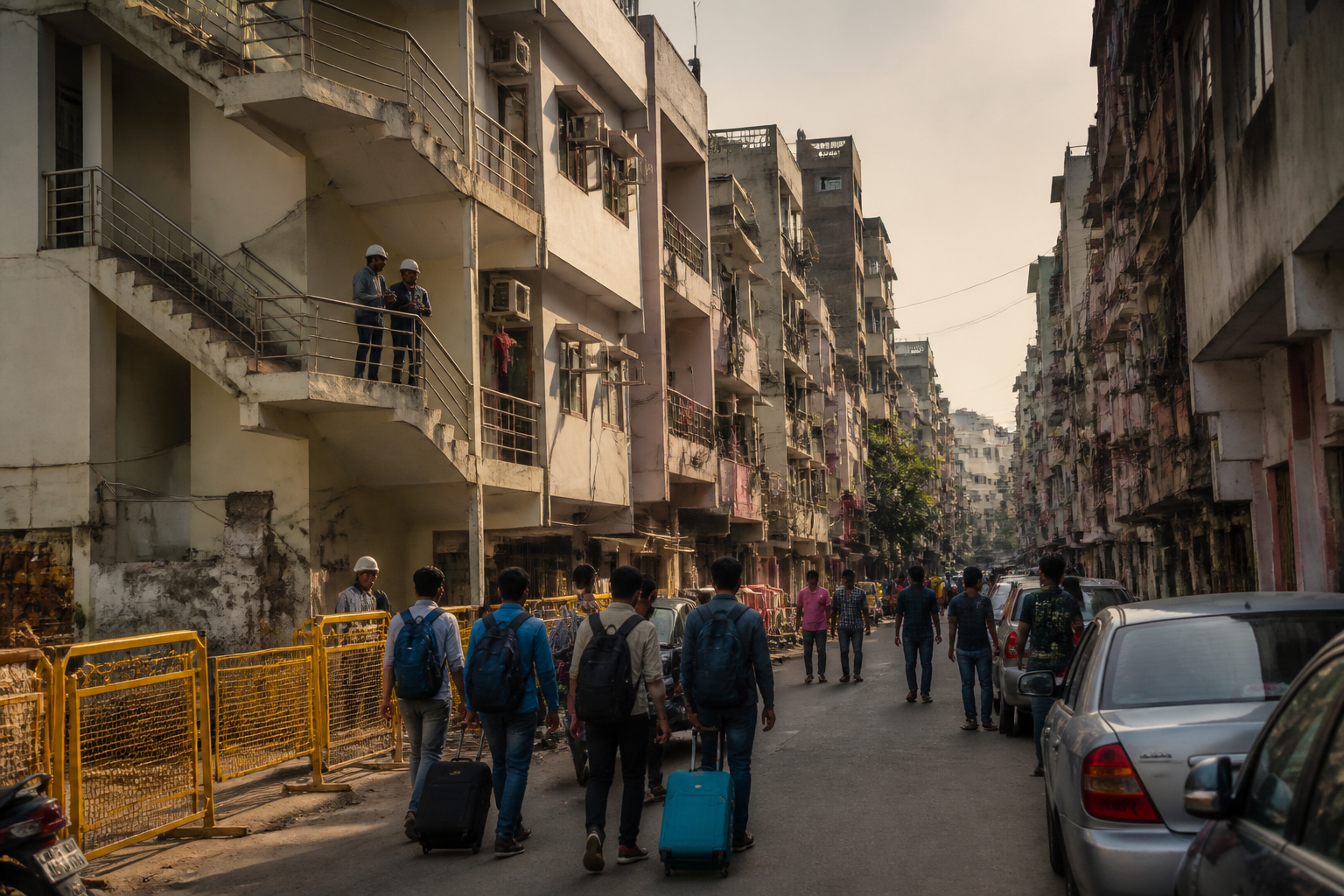
Delhi’s recent fire in Hauz Rani and building collapse in Satya Niketan have left more than damaged structures behind: they have unsettled the low-cost accommodation networks on which medical visitors, students and workers depend. The two incidents occurred in different kinds of neighbourhoods, but the evidence presented in the case of each points to the same urban bargain—location and affordability are prioritised, while safety is treated as a secondary condition.
In Hauz Rani, the June 3 fire at the Flourish Stay B&B killed 23 people, including 14 foreign nationals, according to the police chargesheet cited in the report. In Satya Niketan, the collapse of a five-storey paying guest building killed seven people, including five students and two labourers. The immediate rescue operations ended within hours. The disruption to neighbourhood life has continued for months.
The consequences are visible in how people move through both areas. Foreign visitors and relatives of medical tourists who once filled Hauz Rani’s narrow lanes have largely disappeared. Shopkeepers and autorickshaw drivers are waiting for business to return after several homestays and bed-and-breakfast facilities were sealed. In Satya Niketan, students have been packing their belongings, moving to relatives’ homes or spending nights in college facilities after leaving private paying guest accommodation.
This is not simply a story about two isolated failures. It is a story about how Delhi’s informal and semi-regulated accommodation markets grow around demand that formal housing and institutional capacity cannot absorb. Hauz Rani’s proximity to hospitals created a market for relatively inexpensive lodging. Satya Niketan’s location near Delhi University colleges created another market for students who need rooms close to campus. In both cases, the pressure to provide affordable accommodation has been met through buildings and properties whose safety arrangements may not match their actual use.
The Hauz Rani fire illustrates how the gap between an approved use and an operating business can become lethal. The B&B was licensed for six rooms but was allegedly operating at least 25 rooms across four floors, a basement and an improvised rooftop facility, according to the report. The property allegedly lacked a fire no-objection certificate and an emergency exit. Investigators cited in the chargesheet said the fire began in the kitchen after an oil fryer was allegedly left unattended. Smoke travelled through the central staircase, trapping people on the upper floors.
The first distress call was received at 8.48am. Firefighters reached the site seven minutes later, but the narrow and congested lanes made access difficult. Between 9am and 11.30am, rescuers brought out 48 people. By noon, the fire was under control, but 23 people had died. The chargesheet names the B&B owner, manager-cum-accountant and cook as accused. The allegations focus on unauthorised expansion and the failure to meet basic fire-safety requirements.
The incident also shows why enforcement cannot be measured only by whether a property is eventually sealed. A building opposite the B&B was reportedly found deserted, with flats locked from outside, while nearby accommodation facilities remained closed after the fire. For residents and traders, the effect has been a loss of confidence extending beyond the property where the blaze began. The neighbourhood’s commercial recovery therefore depends not only on reopening streets, but also on whether visitors believe the accommodation ecosystem around them is safe.
Satya Niketan presents a different but related chain of risk. The collapsed building was reportedly around 40 to 50 years old, with additional floors added over time. Construction work had been underway for roughly two weeks before the collapse. Students said neighbouring buildings had poor ventilation, dangerous staircases and inadequate fire-safety provisions. One adjoining building was being vacated for demolition, while other structures were identified as unsafe, according to the report.
The fear has altered the meaning of a rented room. A student paying Rs 8,000 for accommodation—described as already being on the lower side for Delhi—was facing pressure from his parents to move. The room reportedly had neither ventilation nor air conditioning. For students coming from outside Delhi, leaving is not a simple consumer choice. A more secure room may also mean higher rent, a longer commute or an additional burden on families already financing education and living costs.
The lack of institutional housing intensifies that dependence on private accommodation. Around 71,600 new undergraduate students were admitted in 2026-27, while Delhi University has approximately 7,000 hostel seats, according to figures cited by officials in the report. The difference creates a large and continuing market for private paying guest facilities around college clusters. These buildings become an essential part of the city’s education infrastructure even when they are not managed as part of the university system.
That distinction matters. A private PG may function as a dormitory, rental building, food service and sometimes a construction site at the same time. Yet the oversight mechanisms for these different functions can remain divided between agencies. Licensing, structural safety, fire compliance, construction permissions and tenancy conditions may not be assessed as one connected system. The result is a regulatory environment in which a property can satisfy one administrative requirement while remaining unsafe in its actual day-to-day use.
The proposed policy response acknowledges this gap. Delhi’s urban development minister, Ashish Sood, has promised comprehensive legislation and regulations for PG accommodation within two months. The proposed framework is expected to include mandatory licences, zone-wise rent bands, structural and fire-safety audits, and a central portal listing rents, amenities and compliance details. Students have also demanded a dedicated web portal where owners would disclose rents, facilities, meal plans and structural-safety information. Their demands include pre-monsoon audits, structural certifications and regular fire-safety inspections.
A public portal could improve information for tenants, but the central administrative question is whether disclosure will be connected to enforcement. A listing that records rent and amenities without a current safety certification would not resolve the uncertainty students face. Similarly, inspections conducted only after a fire or collapse would reveal failure without preventing it. The proposed system will therefore have to clarify which authority certifies a building, how often certification is renewed, what happens when unauthorised additions are found, and whether tenants are informed when a property is unsafe.
The two neighbourhoods also demonstrate the economic cost of weak regulation. In Hauz Rani, shopkeepers and autorickshaw drivers depended on the flow of medical visitors and their relatives. When accommodation facilities closed and visitors stayed away, the effects spread to businesses that were not responsible for the alleged violations. In Satya Niketan, colleges became temporary shelters, placing mattresses in health centres, staff rooms and guest rooms while arranging food and counselling. Student volunteers searched for classmates who may have been living in the collapsed building.
These emergency measures provided immediate support, but they also exposed the limits of the formal institutions surrounding private accommodation. Colleges could shelter displaced students temporarily, but they could not absorb a housing shortage of the scale indicated by the difference between admissions and hostel capacity. Nor could individual tenants be expected to assess structural stability, fire escape design or the legality of additional floors before signing a rental agreement.
The evidence in the report does not establish that every private PG or B&B in Delhi is unsafe. It does establish a more specific concern: demand for low-cost, well-located accommodation has expanded faster than the systems used to certify and monitor buildings. The risk is greatest where commercial use changes, additional floors are added, construction continues in occupied properties, or emergency access is constrained by dense lanes.
The larger urban question is whether safety can remain an individual tenant’s responsibility when accommodation markets are shaped by institutional shortages and high land-value locations. Students do not choose Satya Niketan only as a lifestyle preference; many choose it because they need access to colleges and cannot obtain university housing. Medical visitors do not necessarily choose Hauz Rani because its buildings are formally designed as hotels; they choose it because it offers proximity and lower-cost lodging.
The authorities’ proposed legislation and the continuing investigations will determine whether the response remains limited to individual cases or produces a citywide accommodation framework. The issues that require monitoring are already clear from the two tragedies: the implementation timetable for the PG regulations, the scope of structural and fire audits, the publication of compliance information, action on unauthorised additions, and the availability of affordable alternatives for displaced residents and students.
Hauz Rani is waiting for visitors to return. Satya Niketan’s students are deciding whether they can return at all. The lasting lesson from both neighbourhoods is that a cheap room near a hospital or college is part of Delhi’s urban infrastructure—and its safety cannot be left to the tenant to discover after a disaster.
