


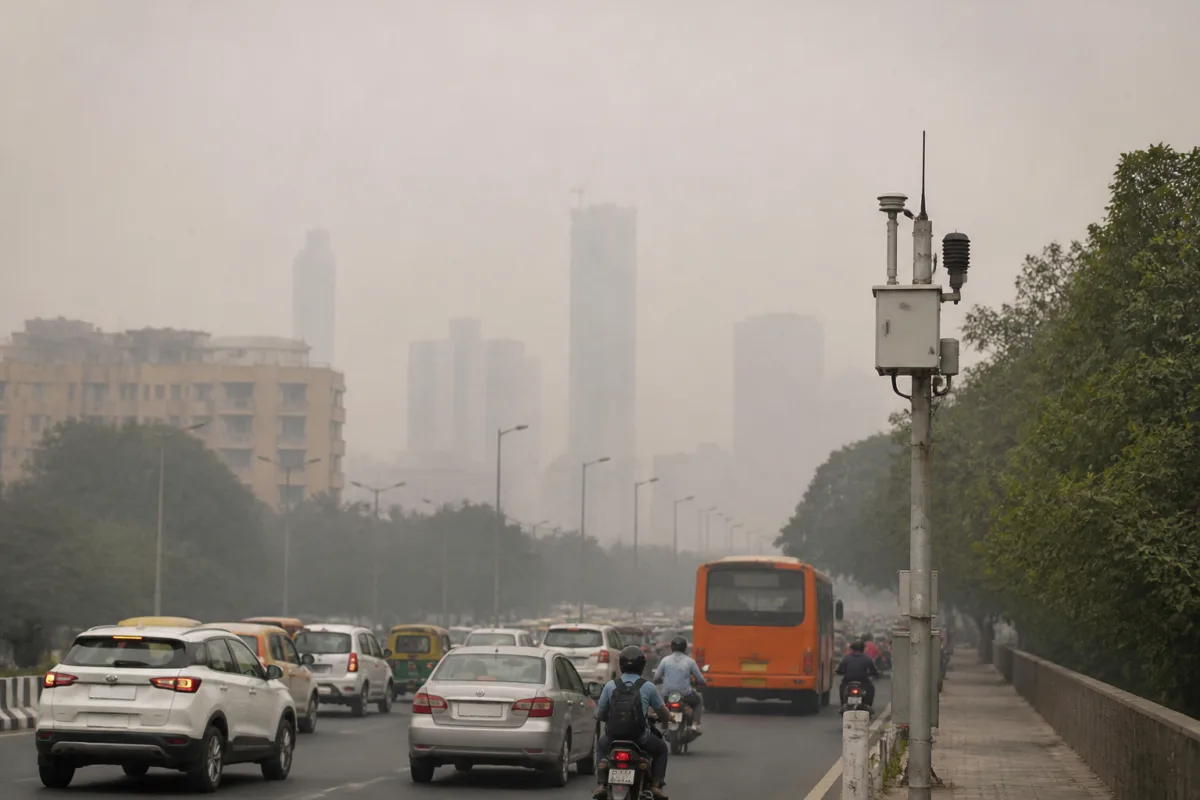
Delhi air quality improved marginally but remained in the ‘poor’ category on Friday, with the citywide AQI settling at 270. The reading was 10 points lower than the previous day, but monitoring data and forecasts indicated that residents could continue to face significant pollution, particularly during mornings and nights.
The capital also recorded its coldest morning of the season so far, with the minimum temperature at 10.5 degrees Celsius. Of the 57 monitoring stations that reported data at 4 pm, 38 recorded ‘poor’ air quality, 15 were in the ‘very poor’ category and four were in the ‘moderate’ category.
Siri Fort recorded the highest AQI among the stations, at 354, placing it in the ‘very poor’ category. The variation across monitoring locations shows that exposure levels were not uniform across the city, even as the overall reading remained within the ‘poor’ band.
The Air Quality Early Warning System’s real-time source-apportionment estimates identified secondary organic aerosols as the largest contributor to Delhi’s PM2.5 concentration, accounting for 27.2 per cent of the estimated pollution load. Biomass burning, including stubble burning and the use of domestic solid biofuels such as wood and dung cakes, contributed 21.2 per cent. Waste burning accounted for 19.4 per cent, while vehicular emissions contributed 16.6 per cent.
The remaining estimated sources were secondary inorganic aerosols at 10.4 per cent, coal combustion at 2.5 per cent, road dust and soil at 2.3 per cent, and industrial sources at 0.3 per cent. The mix indicates that Delhi’s pollution burden was linked to several sources rather than a single urban activity.
The Central Pollution Control Board classifies AQI readings from 201 to 300 as ‘poor’ and those from 301 to 400 as ‘very poor’. The classifications provide the framework for interpreting the city’s monitoring data, including the sharper deterioration recorded at Siri Fort.
Weather expert Navdeep Dahiya said in a post on X that Delhi-NCR’s peak pollution days appeared to have passed and that afternoon air quality in the region was only marginally worse than in Mumbai, Chennai and Bengaluru. He attributed the capital’s continuing night and morning disadvantage to temperature inversion, its landlocked geography and the scale of its urban area. He also said morning AQI spikes could remain in the 350-500 range for several more days before gradually easing.
The AQEWS forecast Delhi’s air quality to remain ‘poor’ on Saturday, deteriorate to ‘very poor’ on Sunday and stay between those two categories over the following six days. For residents, the forecast points to continued exposure risks during periods when pollution accumulates near the ground, even if afternoon conditions show modest improvement.

