


Sustainable transport planning, lower-carbon construction materials and energy-efficient practices are needed to reduce emissions from India’s expanding road and bridge infrastructure, experts said at an Indian Roads Congress technical session in Hyderabad.
A.P. Bahadur, a former chief engineer with the Ministry of Road Transport and Highways, and Prof. Mahesh Tandon called for emissions to be addressed across the infrastructure lifecycle—from planning and design to construction, operation and maintenance.
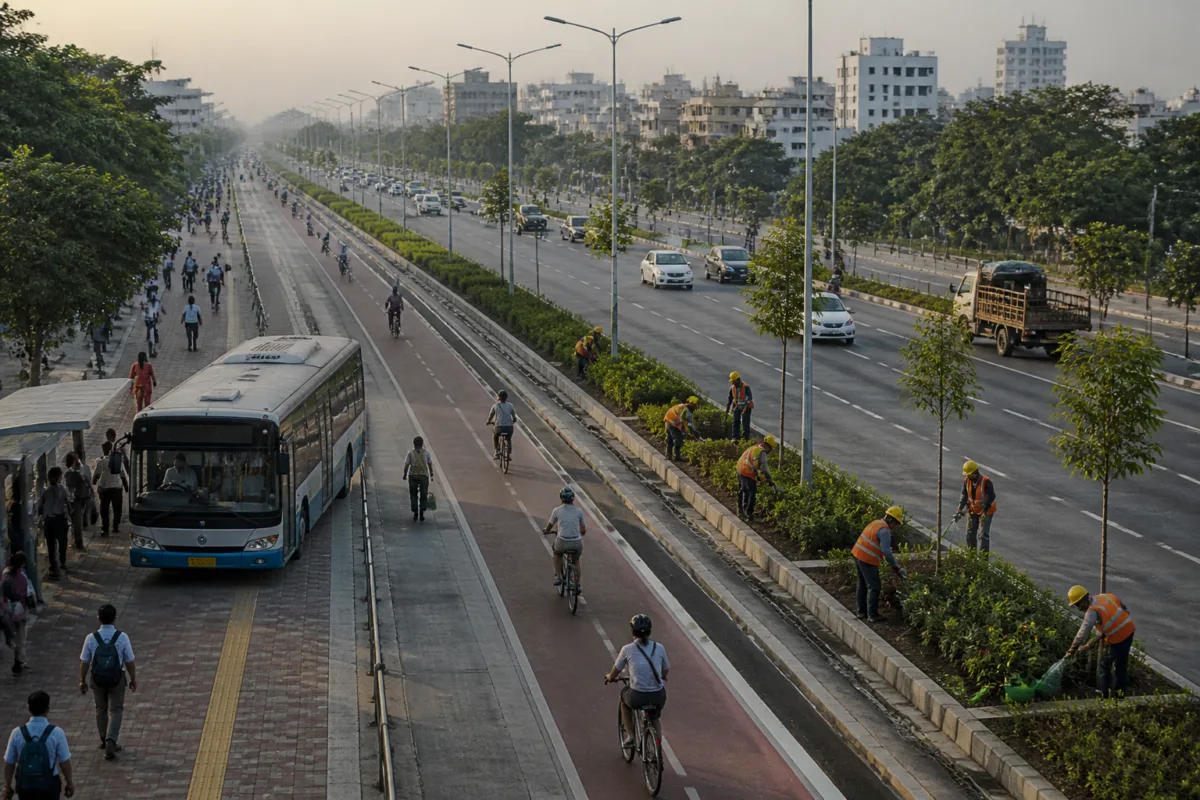
Their recommendations place transport demand and road design alongside construction materials in the decarbonisation debate. Bahadur said public transport, walking and cycling should be prioritised over private vehicles through compact urban planning, equitable distribution of road space, affordable public transport, and dedicated pedestrian and cycling facilities.
He also recommended scientific parking management, congestion pricing, high-occupancy vehicles, car-free zones and bypasses. A central part of his argument was that cities should use existing road capacity more efficiently rather than rely continuously on road expansion.
At the project level, Bahadur suggested roundabouts, bus bays, improved drainage, landscaping and LED lighting to improve road efficiency. He also pointed to AI-based traffic prediction, adaptive traffic signals, incident detection, GPS tracking and centralised traffic control systems as tools that could improve traffic management.
Electronic and free-flow toll collection, he said, could reduce vehicle queues. Shifting long-distance freight from roads to railways and waterways, developing multimodal logistics hubs, and reducing empty return trips could further reduce transport-related emissions.
The recommendations connect road decarbonisation with how urban space is allocated. Prioritising public transport, walking and cycling requires more than cleaner vehicles; it also involves decisions on road space, parking, connections between modes and the location of activities. The session’s focus on better use of existing capacity similarly links emissions reduction to traffic management and demand management rather than only to new construction.
Tandon focused on the emissions associated with concrete bridges. He identified cement production as a major contributor to the carbon emissions of concrete structures and recommended reducing concrete consumption, using supplementary cementitious materials and adopting cleaner manufacturing technologies.
He cited Limestone Calcined Clay Cement, or LC3, as one option. The composition he described consists of 50 per cent clinker, 30 per cent calcined clay, 15 per cent limestone and five per cent gypsum. Tandon said LC3 could reduce carbon dioxide emissions by about 40 per cent. He also said the Indian Standard for LC3 was published in 2023 and that the material had been used at Noida International Airport.
Tandon further recommended ultra-high-performance concrete, saying it could reduce the concrete required for a 100-metre-span structure to 50–60 per cent of conventional quantities. Research on the material was being conducted by IIT Roorkee, IIT Delhi, IIT Hyderabad and IIT Tirupati, he said.
The material choices come with performance requirements. Tandon said fly ash, ground granulated blast furnace slag and silica fume could partially replace cement, but adequate curing would be necessary to prevent carbonation-induced reinforcement corrosion and premature deterioration of structures. This places construction quality and maintenance alongside material substitution in determining whether lower-carbon infrastructure remains durable.
The experts also supported the use of recycled asphalt, reclaimed aggregates and warm-mix asphalt. They recommended energy-efficient machinery, GPS-based fuel monitoring and optimised logistics to reduce emissions during construction and material movement.
Their proposals extend beyond carbon reduction during construction. Alternative fuels, cleaner electricity, waste-heat recovery systems, electric cement trucks and greater use of waterways were identified as measures that could reduce emissions across industrial and transport operations.
Climate resilience was another part of the discussion. Bahadur and Tandon emphasised the need for roads, bridges and drainage systems that can withstand climate-related stresses as part of sustainable infrastructure development. The inclusion of drainage in both road-efficiency and resilience discussions highlights the connection between everyday infrastructure performance and long-term durability.
The session therefore presented decarbonisation as a combined planning, engineering and operations challenge. Cleaner cement and asphalt can reduce the emissions intensity of projects, while public transport, non-motorised travel, freight modal shifts and better traffic management can influence emissions from road use. The recommendations also underline that lower-carbon materials must be matched by appropriate curing, design and maintenance practices if emissions savings are not to come at the cost of premature deterioration.

