


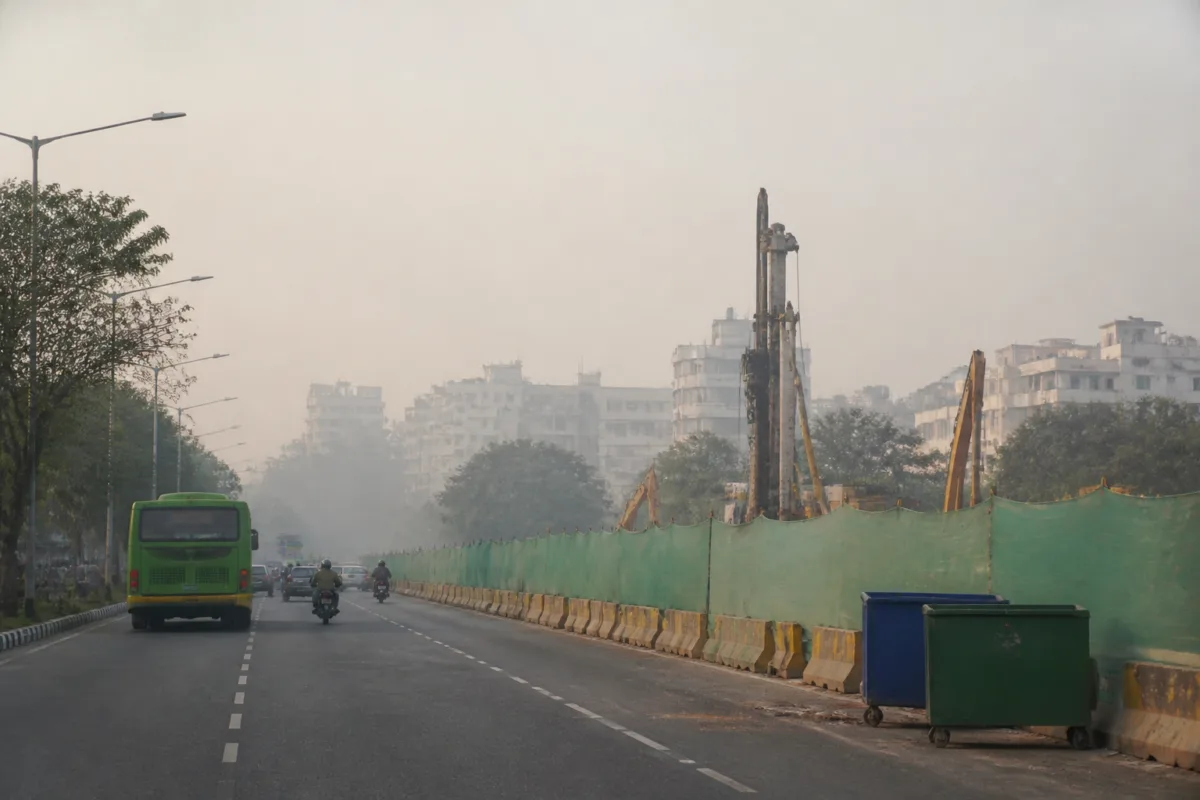
Delhi’s air quality remained in the poor category for a sixth consecutive day on Friday, with the city’s 4 pm Air Quality Index (AQI) settling at 270, even as the Commission for Air Quality Management (CAQM) lifted an NCR-wide construction ban.
The AQI was 268 at noon before rising slightly to 270 at 4 pm, compared with 280 at the same time on Thursday. Better ventilation kept all monitoring stations out of the severe category, but several locations recorded very poor air. Sirifort reported an AQI of 357, followed by Pusa at 349, Chandni Chowk and ITO at 346 each, and CRRI Mathura Road at 336, according to the report.
The Indian Institute of Tropical Meteorology has forecast that Delhi’s air quality will remain poor on Saturday and could deteriorate to the very poor category on Sunday because of unfavourable meteorological conditions for pollutant dispersion.
Friday also marked the end of the construction ban imposed by CAQM across the National Capital Region from November 5 to 20. However, restrictions under the Delhi government’s separate winter pollution framework will continue until January 31, 2027. Stricter curbs under that framework are scheduled to take effect from December 10.
CAQM had revoked Stage III of the Graded Response Action Plan on Tuesday after an improvement in air quality. Measures under Stages I and II remain in force, alongside Delhi’s winter pollution restrictions. These include restrictions on the entry of non-Delhi-registered BS-IV or older vehicles into the capital and a ban on private construction activities until January 31, 2027.
At a review meeting with NCR cities, CAQM directed civic authorities to strengthen action against municipal solid waste burning, which it identified as a significant regional pollution concern. Urban local bodies in Faridabad, Gurgaon, Sonipat, Rohtak, Karnal, Panipat and Manesar were asked to improve solid waste management, speed up the remediation of legacy waste, prevent landfill fires and comply with the commission’s directions.
The civic bodies were also told to stop open waste and biomass burning and ensure that waste is fully removed from streets and public spaces. CAQM advised them to provide heaters at rain baseras and for security guards to discourage open fires during winter.
IITM data for Thursday showed biomass burning, including farm fires, as the largest reported contributor to pollution at 33.3%. Waste burning accounted for 19% and vehicular emissions for 18%.
The contrasting measures mean that while CAQM’s region-wide construction prohibition has been withdrawn, Delhi-specific restrictions and pollution-control actions remain in place. The city’s forecast deterioration over the weekend will continue to test the enforcement of these measures by civic bodies and other agencies.

