


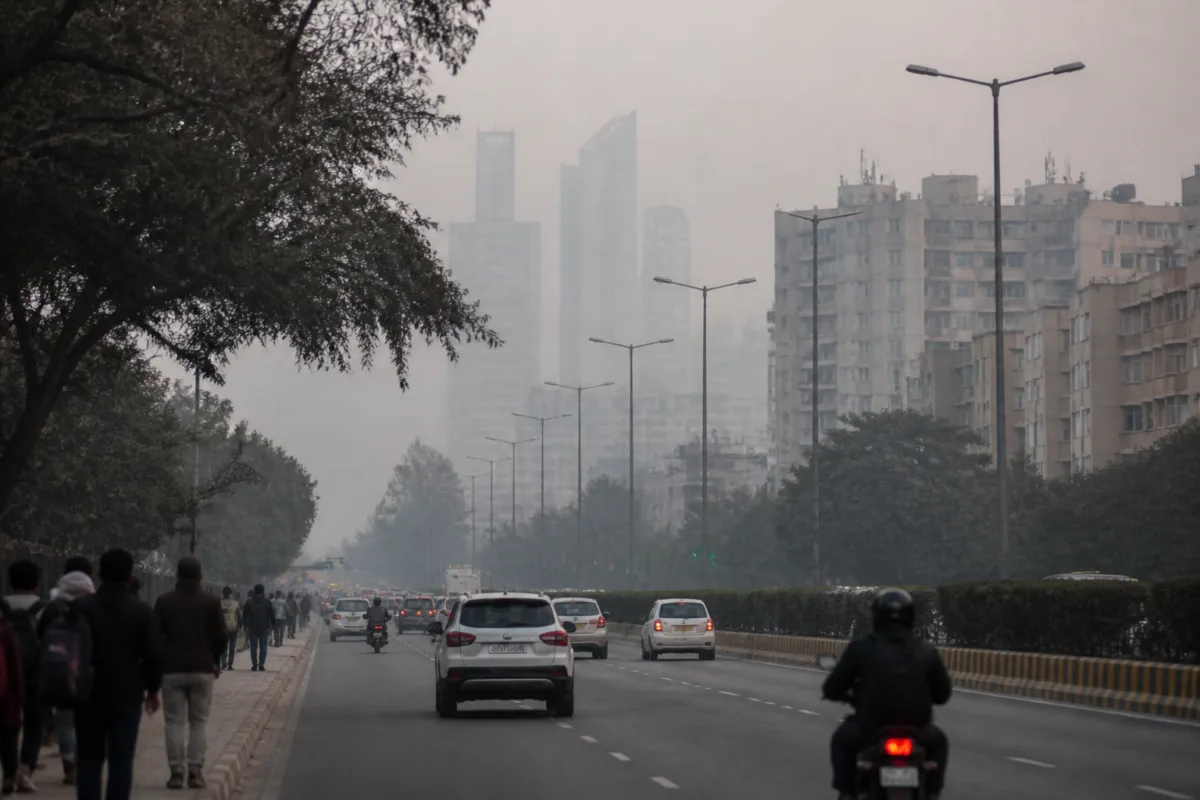
Delhi’s air quality improved marginally on Friday, with the city’s 24-hour average Air Quality Index (AQI) falling by 10 points to 270, but pollution levels during the morning could remain between 350 and 500 over the next few days, according to a Jagran report citing air-quality forecasts.
An AQI of 270 falls in the ‘poor’ category. The Air Quality Early Warning System forecast that Delhi’s air could return to the ‘very poor’ category on Sunday, with conditions expected to remain between poor and very poor for the following six days.
At 4 pm on Friday, 38 of Delhi’s 57 monitoring stations recorded poor air quality, while 15 reported very poor conditions and four recorded moderate levels. Siri Fort recorded the highest station-level AQI at 354.
The report said the early warning system’s real-time source-apportionment assessment estimated that secondary organic aerosols accounted for 27.2% of Delhi’s PM2.5 pollution on Friday. Crop-residue burning and the use of wood and cow-dung cakes as household fuel contributed an estimated 21.2%, followed by waste burning at 19.4% and vehicle emissions at 16.6%.
Secondary inorganic aerosols accounted for 10.4% of the estimated contribution, while coal burning, road dust and soil, and industrial sources contributed 2.5%, 2.3% and 0.3%, respectively.
Weather expert Navdeep Dahiya said Delhi and the National Capital Region could continue to experience poorer air during the night and morning because of temperature inversion, the region’s geography and urban sprawl. He said afternoon conditions could be relatively better.
Delhi recorded its coldest morning of the season so far on Friday, with a minimum temperature of 10.5 degrees Celsius, 1.8 degrees below normal. The maximum temperature was 28.9 degrees Celsius, 1.1 degrees above normal.
The report said the mixing depth, which indicates how high pollutants can disperse, was around 1,100 metres on Friday and was forecast to rise to 1,400 metres on Saturday, 1,450 metres on Sunday and 1,400 metres on Monday. The ventilation index was estimated at 2,000 square metres per second on Friday and forecast to increase to 3,000 on Saturday, 4,500 on Sunday and 6,000 on Monday.
According to the report, a ventilation index below 6,000 square metres per second, combined with wind speeds below 10 kilometres per hour, is considered unfavourable for pollutant dispersion.

