


The decision to take Maharashtra’s Bohada masks to a global audience is more than a cultural promotion exercise. It is an attempt to build a tourism model around living heritage, in which digital visibility, local artisans, community-run accommodation and direct market access are expected to work together without displacing the people who sustain the tradition.
The Maharashtra Tourism Development Corporation, working with Contact Base, has placed the Bohada mask-making tradition on Google Arts & Culture through an exhibit titled “Bohada Masks and Myths: Ritual, craft and storytelling tradition of Maharashtra’s tribal heartland”. The exhibit was launched on October 17, the International Day of the Intangible Cultural Heritage, giving an ancient local practice an international digital platform.
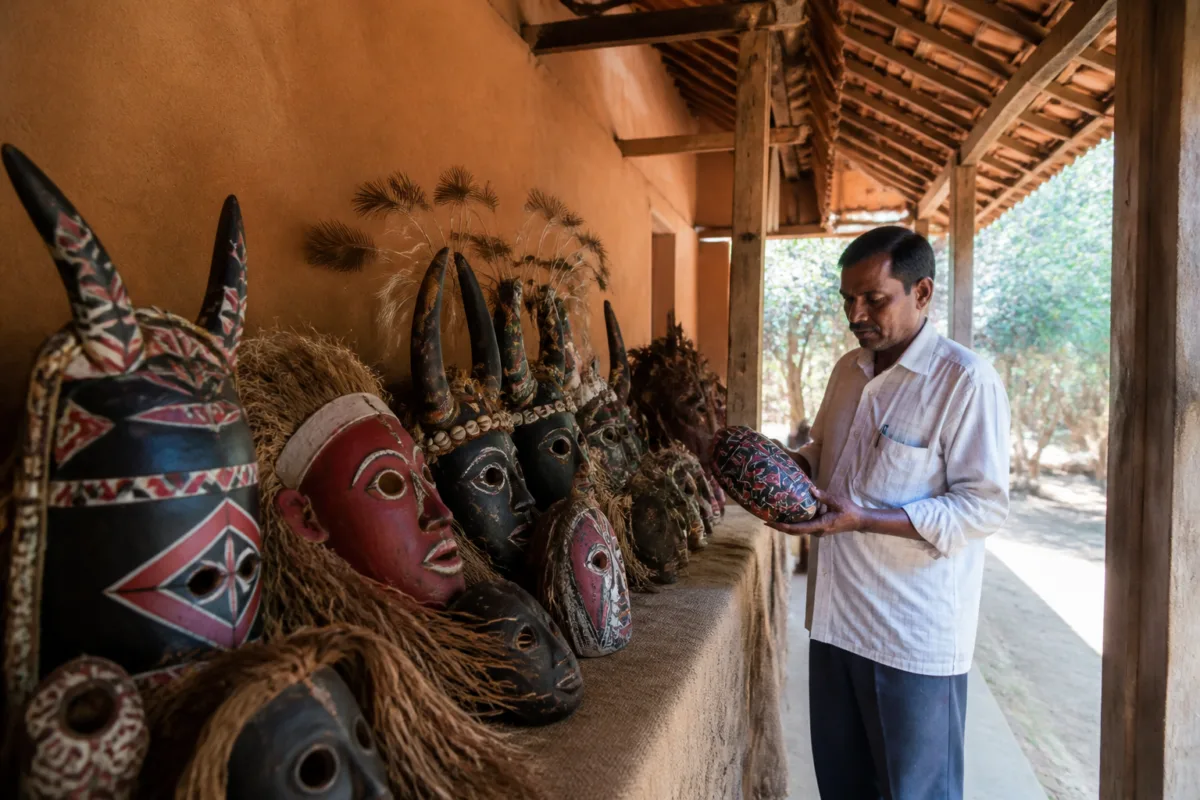
The initiative is centred on Pimpalsond, a remote settlement described as an important location on the living heritage trail. The village is associated with Bohada, a tradition linked to local rituals and tribal dance dramas. Its masks are not presented simply as objects for display. They are sacred and functional parts of festivals, processions and performances, with dancers and participants sometimes wearing them throughout the night.
That distinction is important for the tourism model being proposed. The project’s stated objective is not to convert the tradition into a mass-market attraction, but to develop niche tourism that directs economic benefits to the community while protecting the art form. Amitava Bhattacharya, founder-director of Contact Base, said the community should remain at the centre of the programme and that tourism should benefit residents of Pimpalsond directly.
The approach places cultural heritage within a wider local development system. A dedicated Bohada Mask Folk Interpretation Center has been established on land provided by master artisan Shivaram Choudhary, according to Bhattacharya. The centre creates a physical location for interpretation and engagement, while the Google Arts & Culture exhibit provides a digital entry point for audiences who may never travel to the settlement.
Together, these two platforms address different limitations. A local interpretation centre can anchor visitors, artisans and cultural practitioners in the place where the tradition exists. A digital archive or exhibition can make the craft visible beyond the region and potentially support awareness, documentation and demand. The source report does not establish visitor numbers, revenue targets or a formal operating plan for the centre, but it makes clear that the project is intended to combine local participation with wider exposure.
The masks themselves reflect the depth of the tradition. The 52 traditional Sohang masks represent characters from ancient mythology, elemental forces such as Agni Dev and revered deities including Maa Jagadamba. They are made by hand using paper pulp, clay and local gum. Many are owned and maintained by individual families across successive generations, making the objects part of household inheritance as well as community ritual.
This family-based ownership structure also shows why a conventional tourism strategy could be disruptive. The masks are not interchangeable souvenirs or standardised products. Their value is connected to ritual use, inherited knowledge, local materials and the skills of traditional artists. A tourism system that treated them only as commercial commodities could weaken the relationship between the object and the community that gives it meaning.
The project instead emphasises direct market linkages and the removal of intermediaries. Contact Base has worked with master artisans, built local capacities and created opportunities for the artists to present their work at exhibitions in Mumbai, Pune, Goa, Bengaluru and Kolkata. According to the report, these platforms generated recognition and helped build confidence within the community.
The market-linkage component is significant because cultural tourism often depends on who controls access to visitors and buyers. If artisans remain separated from exhibitions, consumers and tourism operators, much of the value generated by interest in the craft can accrue elsewhere. Direct links do not automatically guarantee equitable earnings, but they address one structural barrier by reducing the distance between makers and markets.
The initiative also connects heritage promotion with rural tourism infrastructure. A senior officer from the Tribal Development Corporation said the Shabari Tribal Development Corporation is strengthening the regional tourism ecosystem by developing community-run homestays. The homestay model, as described in the report, would give visitors a way to stay within or near the communities associated with the heritage trail rather than relying only on conventional tourism facilities.
Community-run accommodation can change the distribution of tourism income, but its success depends on implementation details that are not provided in the available material. The report does not specify the number of homestays, the locations selected, the training arrangements, the expected capacity or the method for monitoring benefits. Those unanswered questions matter because the difference between community participation and community control is ultimately administrative and financial.
The institutional arrangement is therefore central to the project. MTDC has partnered with Contact Base to establish the initiative, while the Tribal Development Corporation and the Shabari Tribal Development Corporation are associated with the wider tourism ecosystem. Local artisans and landowners provide knowledge, creative authority and physical foundations for the programme. The model involves several institutions, but the available account does not describe their respective legal responsibilities, funding commitments or decision-making mechanisms in detail.
That institutional complexity is common in heritage-led development. Tourism bodies are equipped to promote destinations and attract visitors. Cultural organisations may focus on documentation, interpretation and capacity building. Tribal development agencies have responsibilities relating to community welfare and regional economic development. Local practitioners, however, hold the knowledge that determines whether a tradition is represented accurately and whether tourism remains compatible with customary use.
The Bohada project’s stated emphasis on the community is therefore more than a cultural principle. It is a test of whether multiple public and development institutions can coordinate around local ownership. The interpretation centre, digital exhibition, artisan showcases and homestays will produce durable benefits only if the people who maintain the tradition retain meaningful influence over how it is presented and commercialised.
The available evidence shows a project at an early institution-building stage rather than a completed tourism system. A global digital exhibit has been launched. A dedicated interpretation centre has been established. Artisans have received exposure at exhibitions in several cities, and community-run homestays are being developed as part of the regional tourism ecosystem. The report does not provide data on visitor growth, artisan income, employment, homestay occupancy or the number of people participating in the programme.
That absence of data does not diminish the significance of the initiative, but it defines what can currently be established. The project has created platforms and partnerships; its long-term development impact remains to be demonstrated through measurable outcomes. The central question is not simply whether the masks reach a global audience, but whether that audience produces stable and fairly distributed benefits for the families and artists who sustain the tradition.
The broader urban connection lies in the relationship between cities and cultural hinterlands. Mumbai, Pune, Bengaluru, Kolkata and Goa appear in the project because they provide exhibition and market platforms. Urban audiences, institutions and tourism networks can amplify rural and tribal traditions, but they can also shape demand around simplified or commercialised versions of those traditions. The project’s direct-linkage approach attempts to use cities as markets without allowing them to become the sole owners of cultural value.
For Urban Acres, the Bohada initiative is therefore a small but revealing case of place-based development. It shows how a remote settlement can be connected to digital platforms, urban exhibition circuits and tourism infrastructure while retaining a community-centred identity. It also exposes the limits of visibility as a development strategy. Recognition can open doors, but institutions must still establish how land, accommodation, exhibitions, visitor access, intellectual property and income will be managed.
What is confirmed is that MTDC and Contact Base have launched a digital exhibition, that a Bohada Mask Folk Interpretation Center has been established on land provided by an artisan, that artisans have been taken to exhibitions in multiple cities and that community-run homestays are part of the regional tourism plan. What remains unestablished in the supplied material is the scale of funding, visitor projections, income distribution and operational governance. Those will be the measures by which the promise of community-led cultural tourism can ultimately be assessed.

