


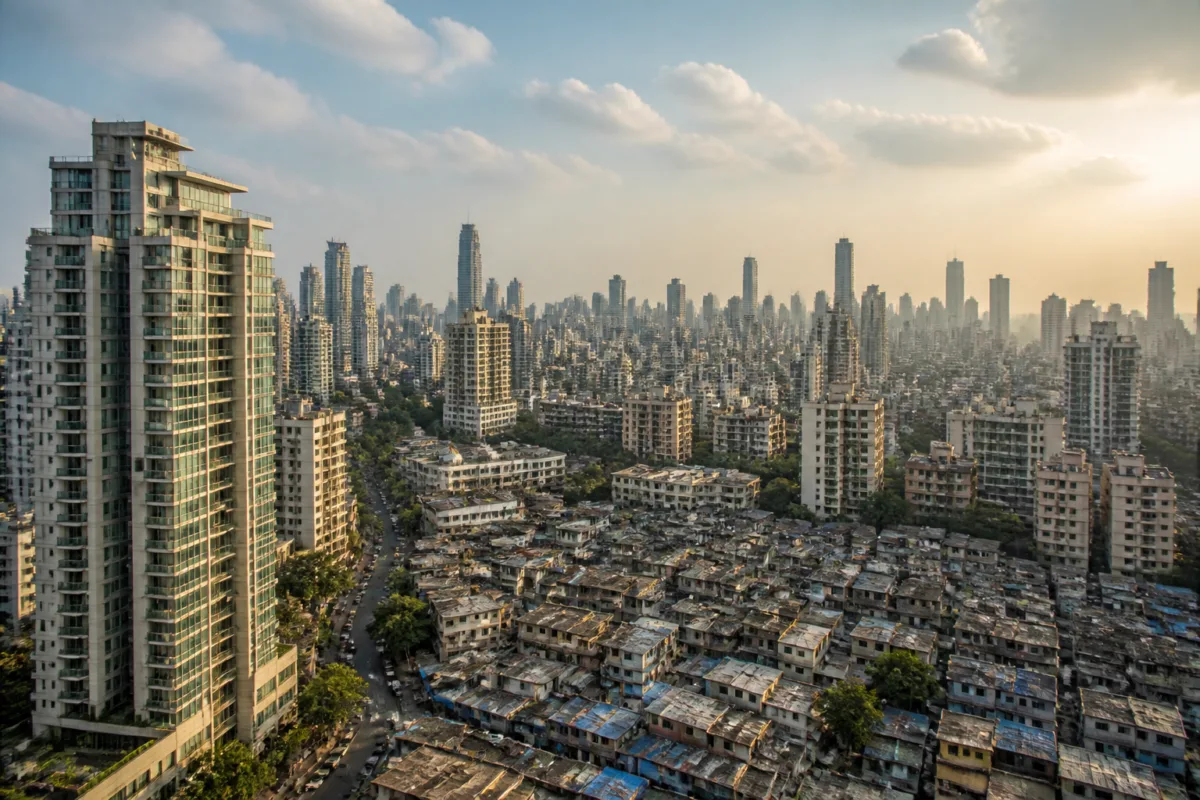
Mumbai’s housing market is not slowing uniformly. The latest data cited by Liases Foras shows that sales below Rs 2 crore are facing sustained pressure while homes above that threshold continue to gain share, exposing a sharper divide between the city’s mass-market housing demand and its premium segment.
By the end of the September quarter, 32,437 residential units had been recorded in BMC areas during 2026, according to the report. Industry participants expect the festive season to support activity in the final quarter, but the overall numbers suggest that Mumbai’s residential market may be operating close to its upper limit on volumes, with limited room for further increases.
That interpretation matters because a stable or expanding headline market can conceal very different conditions for different groups of buyers. The data cited in the report indicates that the cooling is concentrated in the segment that serves a large share of Mumbai’s residential demand: homes priced below Rs 2 crore.
The sub-Rs 2 crore segment recorded roughly 30,000 units at its 2024 peak. It contracted by around 8% in 2025, a decline attributed in the report to affordability constraints and buyer fatigue. In 2026, the segment has recorded about 16,904 units so far, pointing to a materially weaker pace than the 2024 high.
The figures do not establish that demand has disappeared. They show that the pace of transactions in the entry and mid-market segments has weakened while prices remain elevated. Buyers appear to be weighing purchases more cautiously, a pattern that places greater pressure on households dependent on home loans and on developers whose project pipelines are aimed at a broader buyer base.
The contrast with the premium segment is pronounced. Properties priced above Rs 2 crore continued to expand and gain market share even as broader volumes cooled. Liases Foras highlighted the September quarter of 2026 because the above-Rs 2 crore category did not show the same decline visible in lower price bands.
The divergence suggests that Mumbai’s market is increasingly being supported by buyers with greater financial capacity. According to Pankaj Kapoor, managing director of Liases Foras, affluent end-users and investors have remained active and are less sensitive to borrowing conditions or short-term economic volatility. The report does not provide a separate count of end-users and investors, so the precise composition of this demand remains unclear.
Registration data cited from the Inspector General of Registration adds another layer to the pattern. Transactions above Rs 10 crore have risen steadily over the past three years, with no year recording a decline in this bracket. This growth indicates that the high-value market has not merely been sustained by a small number of exceptional purchases.
The distribution within the ultra-luxury segment is particularly significant. Properties priced between Rs 10 crore and Rs 20 crore account for close to 74% of transactions above Rs 10 crore. Around 15% fall in the Rs 20 crore to Rs 30 crore range, about 9% in the Rs 30 crore to Rs 50 crore range, and approximately 2% between Rs 50 crore and Rs 100 crore. Roughly 1% exceed Rs 100 crore, including 11 deals recorded in the data cited.
This distribution challenges the idea that Mumbai’s luxury market is driven only by occasional trophy purchases. The largest share sits in the Rs 10 crore to Rs 20 crore band, suggesting that the segment’s strength is based more on repeated activity within a defined high-value market than on a handful of headline-making transactions.
At the same time, the strength of luxury housing should not be read as evidence of broad-based market health. A market can record strong premium transactions while becoming less accessible to households seeking homes below Rs 2 crore. The data cited in the report points to precisely that situation: overall activity remains substantial, but the composition of demand is shifting upwards.
That shift has consequences for the kind of housing Mumbai produces. When premium homes continue to sell while lower-priced units slow, the financial signal to developers is uneven. Higher-value projects may appear more resilient, while projects dependent on entry and mid-market demand face greater pressure from affordability limits and cautious purchasing decisions. The supplied data does not establish how developers are changing their launches, construction schedules or pricing strategies, but it shows the demand conditions influencing those decisions.
The institutional backdrop is also important. The overall unit count comes from market data cited in the report, while the high-value pattern is supported by registration figures attributed to the Inspector General of Registration. These measures capture different aspects of housing activity. Unit registrations provide evidence of completed transactions, while market analysis helps interpret the performance of different price bands. Neither measure alone fully describes housing need, unsold inventory, rental stress or the availability of affordable homes.
This distinction is central to understanding Mumbai’s affordability problem. The report establishes that the sub-Rs 2 crore segment has weakened from its earlier pace and that premium transactions have continued to grow. It does not establish whether the decline reflects a shortage of suitable homes, unaffordable prices, higher financing costs, delayed decisions, changing buyer preferences or some combination of these factors. Kapoor’s comments identify affordability constraints and buyer fatigue as important pressures, but the available material does not quantify their individual contribution.
The premium market may also be approaching a limit of its own. Kapoor said luxury housing had recorded impressive growth over the past four to five years, particularly after the Covid period, but now appeared to be nearing a plateau. He attributed part of recent demand to investors redeploying gains from financial markets into real estate, including to optimise capital gains tax outcomes.
That explanation links Mumbai’s luxury housing cycle to conditions beyond the city. Kapoor said the stock market had corrected by about 15% from its peak and that the pool of investors with large realised gains could shrink. On that basis, he expects luxury demand to moderate in Greater Mumbai and other major Indian markets. This is an attributed expectation, not an established outcome, and the supplied report does not provide subsequent transaction data to confirm whether moderation has begun.
The broader urban question is therefore not simply whether Mumbai’s property market is growing or cooling. It is who remains able to participate in it. The latest figures show a market with considerable activity at the top end but weaker momentum in the segment more closely associated with mass-market purchases. That difference can widen the gap between the financial performance of real estate and the housing options available to ordinary households.
For policymakers and urban institutions, the data also underlines the limits of using aggregate sales as a measure of housing health. The 32,437 units recorded in BMC areas by the end of the September quarter provide an important volume indicator, but the price-band split reveals more about accessibility and demand quality. The next indicators to watch are the final 2026 unit count, the performance of the sub-Rs 2 crore segment, and whether the Rs 10 crore-plus market continues its three-year upward pattern.
What the evidence confirms is a two-speed Mumbai housing market: lower-priced sales have weakened from their recent peak while premium and ultra-luxury transactions remain comparatively strong. What remains uncertain is how durable that premium demand will be if investor-linked gains diminish, and whether affordability pressures will ease or further restrict the city’s mass-market housing pipeline.

