

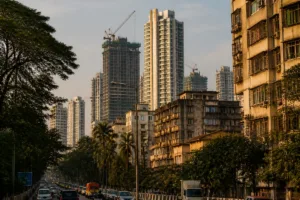
Mumbai’s luxury housing market is still expanding, but the city’s broader residential market is no longer growing uniformly. Sales within Brihanmumbai Municipal Corporation limits rose from 16,371 units in 2016 to 48,772 in 2024 before slipping to 47,473 units in 2025. The latest figures cited by Liases Foras show that the next phase of the market is being carried by homes priced above Rs 2 crore, while the sub-Rs 2 crore segment is losing momentum.
That divergence matters because a housing market can remain active even as access to it becomes narrower. Mumbai’s headline transaction numbers may appear relatively resilient, but the composition of those transactions suggests that the city is approaching a volume plateau and relying increasingly on high-value purchases to sustain activity. The market is not simply cooling or growing. It is being redistributed upwards across price bands.
The shift is visible in the longer trend. Annual residential sales within BMC limits almost tripled between 2016 and 2024, reaching the highest level cited in the report. Growth then weakened, with sales falling by about 3% year-on-year in 2025. By the end of the September quarter of 2026, 32,437 units had been recorded for the year. The festive season could support the final quarter, according to industry expectations cited in the report, but the available figures point to a market operating close to its current upper limit in terms of transaction volume.
The important question is what kind of housing is still moving when total sales stop increasing. The answer from the Liases Foras data is clear: the strongest momentum is at the upper end. Homes priced above Rs 2 crore have continued to gain share, and the September quarter of 2026 did not show the same decline in this category as the rest of the market. By contrast, the sub-Rs 2 crore segment, which has historically contributed a large share of Mumbai’s unit sales, is under pressure.
At the 2024 peak, homes below Rs 2 crore accounted for about 30,000 units. The segment contracted by approximately 8% in 2025. It recorded around 16,904 units by the end of the September quarter in 2026, indicating a materially slower pace than at its earlier peak. The figures do not establish a single cause, but they show that the slowdown is concentrated most sharply among buyers operating within the lower and middle portions of Mumbai’s formal housing market.
This is a critical distinction. A decline in the sub-Rs 2 crore category does not necessarily mean that demand for housing has disappeared. It may indicate that the price of available homes, household purchasing capacity and buyer confidence are no longer aligned. The supplied data shows the outcome—fewer transactions in the segment—but does not quantify how much of the pressure comes from prices, interest rates, income growth, inventory, household formation or changes in buyer preferences. What it does establish is that the city’s unit-sales story is increasingly being shaped by who can continue to transact at high values.
The luxury market presents a different pattern. Registration data from the Inspector General of Registration, as cited in the report, shows that transactions above Rs 10 crore have risen steadily over the past three years, with no year recording a decline in that bracket. Within this market, the Rs 10 crore to Rs 20 crore range accounts for close to 74% of transactions above Rs 10 crore. About 15% fall between Rs 20 crore and Rs 30 crore, around 9% between Rs 30 crore and Rs 50 crore, and approximately 2% between Rs 50 crore and Rs 100 crore. Roughly 1% exceed Rs 100 crore, with 11 such deals recorded.
This distribution changes the way Mumbai’s ultra-luxury market should be understood. Its strength is not being sustained only by occasional trophy purchases above Rs 100 crore. The deeper activity is concentrated in the Rs 10 crore to Rs 20 crore band. That suggests a repeatable, relatively broad base of affluent demand within the ultra-luxury segment, rather than a market dependent entirely on a handful of exceptional transactions.
At the same time, the data should not be read as evidence that every part of the luxury market is insulated from economic conditions. Pankaj Kapoor, managing director of Liases Foras, said the segment had experienced particularly strong growth over the four to five years after the pandemic but appeared to be approaching a plateau. He also attributed part of recent demand to investors redeploying gains from financial markets into real estate, including for capital-gains tax considerations.
Kapoor said a stock-market correction of about 15% from its peak could reduce the pool of investors with large realised gains and, in turn, the incentive or capacity to reinvest in premium housing. His assessment is a source-attributed interpretation rather than a demonstrated causal finding in the figures supplied, but it identifies an important feature of Mumbai’s high-value housing market: some demand may be connected not only to housing requirements but also to the availability and redeployment of financial capital.
That connection makes the luxury segment more influential than its unit count alone would suggest. A relatively small number of high-value transactions can support the value of sales, developer cash flows and market sentiment even when the number of homes sold is flat. But this can also create a misleading sense of broad market health. If the number of transactions below Rs 2 crore falls while expensive homes continue to sell, aggregate activity may remain stable without indicating improved access to housing for the wider population.
Mumbai’s market therefore appears to be entering a phase in which price composition matters more than headline volume. From 2016 to 2024, the principal story was expansion: annual sales increased from 16,371 units to 48,772 units. After 2024, the story became one of divergence. Total sales eased, the sub-Rs 2 crore segment weakened, and homes above Rs 2 crore continued to gain share. This is not a simple transition from boom to bust. It is a shift from broad-based volume growth towards higher-value concentration.
The institutional data sources mentioned in the report also show how different parts of the market are measured. Liases Foras provides the sales analysis across price segments, while the Inspector General of Registration data captures registered transactions above Rs 10 crore. These are useful but distinct lenses. One describes movement across the residential market; the other highlights the distribution of registered high-value deals. Together, they show the contrast between the city’s mass and premium segments, but they do not by themselves provide a complete account of unsold inventory, rents, household affordability or the geography of transactions.
That limitation is important for interpreting the urban consequences. The supplied material does not identify which neighbourhoods account for the luxury transactions, how much of the high-value demand is from end-users or investors, or whether the homes are newly launched, resale properties or redevelopment-linked units. It also does not establish how the weakening sub-Rs 2 crore segment is affecting rental demand, informal housing or peripheral expansion. Those questions remain open and would require additional locality-level, income and inventory data.
Even with those limits, the direction of the market has consequences for Mumbai’s housing system. When higher-priced homes form a larger share of transactions, developers and landowners may have stronger commercial incentives to pursue premium projects, particularly in a land-constrained city where construction and redevelopment costs are high. The report does not establish that supply has shifted for this reason, but its sales data indicates that the segment currently showing greater resilience is the one with the highest ticket sizes.
For households seeking homes below Rs 2 crore, the weakening transaction pace points to a different market reality. The segment remains significant in unit terms, but its contraction suggests that the city’s formal ownership market is becoming harder to sustain at accessible price points. Whether that results in delayed purchases, smaller homes, movement to peripheral locations or continued renting is not answered by the available evidence. What is established is that the affordability-sensitive portion of the market is under greater pressure than the luxury segment.
The policy landscape is consequently more complex than a response focused only on increasing overall housing supply. The data indicates that the market can record substantial activity while the distribution of that activity shifts away from lower price bands. Assessing housing conditions therefore requires attention to the price and income composition of sales, not just the number of units registered or sold. It also requires distinguishing between the needs of end-users and the capital behaviour of investors, a distinction the cited report raises but does not fully measure.
Mumbai’s current housing signal is thus both strong and fragile. It is strong because the Rs 10 crore-plus segment has recorded sustained growth and because the Rs 10 crore to Rs 20 crore band provides depth within the ultra-luxury market. It is fragile because the luxury expansion may be nearing a plateau and because part of the demand, according to Liases Foras, has been linked to financial-market gains that may not be repeated at the same scale.
The central fact is not that Mumbai’s real estate market is either healthy or weak. It is that the city is displaying two simultaneous housing markets. One is high-value, capital-backed and still resilient. The other is larger in its potential citizen impact but increasingly constrained below Rs 2 crore. As the final 2026 sales figures emerge, the key indicators to monitor will be whether the festive quarter changes the annual volume, whether the sub-Rs 2 crore segment stabilises, and whether registrations above Rs 10 crore continue to rise as luxury demand approaches the plateau identified by Liases Foras.