


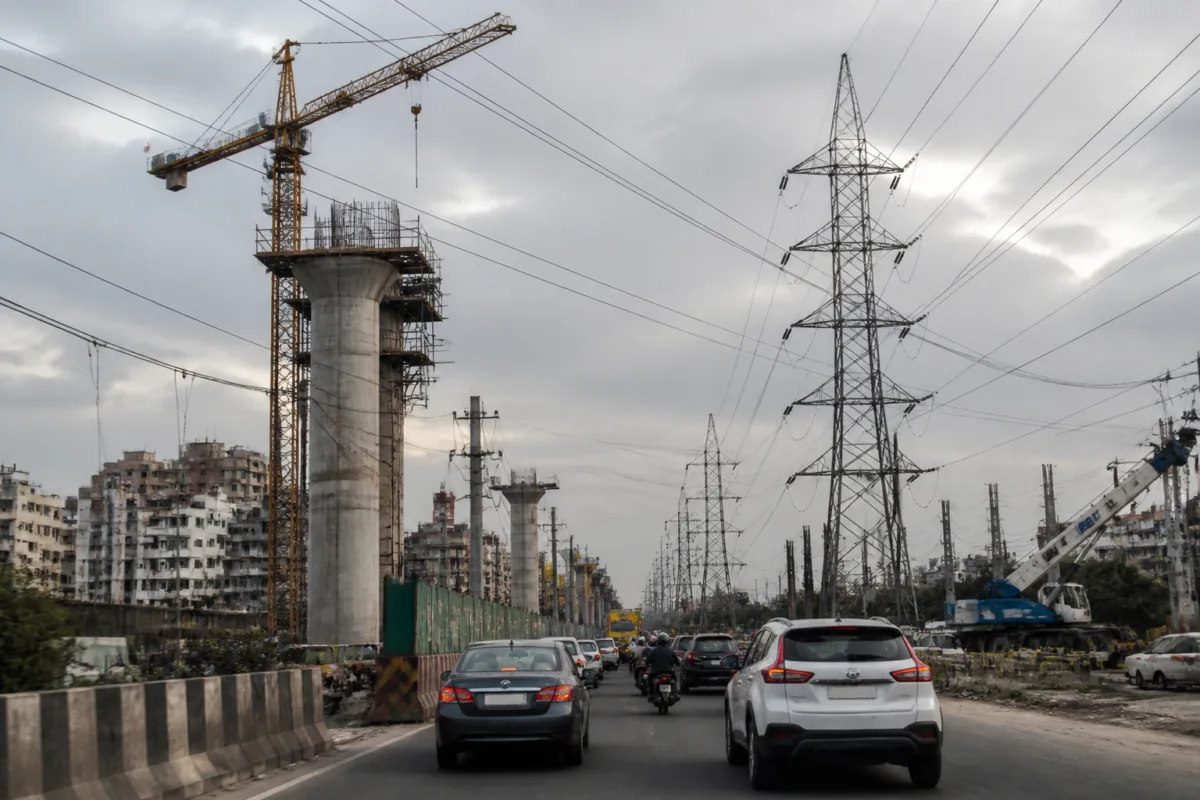
The Old Gurugram Metro is facing a fresh construction setback near Hero Honda Chowk after the National Highways Authority of India (NHAI) declined to shift a 66kV high-tension power line that had been assigned to it under an earlier coordination decision. The dispute is not an isolated technical issue: it exposes how multiple land, utility and administrative dependencies can slow a metro project even after its main construction contract has been awarded.
According to a report by Live Hindustan – NCR, the power line crosses the alignment between Hero Honda Chowk and Umang Bhardwaj Chowk. The Gurugram Metro Rail Limited (GMRL) had asked NHAI to arrange the shifting work, while the cost was to be borne by the Gurugram Metropolitan Development Authority (GMDA). Haryana Vidyut Prasaran Nigam (HVPN) had prepared an estimate and submitted it to NHAI.
The issue was discussed at a meeting chaired by the chief executive officer of the GMDA on 22 December. Officials from GMRL, NHAI and HVPN attended the meeting, where it was decided that NHAI would remove the 66kV lines and GMDA would pay for the work. GMRL subsequently wrote to NHAI on 30 April seeking early action. At another meeting on 16 July, NHAI reportedly assured the participating departments that the line would be shifted by 31 October.
However, on 18 September, NHAI informed GMRL that it would not undertake the work and asked GMRL to arrange it instead. GMRL chief project manager R.P. Gupta has since written to NHAI project director Yogesh Tilak, requesting that the earlier decision be honoured.
The practical consequence is a potential reset of the utility-shifting process. If GMRL takes over the work, a new estimate would have to be prepared, followed by a tendering process. The report says this could delay construction on the section between Hero Honda Chowk and Umang Bhardwaj Chowk. The immediate issue, therefore, is not only who pays for the relocation. It is also which agency has responsibility for executing work that is essential to keeping the metro alignment clear.
This distinction matters in urban infrastructure projects. A metro corridor is built along a fixed alignment, but the land above and below it is rarely free of existing networks. High-voltage transmission lines, substations, roads, private buildings, fuel stations and other utilities can each become dependencies on the critical path. When responsibility for one such dependency changes after an estimate and timeline have already been discussed, the construction contract can continue to exist on paper while the physical work remains blocked at specific locations.
The Old Gurugram Metro project already has several such dependencies, according to the report. The 66kV line near Hero Honda Chowk is one obstruction. An HVPN substation in Sector 10 is another. NHAI is reportedly constructing a new substation in Sector 37 to enable the relocation of the existing facility. The report does not provide a completion date for that replacement substation.
Near Umang Bhardwaj Chowk, five houses in Saraswati Enclave are involved in a dispute pending before the Punjab and Haryana High Court. A CNG station on the route has also not yet been removed. These issues are materially different in legal and technical terms, but they have a common effect: each must be resolved before the relevant portion of the alignment can be constructed without interruption.
The project’s institutional structure makes coordination especially important. GMRL is responsible for developing the metro corridor, while GMDA, NHAI and HVPN control or manage different parts of the land and utility environment through which the line must pass. The reported December decision attempted to assign the execution and funding responsibilities for the 66kV line. The later refusal by NHAI has reopened that arrangement and shifted the burden back towards GMRL.
The report also points to a separate administrative complication at GMRL. A depot is planned in Sector 33 at an estimated cost of about Rs 409 crore. The tender was issued in June and five companies submitted applications. The technical and financial bids had been opened, but the process was reportedly close to award when GMRL managing director Dr Chandrashekhar Khare was transferred. Mukul Kumar, an Indian Administrative Service officer, was appointed in his place and took charge of GMRL, although approval for his appointment from the Union Ministry of Housing and Urban Affairs was still awaited, according to the report.
This means the project is dealing with two different kinds of delay at the same time. The first is physical: construction locations are affected by utilities, property disputes and a CNG station. The second is administrative: decisions relating to contracts and project management are affected by changes in leadership and pending institutional approval. The available report does not establish the duration or financial cost of either delay, but it shows that both forms of uncertainty are present while construction is underway.
The main corridor contract was awarded to Dilip Buildcon Limited. The contractor is required to build the 14-km metro route and 14 stations within 24 months. The report describes construction as progressing slowly, but it does not provide a measured percentage of work completed, a revised completion date or an updated project schedule. Those missing figures are important because an obstruction at one location does not automatically translate into a delay across the entire corridor. The extent of the impact depends on whether work can be resequenced, whether the affected sites are on the critical path and how quickly the responsible agencies resolve them.
The same limitation applies to the 66kV line. The reported 31 October target was an assurance given at a July meeting, not evidence that the relocation was completed. NHAI’s subsequent refusal indicates that the earlier arrangement did not produce implementation. The supplied report does not include the written terms of the agreement, the estimate prepared by HVPN, the reason for NHAI’s change in position or the latest construction schedule issued by GMRL.
Those gaps point to the central governance question raised by the project: how are inter-agency commitments enforced when a metro alignment depends on another public authority’s assets? Meetings can record decisions, estimates can be prepared and deadlines can be announced, but construction depends on a clear chain of authority for procurement, payment, execution and accountability. If any one of those links remains unsettled, responsibility can move between agencies while the obstruction remains physically unchanged.
The project also illustrates why utility mapping and relocation planning must be treated as core construction activities rather than supporting tasks. A transmission line or substation is not a minor site inconvenience. Its relocation involves technical design, safety clearances, an estimate, procurement, shutdown planning and commissioning of the replacement arrangement. The report’s reference to a new estimate and tender process suggests that transferring responsibility to GMRL could create a fresh procurement cycle rather than a simple handover.
For commuters, the immediate impact is that the affected section may not progress at the pace implied by the original contract. The report does not state that the entire metro project has been stopped, nor does it provide a revised opening date. It does establish that work between Hero Honda Chowk and Umang Bhardwaj Chowk is exposed to delay if the line-shifting process is restarted. The pending court case, CNG station and Sector 10 substation create additional points that will need resolution before the alignment can be completed.
The next significant developments are therefore administrative and documentary rather than promotional. They include whether NHAI accepts GMRL’s request to implement the earlier decision, whether GMRL begins a new estimate and tender process, when the Sector 37 replacement substation becomes operational, and how the court proceedings concerning the five Saraswati Enclave houses affect the route. The depot tender award and the status of approval for GMRL’s managing director will also indicate whether the project’s internal decision-making structure is stabilising.
The evidence currently confirms a project facing multiple unresolved dependencies, but it does not establish a final revised completion date or the total delay caused by them. For the Old Gurugram Metro, the immediate test is whether the agencies can convert earlier meeting decisions into executed utility shifts, cleared sites and an updated, publicly accountable construction schedule.

