


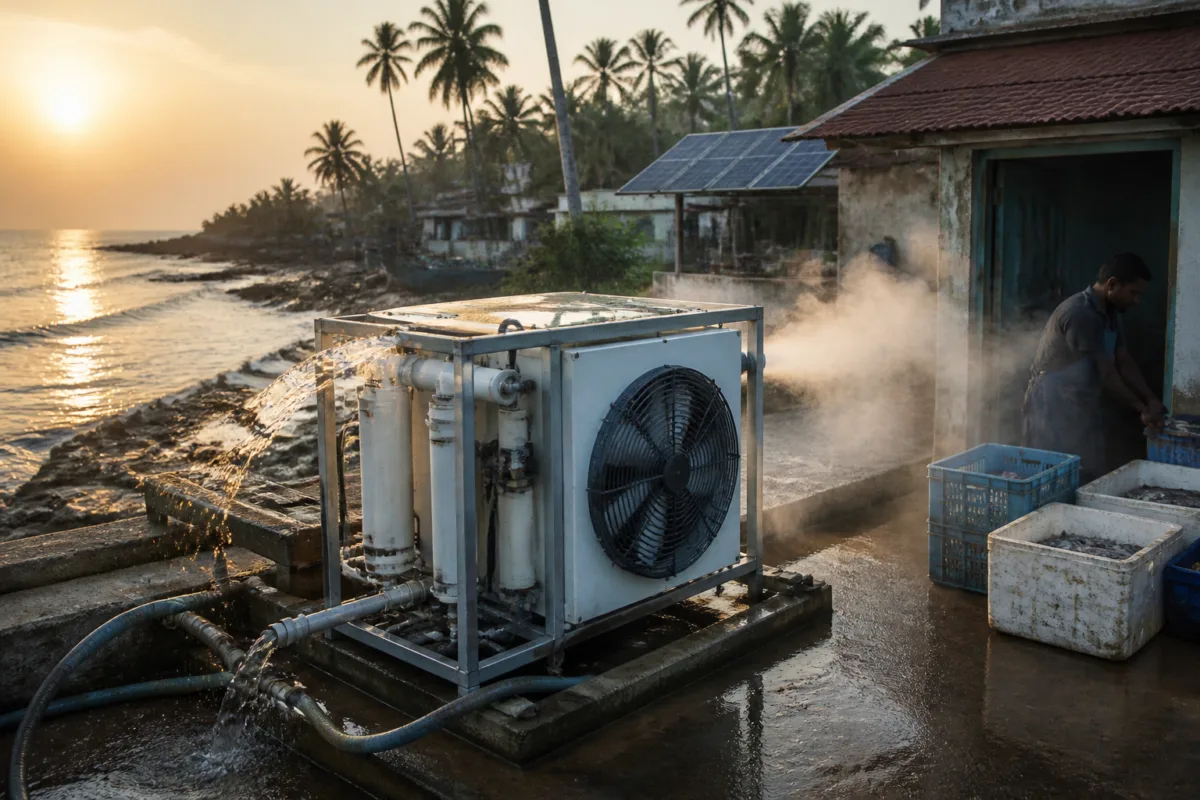
A system developed by researchers at BITS Pilani, Hyderabad, is designed to produce freshwater from seawater or brackish water while supplying cooling from the same process. The prototype could be significant for communities that face water shortages but lack reliable access to separate desalination and refrigeration equipment, although the researchers say further energy integration, climatic adaptation and field trials are still required.
The system brings together humidification-dehumidification, refrigeration and thermal energy storage in one arrangement. Its proposed applications include coastal villages, islands, rural settlements with brackish groundwater, small food-storage facilities and field hospitals. The underlying urban and infrastructure question is not simply whether seawater can be converted into freshwater, but whether a water system can also meet a second essential need—cooling—without requiring a separate installation.
According to the researchers, air is first passed through a humidification unit, where it absorbs moisture from saline or brackish water. The moisture-rich air is then cooled, causing the water vapour to condense into freshwater. The air leaving the process is cooler and contains less moisture, allowing it to be used for cooling. Prof. Sandip S. Deshmukh from the BITS Pilani Hyderabad mechanical engineering department described the process in the report supplied to Deccan Chronicle.
This arrangement changes the way the output of a desalination system is considered. In a conventional single-purpose design, the principal product is freshwater and the energy consumed by the process is a cost to be managed. In the BITS system, the researchers are attempting to use the same thermodynamic cycle to produce water and a cooling service. That does not by itself establish that the system will be cheaper or easier to operate at scale, but it gives the prototype a more specific operating proposition than a standalone desalination unit.
The prototype was fabricated and tested at the Hyderabad campus under different seasonal conditions, according to the report. Laboratory experiments under favourable high-humidity conditions showed that the double-stage configuration with water heating produced up to 12.4 litres of freshwater an hour. It also demonstrated cooling capacity of up to 6.57 kilowatts, with outlet air temperatures as low as 14°C.
Those figures are performance results under particular operating conditions rather than a guaranteed output for every location. The researchers said performance varied according to the configuration and ambient conditions. This qualification is central to understanding the technology. A system that depends on air moisture, water temperature, refrigeration and thermal storage will not operate identically in a humid coastal village, an island settlement, a dry inland location with brackish groundwater or a field hospital operating under changing weather conditions.
The researchers have designed the prototype around a target freshwater production capacity of approximately 200 litres a day. They also proposed a use case in which the system would supply about 200 litres of freshwater daily while cooling a storage facility for approximately 50 kilograms of seafood. The stated application could serve 10 families, linking water production with the preservation of a livelihood-related commodity rather than treating desalination as an isolated utility service.
That proposed combination matters because the infrastructure needs of a small settlement are often interdependent. Drinking and household water, food storage and cooling may compete for limited energy, equipment and maintenance capacity. The BITS system is intended to address more than one of those needs through a single installation. Whether that integration produces a practical benefit will depend on the reliability of the equipment, the availability of energy, the quality of maintenance and the actual water and cooling demand at the site. The supplied report does not establish those field-level outcomes yet.
The development builds on Indian Patent No. 558052, granted in 2025, for a portable solar-powered desalination apparatus. The patent names Prof. Sandip S. Deshmukh and Prof. Santanu Prasad Datta of the mechanical engineering department as inventors. Research scholar K. Sai Sandeep was involved in the subsequent research and prototype development. The patent provides an institutional and technical base for the work, while the later prototype testing indicates an effort to move beyond the original apparatus towards a combined water-and-cooling system.
The research has also been published in Applied Thermal Engineering in 2026, according to the report. Publication and patent protection establish important milestones, but neither one is equivalent to field deployment. The next phase identified by the researchers is therefore important: improving energy integration, adapting the system to different climatic conditions and conducting field trials.
Energy integration is particularly important because the system combines several processes instead of relying on a single desalination step. The researchers said the technology brings humidification-dehumidification, refrigeration and thermal energy storage together. That integration may allow equipment and energy flows to be shared, but it also creates a more complex operating system. Field testing will need to show whether the combined arrangement can maintain water and cooling performance without imposing maintenance or energy requirements that exceed the capacity of the communities it is intended to serve.
The reference to a portable solar-powered desalination apparatus is also relevant to the proposed locations. Coastal villages, islands and remote settlements may not have the same infrastructure access as large urban centres. A portable design could be useful where permanent utility networks are limited, but the report does not provide a final commercial design, deployment model, solar capacity requirement or operating schedule. Those details remain to be established through the next stage of research.
The reported cost estimate illustrates the same distinction between laboratory performance and practical deployment. The lowest estimated production cost during experiments was around 30 paise a litre. The researchers explicitly cautioned that actual costs would depend on location, energy requirements, installation and maintenance. The estimate should therefore be read as an experimental benchmark, not as a final tariff or a universal cost of desalinated water.
For public agencies and local institutions, that distinction affects how such a system would be assessed. Procurement would need to consider not only litres produced, but also cooling capacity, energy use, replacement requirements, operator skills and the quality of water delivered. A facility storing seafood would have a different operating pattern from a field hospital, while a rural settlement with brackish groundwater would face different intake and maintenance conditions from an island community using seawater. The researchers’ stated application areas are diverse, and field trials would need to test the system against that diversity.
The system also raises a broader planning issue: whether small-scale infrastructure should be designed around single outputs or combined services. The reported prototype is an attempt to combine water security and cooling within one technical arrangement. That approach could be relevant in locations where the same energy source must support several basic functions. However, the available evidence establishes the concept and laboratory performance, not its long-term reliability, institutional ownership or suitability for mass deployment.
The proposed 200-litre-a-day capacity gives the technology a defined scale. It is directed towards a small community or facility rather than a municipal water network. The stated seafood-storage example connects the output to approximately 10 families and a storage facility for about 50 kilograms of seafood. Other proposed uses—small food-storage facilities and field hospitals—suggest a distributed infrastructure model in which the system supports a defined site or group rather than replacing a centralised supply system.
This scale also helps clarify what the technology does not yet represent. The report does not say that the prototype can supply an entire village, city or industrial zone, nor does it establish that it can operate continuously under all seasonal conditions. Its demonstrated outputs were recorded in laboratory experiments, with the highest freshwater production reported under favourable high-humidity conditions. The next phase must therefore test whether the target capacity can be maintained outside the laboratory and whether the cooling benefit remains usable at the same time.
The larger urban question is how water-stressed or infrastructure-constrained communities can secure essential services when conventional networks are difficult to extend. Desalination, refrigeration and cooling are usually considered separate infrastructure categories, with different equipment, operators and energy demands. By combining them, the BITS Hyderabad research is testing whether one decentralised system can respond to linked needs. Its importance will ultimately depend less on the novelty of the mechanism than on whether the prototype can survive the operational conditions of the communities it aims to serve.
At present, the evidence confirms a patented research base, a fabricated and tested prototype, reported freshwater and cooling performance, and a target of approximately 200 litres of water a day. It does not yet confirm field deployment, commercial availability or performance across all proposed locations. The developments to monitor are the planned field trials, climate-specific adaptations and the researchers’ work on energy integration. Those steps will determine whether the dual-purpose system can move from promising laboratory results to dependable water and cooling infrastructure.

