


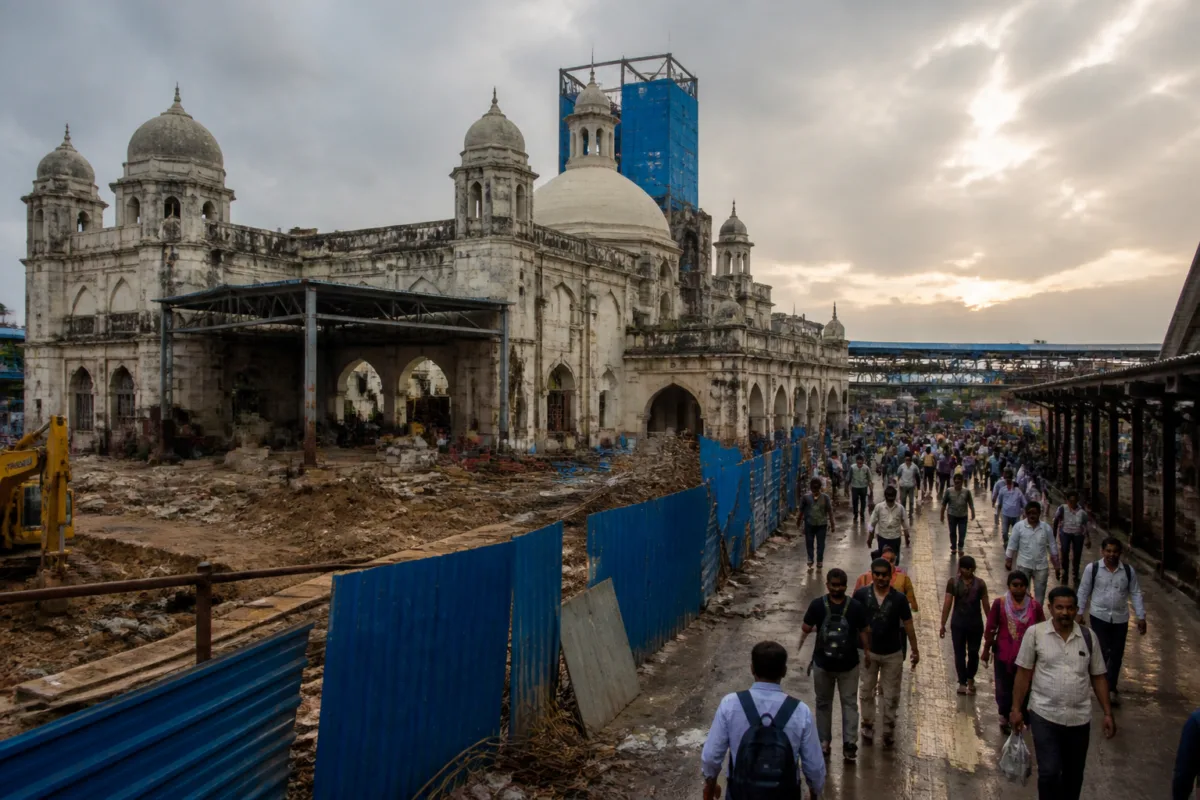
The redevelopment of Hyderabad Deccan railway station at Nampally has exposed a difficult urban question: how should a city modernise a heavily used transport hub without removing the physical history that gives the place its identity? The station’s heritage facade has been demolished as part of a ₹327-crore project under the Amrit Bharat Station Scheme, prompting concern from historians and heritage enthusiasts.
The conflict is not between development and stagnation. The station handles more than 45,000 passengers daily and is a major transport hub in the South Central Railway zone. Its redevelopment is therefore tied to a genuine infrastructure requirement. At the same time, the station’s history dates back to 1907, making the old structure part of Hyderabad’s early 20th-century railway and architectural legacy. The question raised by the demolition is whether modernisation has been planned as a replacement exercise or as an opportunity to retain and reinterpret the station’s historical identity.
The available information establishes that work began in 2024 and that approximately 25 per cent of the redevelopment project has been completed. It does not provide the project’s full design, the reasons the heritage facade could not be retained, or details of any formal heritage assessment. Those gaps are important because the physical removal of an old structure is usually irreversible, while the proposed benefits of a new building depend on how the redevelopment is designed and delivered.
The station’s age gives the debate a significance beyond the appearance of one building. Railway stations are among the few public institutions through which a city’s infrastructure history remains visible to large numbers of people. They connect transport operations with memory, architecture and the experience of arrival. In Nampally’s case, the building represented Hyderabad’s Asaf Jah-era railway heritage, according to historians cited in the report. Its value was therefore not limited to its construction materials or facade. It also lay in the connection between the station and the city’s historical development.
That connection is difficult to reproduce after demolition. A new building can incorporate symbols, architectural references or commemorative displays, but these are not equivalent to preserving an original structure. The distinction matters because heritage is not only a collection of visual motifs. It includes the relationship between a building, its setting and the generations that have used it. Preethi Amar Kumar, a school head of department, described the station’s old building as having sentimental value for generations of Hyderabad residents and argued that the new station could have been built alongside it.
Her suggestion points to the central planning choice in the Nampally project: whether redevelopment must occupy the same physical footprint as the existing heritage structure. The source material does not establish whether alternatives were studied, whether the old block was structurally unsuitable, or whether a parallel construction plan was technically or financially feasible. It does, however, show that some residents see coexistence rather than replacement as the preferred model.
Dr Mohammed Safiullah, honorary managing trustee of the Deccan Heritage Trust, Hyderabad, acknowledged the need for development and expansion while expressing regret over the demolition. He said he hoped the authorities would incorporate symbols of Hyderabad’s heritage and history into the new structure. His position reflects a compromise often sought in urban redevelopment: retain as much of the original identity as possible while meeting contemporary operational needs.
That compromise can take several forms, but the supplied report confirms only one request: that the new structure should carry elements of the city’s history. It does not say whether South Central Railway has accepted this request, released a heritage design plan or committed to specific conservation measures. As a result, the future treatment of Nampally’s identity remains an open implementation question rather than an established project outcome.
The scale of the redevelopment helps explain why the station has become a significant urban issue. A facility serving more than 45,000 passengers a day cannot be treated only as a monument. It must function as transport infrastructure, and the project is being undertaken through a national station redevelopment programme. Passenger demand, circulation, safety and operational requirements are therefore legitimate considerations. Yet the same public scale also makes the station a powerful place for communicating Hyderabad’s history. A transport hub used daily by tens of thousands of people can act as a living civic landmark if its architecture and interpretation are handled carefully.
The tension is characteristic of station redevelopment across growing Indian cities. Older railway buildings often occupy valuable sites and were designed for passenger volumes and operational patterns that have since changed. Redevelopment promises better capacity and a more contemporary passenger environment, but it can also standardise stations and weaken the distinct architectural character of individual cities. The Nampally case demonstrates how this tension becomes visible when a historic facade is removed before the public has a clear account of what will replace it.
The Amrit Bharat Station Scheme provides the administrative framework for the project, while the estimated cost of ₹327 crore indicates a substantial public infrastructure investment. The source does not specify the funding breakdown, the implementing agency beyond the railway context, the contractor, the planned completion date or the exact facilities to be created. It also does not state whether the project approval included a conservation component. These details would determine whether heritage protection was considered at the planning stage or is now being treated as a design addition after demolition.
This distinction is consequential. If heritage is integrated into the original project brief, it can influence site planning, structural decisions and the allocation of project funds. If it is introduced only after the historic structure has been removed, it may be limited to decorative references. The comments from heritage representatives show that the public conversation has moved towards the latter concern: how the new building can retain symbols of the past. The available evidence does not yet establish what institutional mechanism will convert that concern into a binding design or implementation commitment.
The project is reported to be about 25 per cent complete, which means the redevelopment remains at an intermediate stage. That creates a defined point for public scrutiny, but not evidence that the remaining work will or will not address the concerns raised. The next meaningful information would be the approved design for the new station block, any official statement on heritage incorporation, and details of how passenger operations will be managed during construction.
Nampally’s redevelopment ultimately raises a broader question about what cities choose to preserve when infrastructure is upgraded. A station can be judged by the efficiency of its services, but it can also be judged by whether its transformation respects the historical layers that made it part of the city. Hyderabad needs modern transport infrastructure, yet the case shows that modernisation alone does not settle the question of urban value.
What is confirmed is that a 1907 station with a significant passenger role is being redeveloped under a ₹327-crore scheme, that work began in 2024, that roughly a quarter of the project is complete, and that the demolition of the old facade has drawn concern. What remains unclear is how the new building will represent the station’s heritage and whether the redevelopment plan formally recognises that responsibility. Those details will determine whether Nampally becomes only a newer railway station or a modern transport hub that still makes Hyderabad’s history visible.

