


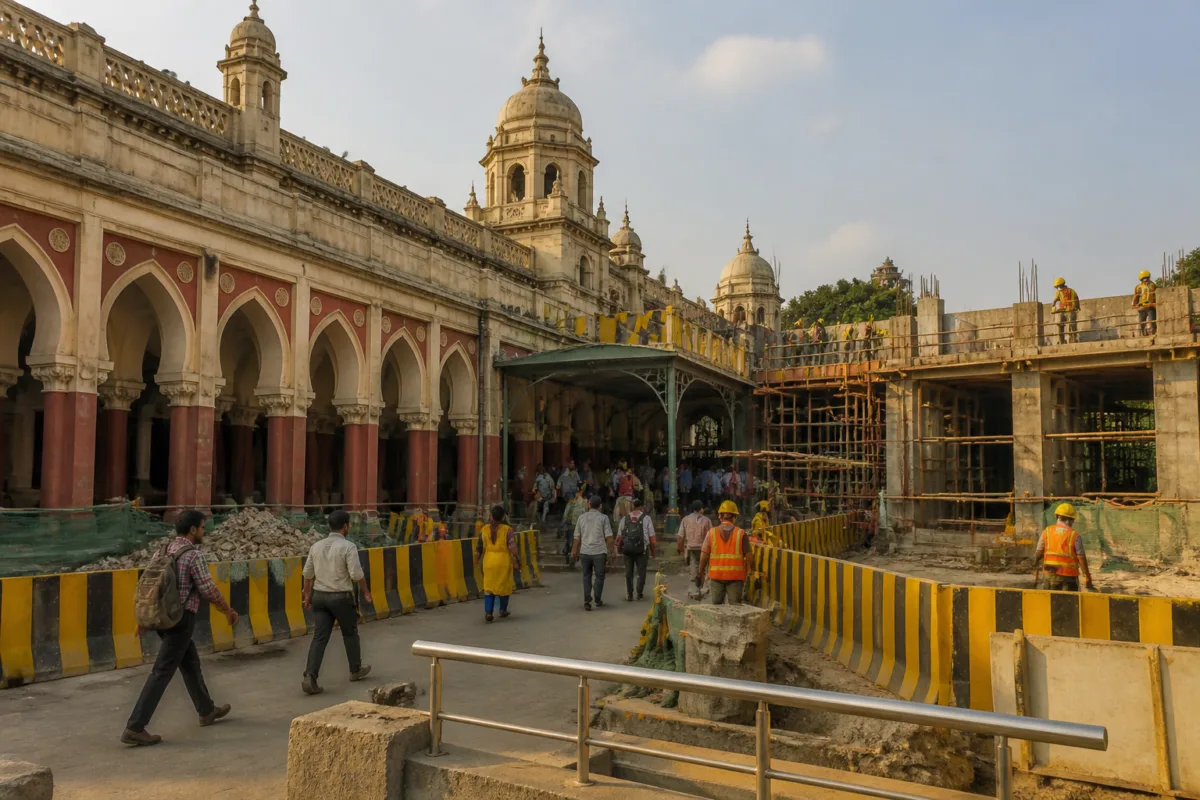
The demolition of the heritage facade at Hyderabad Deccan railway station in Nampally has turned a ₹327-crore modernisation project into a wider test of how Indian cities treat historic transport infrastructure. The redevelopment is intended to upgrade a station that handles more than 45,000 passengers daily, but historians and heritage enthusiasts fear that the removal of the old structure could also erase a visible part of Hyderabad’s early railway history.
The station’s history dates back to 1907, according to a report by Deccan Chronicle – South. Its old facade is associated with the city’s early 20th-century Asaf Jah railway heritage, making the building more than a functional transport asset. It is also an architectural record of how Hyderabad’s rail network developed and how the station became part of the city’s everyday civic life.
That distinction matters because railway stations occupy an unusual position in the urban landscape. They are infrastructure used for movement, but they are also public buildings encountered by large numbers of people every day. Unlike many heritage structures that are visited occasionally, a station remains embedded in routine journeys, memories and neighbourhood identity. When such a building is altered or removed, the change affects both the physical environment and the way residents recognise their city.
The Nampally project is being implemented under the Amrit Bharat Station Scheme at an estimated cost of ₹327 crore. Work began in 2024 and around 25 per cent of the project had been completed when the report was published. The station is described as a major transport hub in the South Central Railway zone, with daily passenger handling of more than 45,000 people.
These figures establish the operational case for redevelopment. A station with that level of use must provide infrastructure suited to contemporary passenger movement and railway operations. The source report, however, does not provide details of the new building’s design, the specific deficiencies in the existing station, the proposed facilities, or the project’s scheduled completion date. It therefore establishes that modernisation is under way, but does not allow a detailed assessment of whether the new scheme has adequately integrated heritage conservation.
That gap is central to the debate. The disagreement reported from Nampally is not presented as a simple choice between an old building and a new one. The heritage voices quoted in the report acknowledge the need for modernisation while questioning whether demolition was the only way to achieve it. Their concern is that redevelopment may remove the physical features that connect the station to Hyderabad’s architectural and institutional history.
Dr Mohammed Safiullah, honorary managing trustee of the Deccan Heritage Trust in Hyderabad, expressed regret over the demolition while accepting that development and expansion involve difficult choices. He said he hoped the authorities would incorporate symbols of the city’s heritage and history into the new structure being built in place of the old Nampally railway station block.
His comments point to the difference between preserving a building and representing its memory. Incorporating symbols into a replacement structure may retain some visual reference to the past, but it is not equivalent to conserving the original facade. The report does not specify which elements were demolished, whether any architectural components were documented or stored, or whether a formal heritage assessment preceded the decision. Those details would be necessary to determine the extent of the loss and the strength of the proposed mitigation.
The issue also reflects the institutional complexity of railway redevelopment. The project is being undertaken within the railway system and under a national station-modernisation framework, while the heritage value of the site is experienced locally by Hyderabad’s residents. Operational requirements, project execution and architectural decisions may be handled through railway institutions, but the cultural meaning of the structure extends beyond the agency responsible for its redevelopment.
The source material does not identify the approvals, heritage regulations, municipal consultations or design review processes associated with the demolition. It also does not state whether the station or its facade had a formal protected status. That distinction is important. A building can have substantial architectural and social value even when it is not legally protected, but the applicable decision-making process depends partly on its official designation and on the authorities involved.
Preethi Amar Kumar, a school head of department, described the heritage building as a structure with sentimental value for generations of Hyderabad residents. She said the old building should have been preserved and the new station constructed alongside it. Her position captures the ground-level dimension of the redevelopment: for regular residents, the station is not only an interchange or railway asset but also a familiar landmark associated with personal and family histories.
The suggestion to build alongside the old structure also raises a practical planning question: whether the redevelopment brief considered adaptive reuse, partial retention or a phased construction model before demolition. The report does not establish that these alternatives were studied or rejected. It therefore cannot support a conclusion about whether retaining the facade was structurally or operationally feasible. It does, however, show that the public debate has moved beyond opposition to change and towards the design of change.
The available numbers make the tension clear. The station serves more than 45,000 passengers daily, while the redevelopment has an estimated cost of ₹327 crore and was about one-quarter complete at the time of reporting. The first figure demonstrates the station’s continuing urban importance; the second indicates the scale of public infrastructure investment; and the third shows that the project is already under implementation rather than remaining at the proposal stage.
At the same time, the supplied report contains no before-and-after passenger capacity figures, no construction schedule beyond the statement that work began in 2024, and no breakdown of the project budget. It also contains no information on temporary passenger arrangements, accessibility improvements, circulation planning, parking, crowd management or the environmental performance of the replacement building. These omissions limit what can be said about the project’s wider infrastructure outcomes.
They also explain why heritage disputes often emerge late in the redevelopment cycle. When a project is framed primarily through cost, construction progress and passenger capacity, the architectural value of the existing structure may receive less attention than operational targets. Once demolition begins, the question is no longer whether the building should be modernised but whether the historic fabric can still be retained. At that point, the room for compromise may be narrower.
The Amrit Bharat Station Scheme provides the policy setting for Nampally’s redevelopment, but the report does not describe the scheme’s specific heritage provisions or the design standards applied at this station. Without those details, it is not possible to assess whether the project reflects a broader national approach to historic stations or a site-specific decision. The case nevertheless shows why station modernisation requires coordination between infrastructure planning and heritage management.
For cities, the larger question is not whether every old station can remain unchanged. Transport infrastructure must respond to safety, capacity and access requirements. The more difficult question is whether modernisation can be planned so that the operational performance of a station improves without treating its historic identity as an obstacle. That may involve retaining significant elements, recording them before alteration, reusing parts of the old structure or incorporating historically accurate design references, depending on the site’s physical and legal conditions.
At Nampally, the report confirms that the old facade has been demolished, redevelopment is under way and concern has been raised by historians, heritage advocates and residents. It does not establish the final design of the replacement building, the official response to the concerns, or the precise heritage safeguards attached to the project. Those are the developments that will determine whether the station’s history survives only through symbolic references or remains legible in the built environment itself.
The next stage of scrutiny should therefore focus on the redevelopment plan, the treatment of the station’s heritage elements and the authorities’ response to calls for historical representation. With the project reported to be around 25 per cent complete, the remaining construction process will show how Hyderabad balances the demands of a busy railway hub with the responsibility to retain the architectural memory embedded in one of its oldest stations.

