


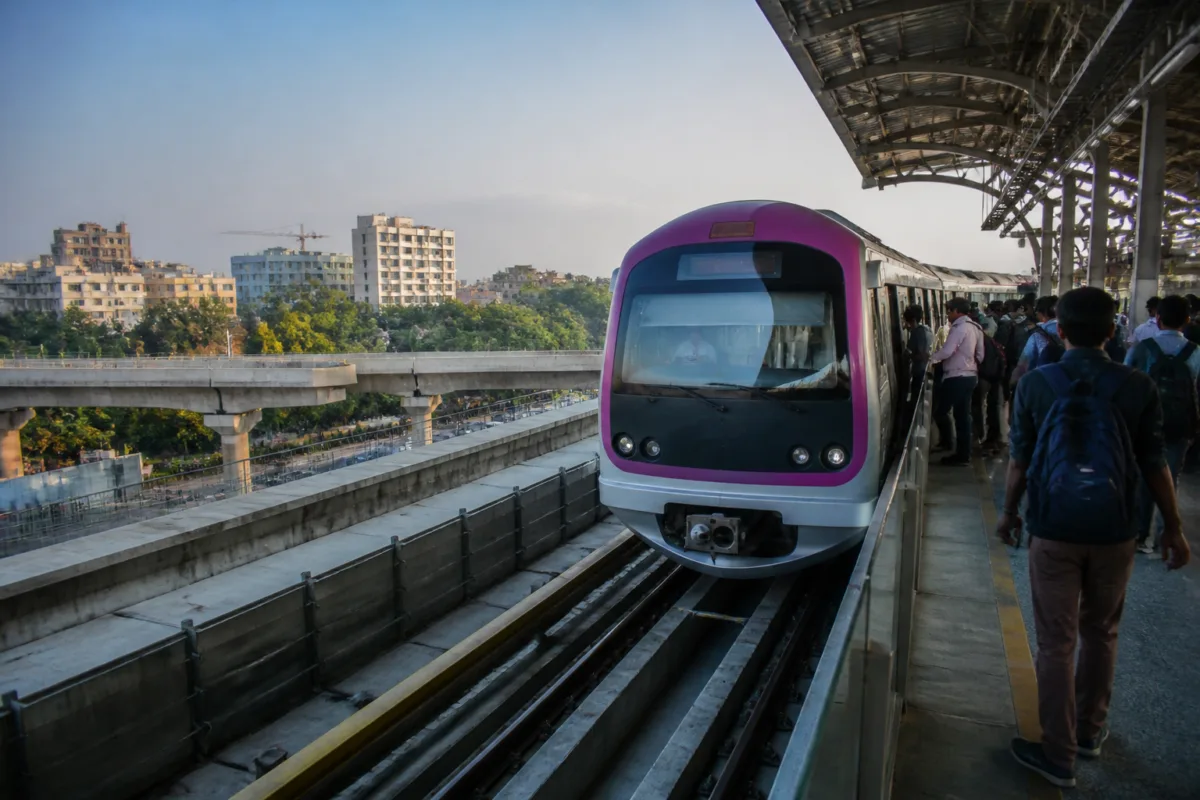
Bengaluru’s Pink Line Metro began public operations on its elevated section on Saturday, giving residents between S.G. Palya and Kalena Agrahara a new alternative to buses and cars and drawing commuters who travelled on the route out of curiosity and convenience.
Minister Krishna Byre Gowda welcomed passengers with roses at S.G. Palya station in the morning, while Chief Minister D.K. Shivakumar travelled on the Metro in the evening. Metro staff also handed flowers to passengers during the first day of public operations.
The operational section runs 7.5 km from S.G. Palya to Kalena Agrahara, with six stations. The stations are S.G. Palya, Jayadeva Hospital, N.S. Palya–JP Nagar 4th Phase, Bilekahalli–IIMB, Hulimavu and Kalena Agrahara. The station earlier referred to as Tavarekere has been renamed S.G. Palya after the local area.
The fare for the full 7.5-km stretch has been fixed at ₹30, while travel between adjacent stations costs ₹10. Trains operate every eight minutes during peak hours and every 10 minutes during other periods, according to the report. The section had previously required many commuters to depend on buses or private vehicles.
Passengers interviewed at the stations described shorter journeys and easier access to destinations around IIMB, JP Nagar and Kalena Agrahara. A resident near IIMB said the new station was about half a kilometre from her home and made travel more convenient. Students travelling from the Kalena Agrahara area said the Metro took about eight minutes for a journey that could take around 30 minutes by bus, while also costing less than the bus fare in their case.
The first day saw a festive atmosphere, with several passengers wearing pink clothes and taking photographs with the minister. However, the report noted that crowding was limited because the day was the second Saturday of the month. Some passengers travelled specifically to experience the new line, while others used it instead of buses.
Byre Gowda said efforts would continue to start full operations on the Pink Line from Dairy Circle through M.G. Road to Nagawara at the earliest. The currently opened section is part of the longer corridor intended to connect south Bengaluru with central and northern parts of the city.
Shivakumar also said Karnataka stones had been used in the construction of the Pink Line stations. He referred to stone sourced from locations including Ramanagara, Tumakuru, Sira, Badami, Ilkal, Kanakapura, Magadi, Kollegala and Mulagund, saying the decision was intended to support the state’s stone industry.
The next major milestone for passengers will be the start of continuous operations across the remaining Pink Line sections towards Dairy Circle, M.G. Road and Nagawara. The report did not specify a final public opening date for the full corridor.

