


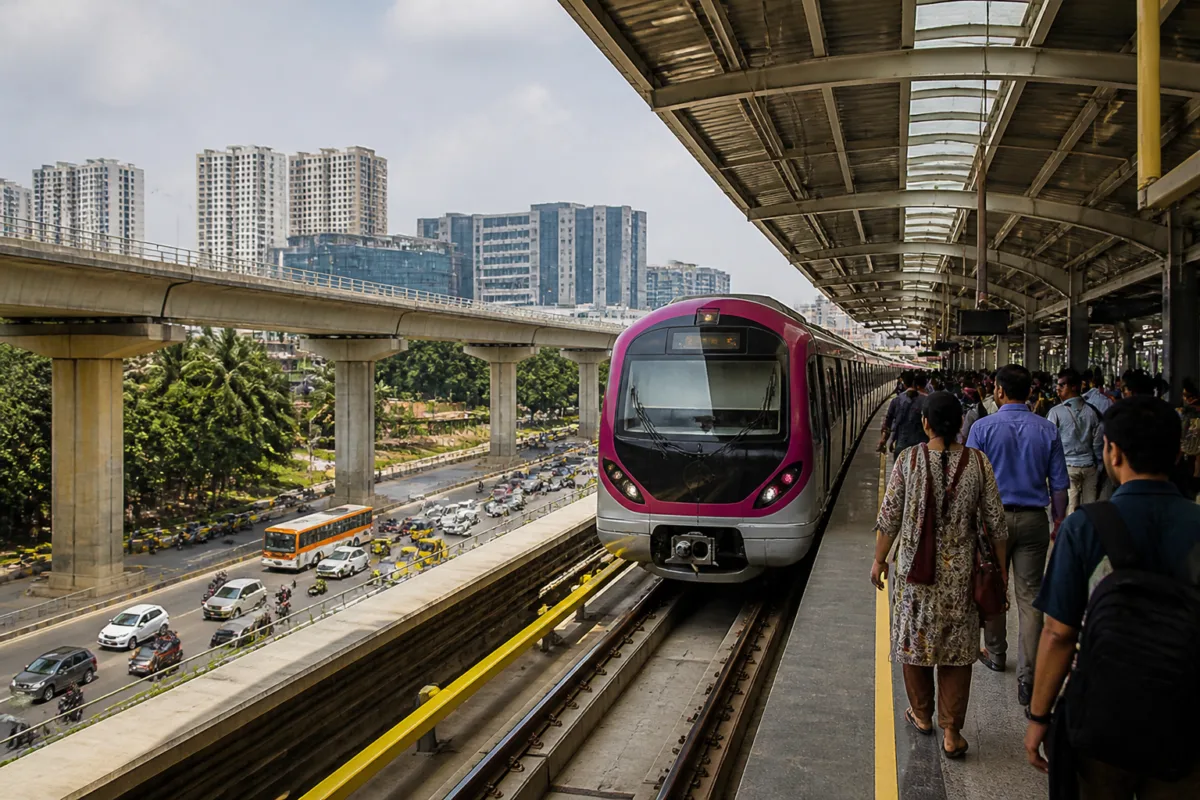
The opening of Bengaluru’s Pink Line has delivered an immediate improvement for residents along Bannerghatta Road, but the first operational stretch also exposes the limits of launching a metro corridor in pieces. Commercial services between Kalena Agrahara and SG Palya began at 6am, giving commuters a 7.5-km route that some passengers completed in about 10 minutes. Yet the larger benefits expected from the corridor depend on the remaining underground section, better interchanges and reliable connections beyond the stations.
For residents who watched construction begin while they were still in school, the service is not simply another addition to Bengaluru’s expanding metro network. The opening represents the completion of one part of a project that has shaped daily movement, road conditions and neighbourhood expectations for nearly a decade. Passengers quoted in the report described years of dust, potholes, diversions and disruption around Bannerghatta Road and the Jayadeva Interchange station.
That history matters because urban infrastructure is experienced in two distinct phases. During construction, residents absorb the costs of barricades, traffic changes and damaged or constrained road space. Once the system opens, the public expects the investment to repay those costs through faster, more reliable and more comfortable journeys. The Pink Line’s first stretch is already producing that benefit, but its current reach does not yet match the corridor’s full intended value.
Construction began in 2017, with completion initially scheduled for 2021-22. The project missed several deadlines, with the report attributing part of the delay to the previous contractor, Simplex, which failed to execute the work according to contractual terms. The gap between the original schedule and the eventual opening illustrates a recurring problem in large urban projects: the public announcement of a corridor is often treated as the arrival of a service, even though construction, contracting, systems integration and operational readiness can extend over several years.
The Pink Line therefore offers a useful view of how delivery delays affect a city beyond the project’s formal cost and schedule. Residents along the corridor did not experience the delay as an abstract administrative failure. They experienced it through prolonged road congestion, construction diversions and uncertainty about when the promised alternative would become usable. The first train has ended some of that uncertainty for passengers within the operational section, but not for those waiting for stations farther towards central Bengaluru.
The strongest evidence of the line’s immediate value is the difference between road and rail travel times reported by passengers. One commuter said the journey from Kalena Agrahara to SG Palya took 10 minutes, compared with at least 45 minutes by road on weekdays. Another passenger said a road trip of around 4 km from Kalena Agrahara to JP Nagar, where he worked, could take about 40 minutes. These accounts are individual experiences rather than a system-wide performance assessment, but they show why even a short operational section can matter in a congested corridor.
The fare structure also places the service within the everyday travel budgets of local commuters. Fares on the operational section range from Rs 10 to Rs 30 depending on distance. The usefulness of that pricing, however, depends on whether passengers can reach stations conveniently and complete their onward journeys without facing a large additional cost in time, money or walking distance. A lower rail fare cannot by itself make a trip affordable if access to the station remains difficult or the final connection is unreliable.
This is where the Jayadeva Interchange becomes important. With the Pink Line opening, the interchange connecting it with the Yellow Line is fully operational. The Yellow Line links towards Electronics City, and Greater Bengaluru development minister Krishna Byre Gowda said the Pink Line is expected to increase ridership on that corridor. An additional train was scheduled to be deployed on the Yellow Line during the week to improve frequency.
The interchange creates a network effect that a standalone corridor cannot provide. The Pink Line can carry passengers from Bannerghatta Road towards the Yellow Line, while the Yellow Line can extend the reach of the trip towards Electronics City. But the report also records an early weakness: commuters found transfers between the two lines difficult and asked for better signage. This is a small operational detail with a large practical consequence. A metro network is only as legible as its interchanges. If passengers cannot easily identify platforms, exits and onward routes, the physical connection does not translate into a seamless journey.
Bangalore Metro Rail Corporation Ltd has attempted to address part of this broader journey through passenger information. For the first time, the report says, a station information system displayed onward bus services and estimated arrival times. At SG Palya, passengers could see information on buses heading towards KR Market, Majestic and the international airport, among other destinations. The Bangalore Metropolitan Transport Corporation has also announced five dedicated feeder services for the Pink Line.
These measures indicate that the metro’s performance will not be determined only by trains, stations and track. It will also depend on the quality of the public transport system around those assets. Feeder buses, station signage and pedestrian access determine whether a station functions as part of a network or as an isolated transport facility. The report records passenger demands for better last-mile connectivity and proper footpaths around stations, showing that the first operational day exposed access problems alongside the benefits of faster travel.
The unfinished underground section is the clearest limit on the line’s present impact. Several passengers said opening the remaining stretch should be prioritised, particularly for access towards MG Road and stations such as Cantonment. They argued that the extension would connect more residents to the central business district and improve links towards other parts of Bengaluru. Byre Gowda said the government was working towards commissioning the remaining stretch in seven to eight months.
That proposed timeline is the next major test for the corridor. The source does not provide a detailed completion schedule, construction status or explanation of the remaining work, so the precise basis for the seven-to-eight-month estimate is not established in the supplied material. What is clear is that the current opening has created demand for the rest of the line. The first section has demonstrated the time savings that the full corridor could offer, increasing the pressure to complete the underground section without repeating the delays that marked the project’s earlier phases.
The Pink Line also shows why metro expansion should be assessed through network completion rather than route length alone. A 7.5-km section can provide meaningful relief when it serves a congested corridor, but its wider usefulness grows when it connects with other lines, reaches major destinations and integrates with buses and walking routes. In this case, the operational interchange with the Yellow Line is already expanding the line’s potential, while the incomplete connection towards central Bengaluru continues to constrain it.
For residents, the opening has transformed a construction corridor into a working transport option. For the city’s institutions, it has shifted the challenge from building the line to operating a connected system. BMRCL must manage passenger movement and interchange information; BMTC must make feeder services dependable; and the authorities responsible for roads and public spaces must ensure that stations can be reached safely and conveniently. The report confirms these institutional links, but it does not provide performance data on frequency, ridership, interchange times or feeder-bus reliability.
The evidence therefore supports two conclusions. First, the Pink Line’s initial section is already producing substantial time savings for some Bannerghatta Road commuters at fares ranging from Rs 10 to Rs 30. Second, the corridor’s full urban value remains dependent on unfinished construction, easier transfers, functioning feeder services and better last-mile infrastructure. The next development to monitor is the commissioning of the remaining underground stretch, which the government has said could take place within seven to eight months.

