


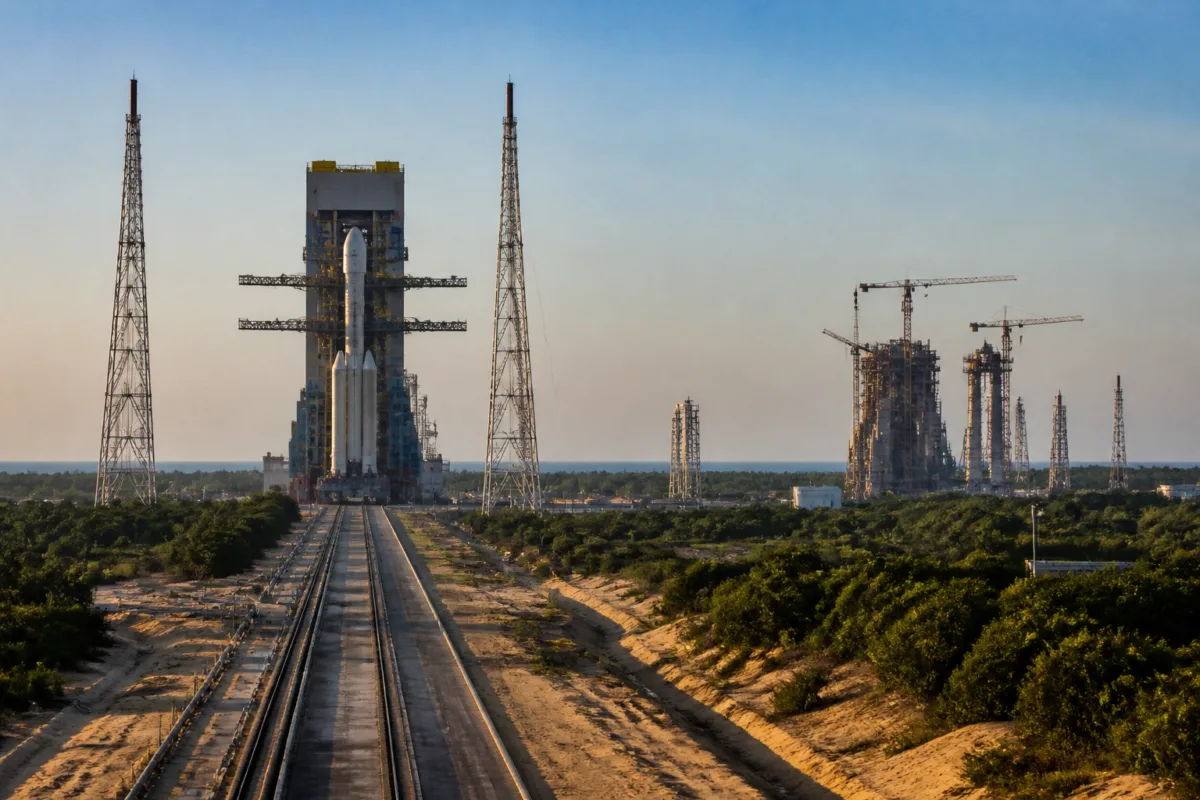
The development of the Kulasekarapattinam Spaceport is being presented not as a replacement for Sriharikota, but as an expansion of India’s launch infrastructure. The distinction matters because it points to a two-centre model in which the Satish Dhawan Space Centre at Sriharikota continues to handle major launch programmes while the new facility in Tamil Nadu adds capacity for selected missions, particularly small-satellite launches into Sun-synchronous polar orbits.
According to a report by Deccan Chronicle, neither the Indian Space Research Organisation nor the Department of Space has indicated any plan to shift major launch programmes from Sriharikota to Kulasekarapattinam. Sources at SDSC-SHAR said Sriharikota would continue to handle launches involving the Polar Satellite Launch Vehicle, Geosynchronous Satellite Launch Vehicle and Launch Vehicle Mark-3. The centre would also remain important for Small Satellite Launch Vehicle missions requiring inclined orbits.
That position places Sriharikota at the centre of India’s established launch architecture even as a second spaceport takes shape. The reported arrangement is not a simple transfer of work from one site to another. Instead, it reflects an attempt to match launch locations and trajectories with the operational requirements of different missions. Kulasekarapattinam’s stated advantage is its ability to support a near-direct southward path over the sea, improving efficiency for SSLV launches into Sun-synchronous polar orbits.
The urban and infrastructure significance lies in this functional separation. Large national facilities are often discussed as isolated engineering projects, but their value depends on how they fit into a wider institutional network. In this case, the new spaceport is being developed with technical support from SDSC-SHAR, according to information cited in the report. That suggests that the expansion is being built through knowledge and systems links with the existing spaceport rather than as an entirely separate operating ecosystem.
This relationship also helps explain why the continued importance of Sriharikota is central to the story. If a second launch complex were understood only as a rival facility, the public discussion could focus narrowly on location and construction. The information available instead indicates a complementary arrangement. Sriharikota remains the principal spaceport for major launch programmes, while Kulasekarapattinam is intended to add specialised capacity and improve the system’s ability to respond to rising demand for smaller launches.
The reported division of roles is particularly relevant to the Small Satellite Launch Vehicle. The SSLV Launch Complex at Kulasekarapattinam is being established to meet growing launch demand, including launches by private-sector enterprises. The report links the facility to India’s effort to improve the competitiveness of its small-satellite launch services. It also identifies additional opportunities for private players as one of the expected outcomes of expanding launch infrastructure.
The evidence supplied does not establish the number of launches that the new spaceport will handle, the precise commissioning date of its facilities, or the financial value of the construction programme. It does, however, identify several stages of physical development. Official information cited by Deccan Chronicle indicates that land acquisition has been substantially completed, site development works are over, and construction of major technical facilities has commenced. These details show that the project has moved beyond a purely conceptual proposal, while also indicating that important work remains before the facility becomes operational.
The institutional design is as important as the physical construction. The report says several key systems and facilities at Kulasekarapattinam are being designed and developed with technical support from SDSC-SHAR. This creates a direct operational connection between the established centre and the new one. It also indicates that the expansion of launch capacity is being managed through existing technical capabilities rather than through a complete duplication of institutional expertise.
For Sriharikota, the immediate implication is continuity rather than contraction. The centre is expected to retain responsibility for PSLV, GSLV and LVM3 programmes, according to the sources cited in the report. Its role in SSLV missions requiring inclined orbits is also expected to continue. This means that the addition of Kulasekarapattinam does not remove the need for Sriharikota’s launch infrastructure or technical base. Instead, the new facility may allow the national launch system to assign certain missions more efficiently while preserving the established centre’s responsibilities.
For Kulasekarapattinam, the stated proposition is more specialised. Its geographic advantage is linked to launch paths over the sea and to missions involving Sun-synchronous polar orbits. The report does not provide a comparative assessment of operating costs, turnaround times or the exact efficiency gains involved. Therefore, the claim that the location would improve launch efficiency should be understood as the rationale for the project, not as a demonstrated performance outcome already established in the supplied evidence.
The infrastructure model also has consequences for the participation of private companies. A dedicated SSLV launch complex is being established at a time when the report says demand for small-satellite launches is growing. The facility is expected to create additional opportunities for private-sector enterprises, but the source does not specify which companies would use it, how access would be allocated, or what commercial framework would govern operations. Those details will be important in determining whether added physical capacity translates into a more competitive launch-services market.
This is where the project’s significance extends beyond the construction of another national facility. Launch infrastructure has a long development cycle and depends on coordination between land, site development, technical systems, safety arrangements and launch operations. The reported completion of land acquisition and site development addresses two early requirements, while the start of major technical construction marks a further step. The remaining sequence of system development, integration and operational readiness is not described in the supplied material and should not be assumed to be complete.
The two-spaceport arrangement also raises a question about capacity planning. If Sriharikota continues to manage major launch programmes and selected SSLV missions, while Kulasekarapattinam takes on suitable polar-orbit launches and private-sector activity, the overall system could gain flexibility. However, the available report does not provide the baseline number of launches at Sriharikota, the additional capacity planned at Kulasekarapattinam, or the projected demand against which the new facility is being sized. Without those figures, the scale of the capacity increase cannot yet be measured.
What can be established is the direction of infrastructure policy described in the report: India is expanding rather than relocating its launch network. Sriharikota remains the country’s principal spaceport, and Kulasekarapattinam is being developed as a complementary facility. The technical support flowing from SDSC-SHAR to the new complex reinforces that interpretation. It points to an incremental expansion in which the established centre continues to anchor the system while the newer site is designed around specific orbital and market requirements.
The project’s public significance will ultimately depend on implementation milestones that are not yet fully detailed in the supplied information. The progress of technical-facility construction, the completion of key systems, the formal readiness of the SSLV launch complex and the participation of private-sector operators will determine how the proposed division of roles works in practice. The report confirms that major development activity has begun, but it does not establish an operational launch date.
The evidence therefore supports a measured conclusion. Kulasekarapattinam is not currently described as replacing Sriharikota. It is being built to expand India’s launch infrastructure, support selected SSLV missions and create room for private-sector participation, while Sriharikota continues to handle the country’s principal launch programmes. The next important indicators will be the completion of the new facility’s technical systems and the eventual demonstration of how the two spaceports divide operational responsibilities.

