


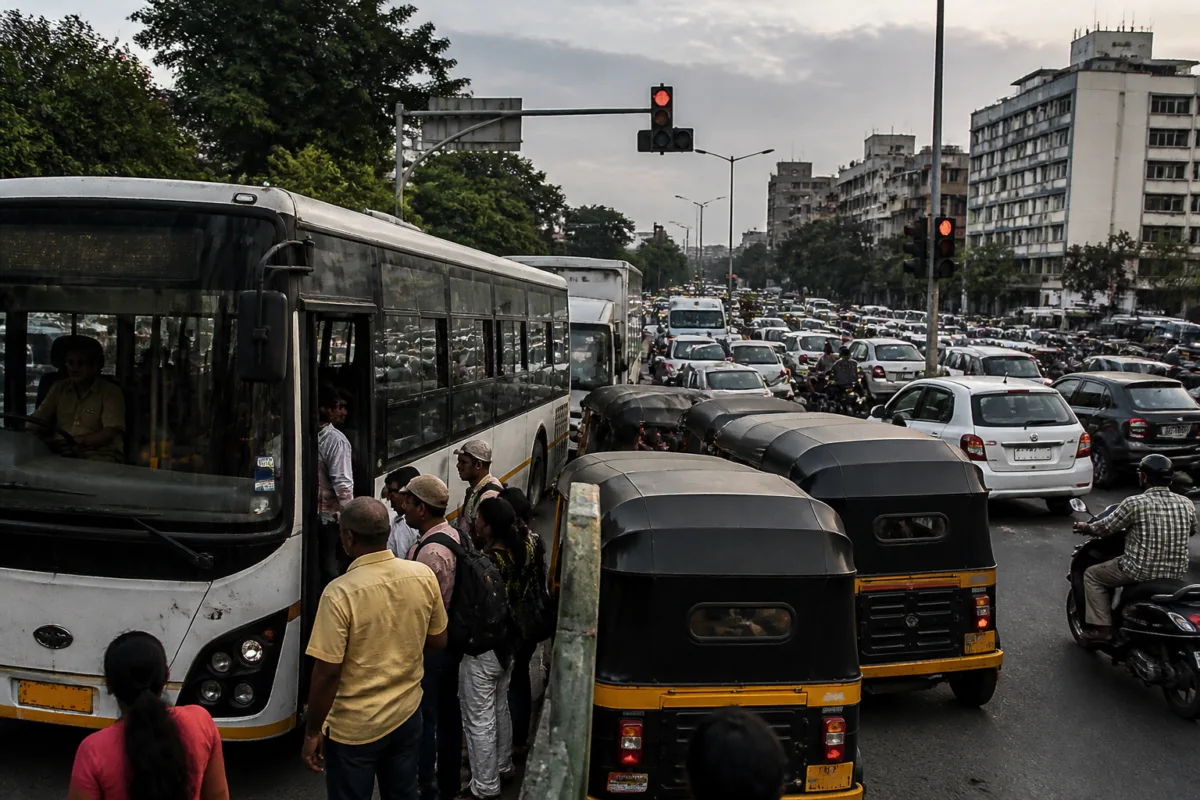
Pune’s traffic congestion problem is no longer only a question of vehicle volumes or road capacity. A joint survey by the Pune Municipal Corporation, the Regional Transport Office and the traffic police has identified bus stops located too close to signal junctions, crowded auto-rickshaw stands and unauthorised parking as direct obstacles. Yet the proposed relocation and redesign of these stops remains pending because the required proposal has not received final approval from the transport authorities.
That gap between identifying a problem and changing the street is central to how Pune’s transport system functions. The city’s agencies have completed the diagnostic exercise, identified stretches where stops interfere with traffic movement and proposed bus bays and relocations. However, implementation is still dependent on an administrative decision. Until that decision is taken, commuters and road users continue to experience the same bottlenecks that the survey was intended to address.
The reported problem is concentrated on major roads, junction approaches, turning points and areas near traffic signals. Buses stopping at these locations leave vehicles behind them with limited room to pass. Motorists often attempt to overtake from the right, creating conflict with vehicles moving through the junction or turning into adjoining roads. The result is not only slower traffic but also a higher risk of collisions and disputes between bus drivers and other road users.
The issue becomes more complicated around bus stops because public transport does not operate in isolation. Auto-rickshaws gather near stops, passengers board or alight from vehicles that may stop within the carriageway, and unauthorised parking reduces the usable road width. A bus stop that appears to be a small roadside facility can therefore become a point where several transport systems compete for the same space.
Pune’s auto-rickshaw growth has intensified this pressure. According to the report, the city had about 50,000 rickshaws earlier, but the number has now increased to nearly two lakh. The report also states that Pune has more than 1,000 auto-rickshaw stands. These figures do not by themselves establish how much each stand contributes to congestion, but they show the scale of the street-management challenge facing the city’s transport agencies.
The proposed response is not simply to remove stops. The joint exercise has recommended shifting bus stops and auto-rickshaw stands, creating some new stops and developing separate bus bays on selected roads. The roads identified for attention include Karve Road, Paud Road, Ganeshkhind Road, Shivajinagar Road, Pune-Solapur Road and the Kharadi bypass. The survey reportedly found that bus stops within 50 metres of signal junctions were obstructing traffic and should be considered for relocation.
That 50-metre criterion is significant because it converts a broad complaint about congestion into an operational rule that agencies can apply to individual locations. It gives the administration a basis for identifying stops that interfere with junction movements. But a distance rule alone cannot resolve every problem. The practical outcome will also depend on whether a relocated stop remains accessible to passengers, whether buses can pull out safely, whether pedestrians can reach it without crossing dangerous traffic and whether the new location has enough space for waiting passengers and rickshaws.
The source report does not provide a detailed list of the stops covered by the survey, the proposed replacement locations, the number of bus bays planned or a completion schedule. That information matters because relocation can shift congestion rather than eliminate it. Moving a stop away from a signal may improve vehicle flow at one point while creating a new obstruction farther along the road if the replacement site lacks adequate space or enforcement.
Pune’s infrastructure changes have also altered the location of older stops. Metro construction, road widening and other public works have led to the shifting of several established bus and auto-rickshaw stops, according to the report. Such changes can leave the city with a fragmented network in which stop locations are determined by construction constraints or available roadside space rather than by a coordinated public transport plan.
This is where the institutional structure becomes important. The municipal corporation is responsible for roads and has prepared a survey report identifying congestion causes and possible measures. The traffic police are involved in studying traffic movement and have forwarded a related proposal through the deputy commissioner of police, traffic branch. The Regional Transport Office or the relevant regional transport authority must approve the proposal before physical implementation can begin.
The arrangement reflects a common governance problem in urban transport: the agency that identifies a street-level engineering solution may not be the agency that can authorise changes affecting regulated vehicles and transport operations. Municipal engineers can identify the need for a bus bay, traffic police can document the obstruction and enforcement officers can manage movement, but implementation still depends on coordination across administrative jurisdictions.
The comments attributed to Additional Commissioner of Police Manoj Patil indicate that the proposal covers shifting bus stops and auto-rickshaw stands, as well as creating some new stops. Patil said the measures could help reduce traffic problems but that approval from the Regional Transport Office was still pending. Pune Municipal Corporation road department head Rajesh Bankar said the corporation had completed its survey and submitted the report to the traffic police, with further action to be taken in coordination with them.
These statements establish the current administrative sequence: survey, report submission, inter-agency coordination, regulatory approval and then implementation. The delay is occurring between the proposal and the approval stage. The supplied report does not state when the proposal was submitted, whether the Regional Transport Office has sought modifications or when a decision is expected. Without those details, the length and precise cause of the delay remain unclear.
The data available in the report nevertheless points to a structural mismatch between demand and street design. The number of rickshaws has expanded substantially, while major roads continue to accommodate buses, private vehicles, pedestrians, construction activity and parking. At the same time, older stop locations have been disturbed by metro and road projects. The result is a transport network in which roadside space is carrying functions that require separation but remain physically concentrated in the same corridors.
Bus-stop design is therefore a capacity issue as much as a traffic-management issue. When buses stop in live traffic lanes, the effective road capacity falls even if the formal width of the road has not changed. When rickshaws wait immediately behind or beside buses, the obstruction becomes wider and less predictable. When parking occupies the remaining space, drivers are forced to merge around stationary vehicles, increasing friction at precisely the points where traffic is already slowing.
The public consequences are distributed across different groups. Bus passengers may benefit from shorter travel times if stops are better located and buses can enter and leave them without blocking through traffic. At the same time, passengers could face longer walking distances or more difficult road crossings if relocation is planned only from the perspective of vehicle movement. Auto-rickshaw users and drivers may also be affected if stands are moved without providing safe waiting and boarding space.
The report does not include pedestrian counts, crash data, bus-delay figures or before-and-after traffic measurements. It therefore cannot establish which proposed locations would deliver the largest improvement or whether the 50-metre standard is sufficient across all road types. Those are important evidence gaps for evaluating the plan once the authority releases its detailed implementation proposal.
The immediate question is no longer whether Pune’s bus stops and rickshaw stands contribute to congestion. The joint survey has already identified locations and mechanisms through which they obstruct movement. The more consequential question is whether the city’s institutions can convert that diagnosis into coordinated street-level action without weakening public transport access or shifting the problem to nearby roads.
The next formal milestone is the Regional Transport Office’s decision on the proposal. Until approval is granted, the relocation of bus and auto-rickshaw stops, the creation of new stops and the construction of separate bus bays cannot begin according to the officials quoted in the report. The quality of Pune’s response will depend on how quickly that approval is issued and whether the final plan specifies locations, responsibilities, enforcement arrangements and an implementation timetable.

