


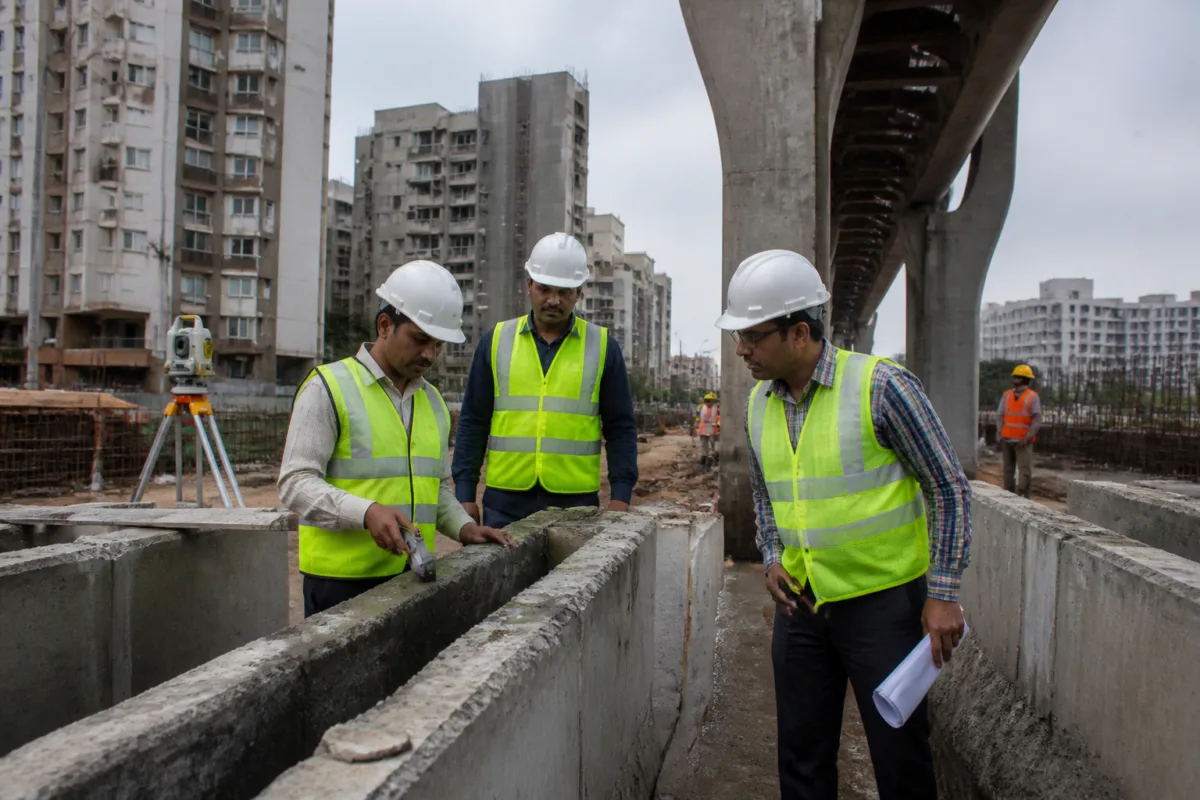
A citizens’ forum’s demand for an independent NMMC quality control department led by a full-time IIT-trained engineering expert has brought a routine municipal function into sharper focus: who verifies the quality of the infrastructure that residents ultimately use and pay for?
The Alert Citizens’ Forum has urged Navi Mumbai Municipal Corporation Mayor Sujata Patil and Municipal Commissioner Kailas Shinde to reform the corporation’s vigilance, quality-control, appointment and transfer systems. Its representations link these administrative mechanisms to three practical outcomes: the quality of civic infrastructure, the use of public money and the transparency of decision-making.
The forum’s proposals are not limited to appointing a technical adviser. It wants an independent Vigilance and Quality Control Department under the direct supervision of the municipal commissioner, headed full-time by a qualified and experienced civil or structural engineering expert from IIT Bombay or another reputed technical institution. The proposed department would inspect construction materials, conduct site assessments and laboratory tests, audit project quality and fix responsibility when work is found to be substandard.
That combination matters because quality control in public construction is not only a laboratory function. It is also an institutional question. A department must have the technical capacity to test materials and assess workmanship, but it must also have enough independence to examine projects handled by other engineering officials. The forum has specifically questioned whether NMMC’s engineering officials can independently scrutinise the work of colleagues within the same system.
The concern identified in the representation is therefore not simply whether a road, bridge, building or other civic asset meets a technical specification. It is whether the process that certifies compliance can identify failure, record it and assign responsibility without becoming an administrative formality. The supplied report does not establish that any specific NMMC project has been conclusively found defective. It does, however, show that the citizens’ forum believes the existing arrangement requires greater independence, disclosure and accountability.
The forum has also asked NMMC to publish the findings and performance report of the Quality Control Committee constituted nearly two years ago. It wants the disclosure to include the projects inspected, deficiencies identified, recommendations on defective work, action against contractors, corrective measures and accountability fixed on officials.
This demand shifts the discussion from the existence of a committee to its measurable work. A committee can be formally constituted without its activities becoming visible to residents. Publishing the number and type of inspections, the deficiencies recorded and the action taken would allow the public to understand whether the mechanism is functioning as an operational safeguard or merely as an internal administrative arrangement. The report does not state whether NMMC has accepted the demand or whether the committee’s findings have previously been made public.
The same issue of institutional visibility appears in the forum’s demands concerning appointments and transfers. It has sought regular appointments to sanctioned administrative and engineering posts according to prescribed qualifications, experience and service rules. It has also argued that additional charge arrangements should be used only when unavoidable and for a defined, limited period.
Additional charge arrangements can keep a municipal office functioning when a sanctioned post is vacant. But they can also make responsibility harder to trace if an arrangement continues without a clear end date or if the officer holding additional charge is not publicly identified. The forum has referred to NMMC’s transfer and posting order dated November 3 and sought clarification on whether the executive engineer’s post in Belapur had remained vacant for six to eight months. It has asked the corporation to identify the officer holding additional charge and the person responsible for overseeing the post’s functions.
The significance of this request lies in the connection between staffing and project oversight. Engineering departments are responsible for planning, tendering, supervision, measurement, certification and, in many cases, coordination with contractors. If important posts remain vacant or are handled through temporary arrangements, the administrative chain can become more difficult for citizens to understand. The available report does not establish that a vacancy caused any particular project failure. It records the forum’s demand that the corporation disclose the relevant arrangements and explain responsibility.
The proposed online transfer system addresses a different but related aspect of municipal administration. The forum has asked NMMC to create a computerised transfer and posting system for employees, officers and engineers, modelled on the system used by the Brihanmumbai Municipal Corporation. It has proposed objective criteria such as seniority, tenure, vacancies, administrative requirements and employee preferences.
It has further sought publication of transfer criteria, vacancies and final orders on a public portal, along with written reasons for premature transfers. According to the report, the forum believes such a mechanism could reduce discretion and political interference. That statement is the forum’s position and is not independently established in the supplied material. The broader administrative principle, however, is clear: a public transfer system becomes easier to audit when its rules, vacancies, orders and reasons are recorded in a consistent form.
The forum has also requested disclosure of administratively permissible details from the Civil Services Board meeting held on October 28, 2026, including recommendations and transfer criteria. It has recognised that disclosure would remain subject to statutory confidentiality requirements. This qualification is important because transparency in municipal administration is not the same as unrestricted publication of every personnel record. The demand is for the maximum disclosure permitted under applicable rules, while retaining legally protected information.
Taken together, the proposals describe a governance chain with four linked parts. Technical quality requires qualified personnel and testing capacity. Administrative accountability requires clear responsibility for posts and decisions. Transparency requires publication of inspections, deficiencies and corrective action. Procedural fairness requires transfers and appointments to follow stated criteria rather than remain dependent on undocumented discretion.
The supplied report does not provide NMMC’s written response to the representations, the budget required for a new quality-control department, the number of sanctioned and vacant posts, or the performance data of the existing Quality Control Committee. It also does not provide the findings of any specific laboratory test, site inspection or audit. Those gaps limit what can be concluded about the present performance of NMMC’s quality-control system.
They also identify the information that would be necessary to assess the issue more rigorously. A public record would need to show which projects were inspected, what deficiencies were found, whether contractors were directed to undertake corrective work, whether payments or penalties were affected, and whether officials were held accountable. It would also need to clarify the duration of additional-charge arrangements and the basis for transfers and postings in engineering departments.
For Navi Mumbai residents, the practical question is not only whether the corporation has a quality-control committee or vigilance function on paper. It is whether residents can follow the path from a civic project being approved to materials being tested, work being inspected, defects being recorded, corrections being completed and responsibility being fixed. Without that chain, the public can know that infrastructure has been built but may find it difficult to establish how quality was assessed.
The citizens’ forum has asked the mayor to direct the municipal commissioner to examine and implement its proposals and submit a time-bound action-taken report. Its separate representation to the commissioner seeks written responses and a definite implementation timeline. Those responses, together with the publication of the Quality Control Committee’s work and clarification of the Belapur engineering post, will determine whether the demands lead to verifiable administrative changes or remain another set of representations awaiting action.

