


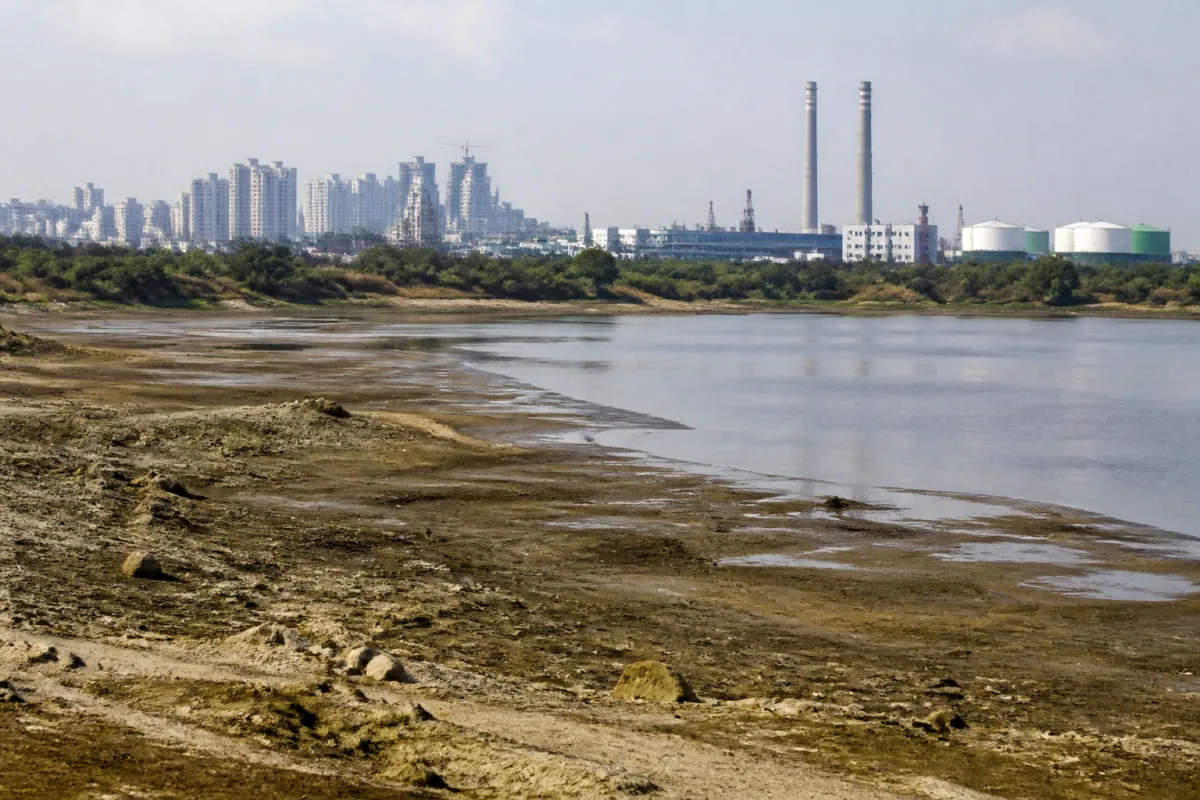
Chennai’s worsening water position is no longer only a question of whether the city will receive more rain before summer. Reservoir storage has fallen by nearly half from last year, groundwater levels have deepened sharply in several parts of the city, and Chennai Metrowater has indicated that supply rationalisation may become necessary if conditions do not improve. The immediate response is to increase desalination, but the evidence in the latest assessment points to a wider weakness: the city still lacks a sufficiently reliable system for managing both drought risk and groundwater recharge.
The five principal reservoirs supplying Chennai—Poondi, Cholavaram, Red Hills, Chembarambakkam and Kannankottai-Thervoy Kandigai—held 4.79 thousand million cubic feet on Thursday, compared with 10 tmcft on the same day last year. Their combined capacity is 11.75 tmcft, meaning current storage is about 41% of capacity. When Veeranam is included, total storage rises to 5.71 tmcft, against 10.93 tmcft last year, a decline of nearly 47%.
That comparison is significant because reservoir storage is the city’s most visible buffer against a difficult summer. A lower starting point leaves Metrowater with less flexibility if rainfall remains weak, evaporation increases or demand rises. The report does not establish that Chennai has already entered a formal water emergency, but it does show that the city is approaching the next high-demand season with considerably less surface-water security than it had a year earlier.
The pressure is also visible below ground. Average groundwater depth increased from 3.77 metres in October 2025 to 5.48 metres in October this year, a fall of 1.71 metres, or 45%. The decline was especially pronounced in Madhavaram, where the depth increased from 5.80 metres to 10.81 metres, and in Thiru-Vi-Ka Nagar, where it moved from 4.57 metres to 8.82 metres.
Groundwater measurements require careful interpretation because aquifers respond differently across locations and rainfall events can produce short-term changes. The reported city-wide level did improve by nearly a metre from the previous month. That improvement, however, does not erase the year-on-year decline. It instead highlights the unstable nature of Chennai’s water position: local recovery can occur even as the broader seasonal balance remains adverse.
The immediate cause identified in the report is inadequate rainfall. Chennai receives an average of about 120 centimetres of rain annually, while the city had received around 110 centimetres as of November 10, according to Sekhar Raghavan of The Rain Centre. The shortfall is not only a matter of annual total. The timing, intensity and distribution of rainfall determine how much water reaches reservoirs, infiltrates the ground or runs off rapidly through urban drains.
This is where Chennai’s water challenge becomes an urban systems issue rather than a simple supply deficit. Rainfall that arrives in intense bursts may produce flooding without adequately recharging groundwater or storing water for the dry season. Conversely, a prolonged period of weak rainfall can increase dependence on reservoirs and borewells at the same time. The city therefore faces a dual exposure: too much water during extreme rain events and too little usable water when rainfall is deficient.
S Janakarajan, a retired professor at the Madras Institute of Development Studies, warned that summer evapotranspiration—the combined loss of water from soil and plants—could be high. If water extraction rises faster than groundwater recharge, the aquifer deficit will deepen even if some rainfall arrives later. His assessment also raises a governance question: whether water planning is organised around annual crises instead of a continuing cycle that links rainfall forecasting, storage, recharge, demand and emergency supply.
Metrowater is relying on desalination to cushion the shortfall. Chennai’s 110 million litres per day and 150mld desalination plants supplied 100mld and 87mld respectively on Wednesday, before output rose to more than 100mld at both plants the following day. An official said both Nemmeli plants could operate at full capacity. The Minjur plant, which has a capacity of 100mld, is expected to yield at least 20mld by February, according to another senior official.
These figures show why desalination is attractive to a coastal city with variable rainfall. It provides a source that is less directly dependent on reservoir inflows and can support the distribution network during periods of shortage. The plants also offer Metrowater an operational buffer while the utility waits for rainfall or additional surface-water inflows.
But desalination does not remove the underlying water-security problem. It adds treated water to the supply system; it does not restore depleted aquifers, improve rainwater capture or reduce losses in the urban water cycle. Its usefulness therefore depends on how it is positioned within the larger system. If it is treated as a substitute for recharge, demand management and catchment protection, the city may gain short-term supply without building long-term resilience.
Janakarajan described desalination as harmful to the coastal ecosystem and argued that it could not be the city’s sole solution. The source report does not provide an assessment of the environmental impact of Chennai’s plants, so the scale of that impact cannot be established here. It does, however, record a legitimate policy tension: desalination may improve supply reliability while raising questions about energy use, brine management and the vulnerability of concentrating supply infrastructure along the coast.
Rainwater harvesting is the other major part of the debate. Raghavan said many buildings had not installed systems properly even though approvals had been granted by the Chennai Metropolitan Development Authority. He called for third-party monitors to check implementation and for a preventive plan covering both droughts and floods.
The enforcement issue is central. Chennai has long used rainwater harvesting as a policy instrument, but the existence of a requirement does not guarantee that systems are correctly designed, connected or maintained. A recharge pit that is blocked, undersized or disconnected from a building’s roof runoff may satisfy a paper requirement while contributing little to groundwater replenishment. Monitoring after construction is therefore as important as approval at the planning stage.
This also exposes the fragmented institutional structure of urban water management. Metrowater manages the public supply system, while building approvals, planning permissions and enforcement involve other public agencies and local administrative mechanisms. Residents, builders and institutions control many of the physical sites where rainwater can be captured, but the benefits of recharge extend beyond individual plots. Effective implementation consequently requires coordination between supply agencies, planning authorities, building regulators and communities.
The numbers reported from Chennai’s reservoirs and aquifers point to a mismatch between the city’s water demand and the reliability of its natural storage systems. Reservoirs are at about 41% of combined capacity, while groundwater depth in the reported comparison has worsened by 1.71 metres. Desalination output is measured in millions of litres per day, but its contribution must be considered alongside total demand, network distribution and the condition of other sources. The supplied material does not provide current city-wide demand, leakage levels or the share of supply coming from each source, so the precise size of the gap cannot be calculated from this report alone.
That missing information matters for public accountability. Residents need to know not only how much water is available at treatment plants, but also how much reaches different neighbourhoods, how supply schedules are determined and whether areas with deeper groundwater decline are being monitored differently. Without ward-level information on supply, groundwater, recharge structures and emergency action, the public sees a shortage as a general warning rather than a measurable management problem.
The report also records a difference between official confidence and expert concern. Metrowater officials said they were confident of handling the situation, pointing to the operating capacity of the Nemmeli plants and additional output expected from Minjur. Experts cited in the report were less optimistic, warning that groundwater extraction could outpace recharge and that the government needed a preventive water-security plan.
These positions are not necessarily contradictory. The utility may have enough short-term operational tools to maintain supply, while the city may still be moving in the wrong direction on aquifer health and rainfall resilience. A system can avoid immediate rationing and remain structurally vulnerable. That distinction is important because emergency supply capacity can conceal the deterioration of the natural and built systems that support the city between crises.
Chennai’s present situation therefore raises a question larger than whether the next round of rain will refill its reservoirs. It asks whether the city treats rainfall as a seasonal event or as the foundation of an integrated water system. The evidence available so far confirms a substantial year-on-year decline in reservoir storage, a significant deepening of groundwater levels and increased reliance on desalination. It does not establish how long current supplies will last, whether rationing will be introduced or how much rainfall will arrive before summer.
The next milestones are clear: rainfall through the remainder of the season, the operating performance of the Nemmeli plants, the additional output from Minjur expected by February, and the enforcement of rainwater-harvesting systems across the city. Chennai’s water security will depend not only on those immediate developments, but on whether its institutions can connect supply planning, groundwater recharge and flood-drought preparedness before the next shortage becomes an emergency.

