


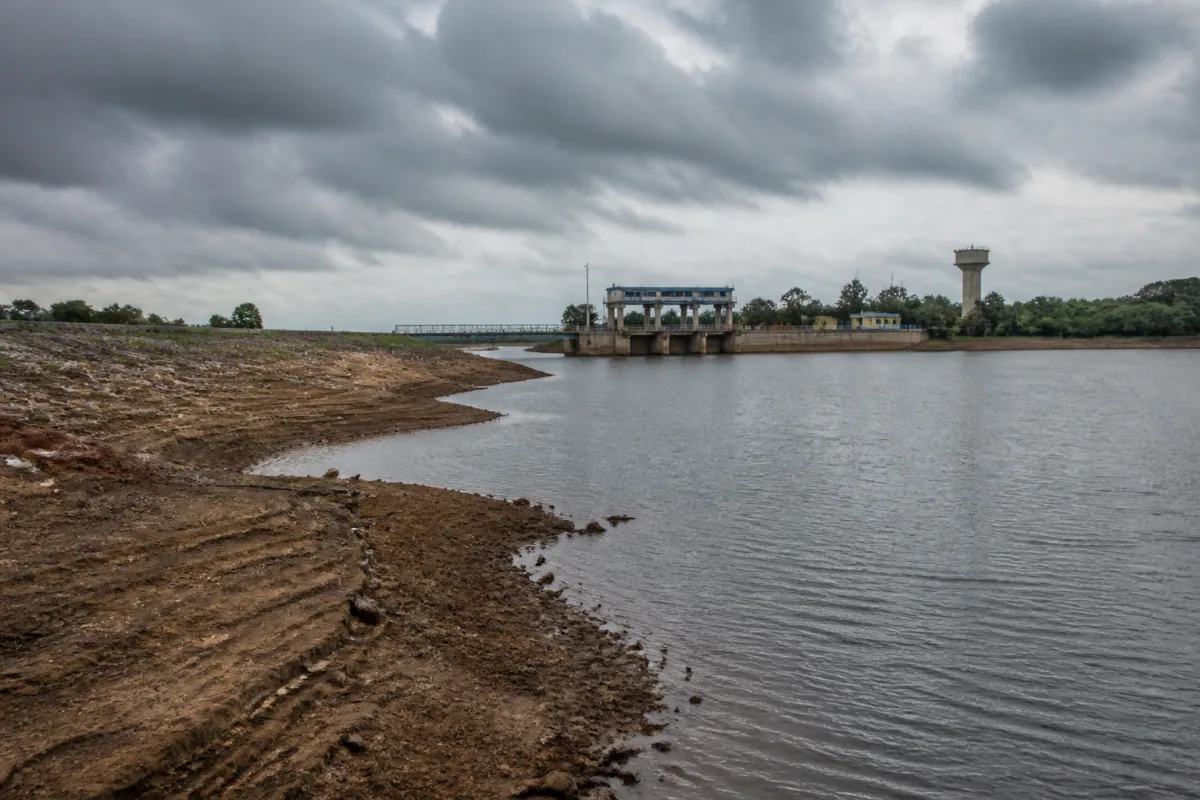
Chennai’s water supply is holding steady even as its principal reservoirs remain far below last year’s storage, revealing a widening gap between the water available in conventional sources and the water the city is currently able to deliver. Metrowater supplied 1,244.25 million litres a day on Wednesday, higher than the 1,209.19 MLD supplied during the corresponding period last year, while the five major reservoirs together held only 4,820 million cubic feet, or 41 per cent of their combined capacity.
The figures, reported from Metrowater data, show that Chennai’s immediate supply position is being protected by a broader system of sources rather than by strong replenishment of its main lakes. The five reservoirs were carrying 5,188 mcft less water than the 10,008 mcft recorded on November 11 last year. Their combined storage also declined by 17 mcft during the day, and there was no inflow through the Krishna water supply canal on the Tamil Nadu border.
This matters because reservoir storage remains the most visible measure of Chennai’s conventional water security. The current numbers indicate that daily supply and reserve strength are no longer moving in the same direction. The city is delivering more water than it did last year, but its principal surface-water reserves are substantially weaker.
The mismatch is particularly pronounced at Poondi and Chembarambakkam. Together, the two reservoirs account for nearly 3,935 mcft of the overall year-on-year shortfall. Poondi held 585 mcft, compared with 2,708 mcft on the corresponding day last year, leaving a deficit of 2,123 mcft. It was at only 18.11 per cent of capacity. Chembarambakkam held 1,398 mcft against 3,210 mcft last year and was 38.35 per cent full.
The other reservoirs also remained below their previous-year levels. Cholavaram held 165 mcft against 777 mcft last year, a shortfall of 612 mcft. Kannankottai-Thervoykandigai held 255 mcft against 441 mcft, while Red Hills, the largest of the five in terms of capacity, held 2,417 mcft, or 73.24 per cent of capacity. Even Red Hills was 455 mcft below its level last year.
The data also show that the weakness is not simply a question of total rainfall across the wider region. Tamil Nadu and Puducherry received 25.4 cm of rain between October 1 and November 9, against a seasonal normal of 24.3 cm, a 4 per cent surplus. Yet the five reservoir locations recorded no rainfall on Wednesday, and the rainfall pattern had not produced significant replenishment in Chennai’s water sources.
That distinction is central to understanding the city’s water system. Regional rainfall totals do not automatically translate into storage in the reservoirs that supply Chennai. Replenishment depends on where rain falls, the timing and intensity of the rainfall, the movement of water through supply channels and the condition of individual catchments. The reported figures show that a season with a modest overall surplus can coexist with weak storage at key urban reservoirs.
The immediate weather outlook offered some possibility of further rainfall but did not indicate an instant solution for the city’s reserve position. The Regional Meteorological Centre forecast additional rainfall activity, with a fresh low-pressure system likely to develop over the southeast Bay of Bengal around November 13. The report said the immediate forecast was more favourable for southern and delta districts, while Chennai was expected to receive another spell of rain only later.
The daily inflow and outflow numbers reinforce the limited recovery visible in the storage data. Cholavaram received a marginal inflow of 2 mcft, while Poondi recorded no net inflow. Red Hills lost 7 mcft, Chembarambakkam lost 11 mcft and Veeranam lost 17.2 mcft during the day. These movements suggest that the city’s main surface-water system was not yet receiving a broad-based replenishment pulse.
Veeranam provides an additional source but does not fundamentally change the picture. Its storage stood at 928.75 mcft, compared with 978.20 mcft last year. When it is included, the combined storage of the five city reservoirs and Veeranam was 5,748.75 mcft, or 43.48 per cent of total capacity of 13,222 mcft. That was 5,237.45 mcft below the 10,986.20 mcft recorded last year.
At the same time, desalination has become more important in maintaining Chennai’s daily supply. The 110-MLD Nemmeli desalination plant supplied 100.02 MLD, compared with 49.04 MLD last year. The 150-MLD plant supplied 100.88 MLD, compared with 92.60 MLD during the corresponding period. Together, the two plants supplied 200.90 MLD on Wednesday, compared with 141.64 MLD last year.
The increase does not eliminate the reservoir deficit, but it shows how Chennai is using a diversified supply system to maintain delivery while conventional reserves remain under pressure. The city’s water administration is therefore managing two different tasks at once: maintaining the current daily flow to residents and protecting the reserve base needed to sustain that flow when rainfall or inflows remain weak.
This changes the institutional meaning of a reservoir report. A daily storage figure is not only a measure of how much water is in a lake. It is also an indicator of the balance between rainfall, catchment response, inter-basin or canal inflows, reservoir withdrawals, desalination output and other alternative sources. In Chennai’s case, the reported data show that supply continuity is increasingly linked to the performance of infrastructure outside the conventional reservoir network.
The numbers do not establish that Chennai is facing an immediate reduction in daily supply. In fact, the reported daily supply was higher than last year’s level. Nor do they establish how long the current balance can be maintained, because the supplied report does not provide a forward operating assessment, demand projections or an official contingency plan. What they do establish is that the city is delivering water against a much weaker reservoir position than it had at the same point last year.
That distinction is important for residents and for urban planning. A city can avoid an immediate supply cut while its underlying reserves deteriorate, provided alternative sources compensate for the shortfall. But that arrangement makes the system more dependent on the capacity, reliability and operating conditions of those alternatives. The report’s figures do not assess the resilience of each source, but they clearly show the growing contribution of desalination to the present supply mix.
Chennai’s current position is therefore best understood as a supply-system adjustment rather than a simple rainfall story. The monsoon has produced a slight regional surplus, yet the city’s principal reservoirs remain between 18.11 per cent and 73.24 per cent full, with the largest deficits concentrated in Poondi and Chembarambakkam. Daily supply has been sustained because desalination output has increased and other sources continue to contribute.
The next significant indicator will be whether subsequent rainfall reaches the city’s reservoir catchments and produces measurable inflows. Until then, the evidence points to a city whose water delivery remains stable on the surface while its conventional storage base is considerably weaker than last year. The balance between those two realities will determine how much pressure Chennai’s water system carries through the rest of the season.

