


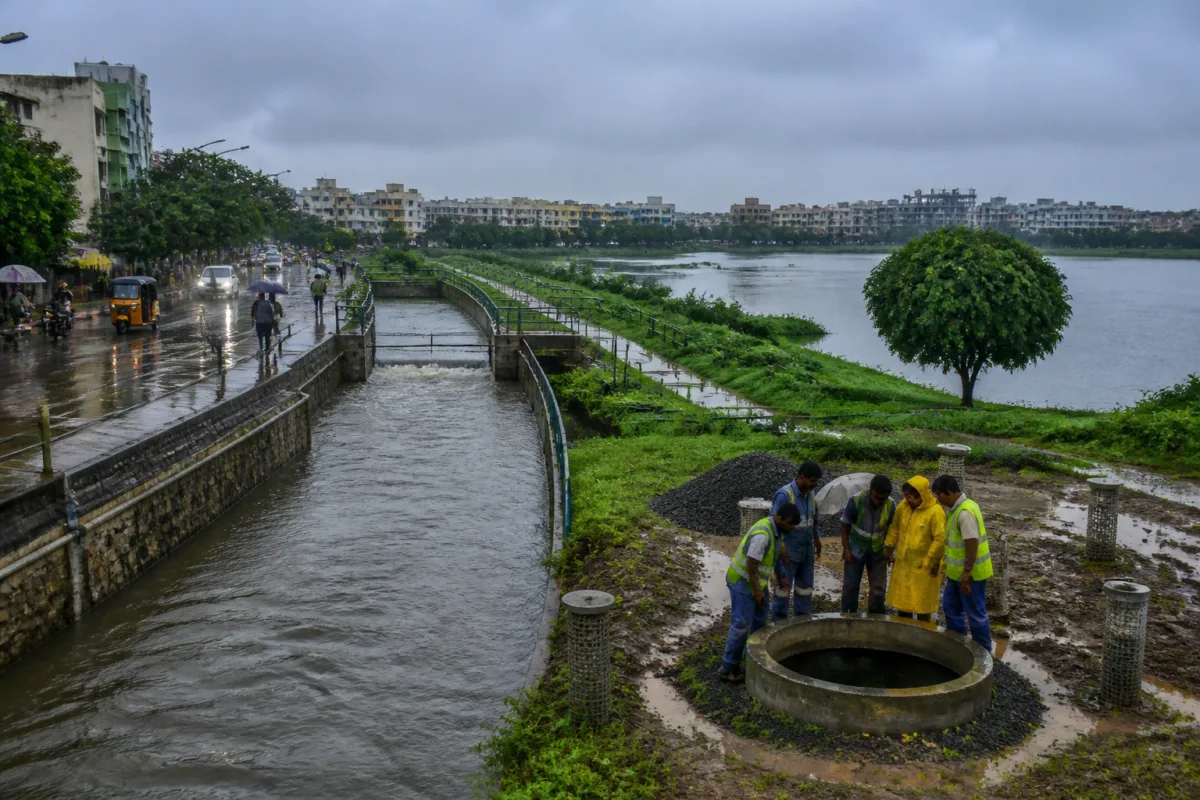
Chennai’s recurring monsoon dilemma is not simply that the city receives too much or too little water. It is that the systems designed to move rainwater away from flooded neighbourhoods are not adequately connected to the systems that could store it for future use. A report in Deccan Chronicle has brought that gap into focus as the city prepares for the northeast monsoon and authorities review the management of the Chembarambakkam reservoir.
The central issue is the absence of an integrated rainwater network linking reservoirs, lakes, ponds, rivers and neighbourhood-level recharge structures. In the present arrangement, water released from a major reservoir to preserve a safety buffer can travel through the Adyar river and eventually reach the sea. The same city that manages flooding during intense rain then faces water scarcity when the monsoon has passed.
That contradiction is particularly significant for Chennai, where flood control and water security are usually treated as separate administrative tasks. Reservoir operations are focused on maintaining storage within safe limits. Drainage systems are expected to carry stormwater away quickly. Rainwater harvesting structures are maintained at building or local-body level. The report’s evidence suggests that these functions are not yet being managed as one connected urban water system.
Chembarambakkam illustrates the operational trade-off. Water Resources Department officials told the newspaper that the reservoir is generally maintained at about 21 feet during the monsoon, against a full reservoir level of 24 feet, to accommodate further inflows. When water exceeds the level considered operationally safe, surplus is released into the Adyar river. That release may be necessary to reduce the risk of a deluge, but there is no comprehensive mechanism to divert or store the water after it leaves the reservoir.
The reservoir’s recorded position also shows why storage decisions cannot be separated from forecasting and downstream capacity. At 6 am on October 26, its water level was 14.76 feet, against a full level of 24 feet. Storage stood at 1,488 million cubic feet, or around 41 per cent of its 3,645-million-cubic-foot capacity. Inflow was recorded at 150 cusecs while discharge was 208 cusecs. These figures describe a reservoir with available capacity at that point, but they also show that releases are part of continuous monsoon management rather than an exceptional event.
The larger question is what happens to water once it is released. Veteran environmental activist V. Santhanam said the city loses an opportunity to conserve water whenever surplus from Chembarambakkam is allowed to drain through the Adyar to the sea. He proposed diverting surplus water to lakes in the southern suburbs and constructing a smaller reservoir to retain runoff. He also identified a possible chain involving water bodies at Thiruneermalai, Pallavaram, Chitlapakkam, Sembakkam and Kilkattalai.
Such a proposal would require more than a physical connection between lakes. It would involve decisions over operating levels, land ownership, conveyance channels, flood risk, water quality, local maintenance and responsibility for releases. The report does not establish that a detailed interlinking plan has been approved. It does, however, show how the current system leaves a gap between the point where water is released and the places where it could potentially be stored.
The same problem extends beyond the city’s principal reservoirs. Government data cited in the report indicates that around 3,600 water bodies are located across the neighbouring districts of Tiruvallur, Kanchipuram and Chengalpattu. Many of these water bodies are connected, directly or indirectly, to rivers and drainage channels. Yet surplus water from several of them ultimately reaches rivers and the sea without being adequately conserved.
This makes the condition and capacity of existing tanks as important as the construction of new reservoirs. Santhanam argued that restoring thousands of existing water bodies to their original capacity could provide a larger water-storage network without relying only on major infrastructure. He pointed to tanks along the East Coast Road and Old Mahabalipuram Road corridors, spread across thousands of acres, as potential assets for meeting the needs of southern Chennai if restored and used properly.
The evidence in the report points to a city whose water geography is larger than its municipal boundary. Chennai receives more than 1,000 millimetres of annual rainfall in most years. When rainfall in neighbouring districts within the Chennai Metropolitan Area is considered, the average is around 1,400 millimetres. The rain therefore falls across a metropolitan catchment, while much of the planning and maintenance responsibility remains divided among different local bodies and agencies.
The metropolitan water system also has a natural network. The Kosasthalaiyar in the north, the Cooum in the central region and the Adyar in the south, along with the Buckingham Canal, form an extensive set of waterways. Their current public identity is often associated with drainage, pollution or flood conveyance. The report highlights a different management question: whether the network can be operated in a way that reduces flood risk while retaining more water for later use.
That does not mean every river, canal or lake can simply be converted into a storage facility. Water quality, carrying capacity and local soil conditions would determine what form of conservation is technically suitable. A senior scientist at the Central Groundwater Board in Tamil Nadu cautioned that clay can act as an impermeable layer and restrict the movement of stormwater into the ground. As a result, recharge structures cannot be designed uniformly across the city.
This point is important because rainwater harvesting is often treated as a standard building-level intervention. The report describes a broader set of possible structures, including recharge trenches, recharge shafts, percolation pits, recharge wells and storage facilities. Their suitability would depend on local conditions. A structure that supports infiltration in one area may not produce the same result where soil layers prevent water from moving deeper underground.
The city’s rainwater strategy also needs to move beyond rooftops. Conservation experts cited in the report have called for runoff from roads, pavements, parks, playgrounds, parking areas and other open spaces to be captured. These surfaces generate large volumes of stormwater during intense rain, but they are usually managed primarily as drainage sources. Treating them as part of the storage system would require changes to road design, public-space maintenance, stormwater engineering and local-body operations.
The government’s Thuli rainwater harvesting campaign addresses part of this institutional challenge. Local bodies have been directed to inspect existing systems in residential, commercial and government buildings, clean filter chambers and recharge pits, and restore defunct structures wherever technically feasible. A senior official of the municipal administration and water supply department described rainwater harvesting as vital for Tamil Nadu and said the initiative would require continuing inspections and reviews.
The emphasis on inspection is significant because the presence of a recharge pit or harvesting system does not guarantee that it is functioning. Filter chambers can become blocked, pits can fill with sediment and connections can be damaged. The report also records environmental activist Darwin Annadurai’s call for closer monitoring of existing structures and the construction of underground storage points. He argued that improving the groundwater table would require the systems already installed to be monitored rather than merely counted.
The report does not provide a consolidated estimate of how many existing rainwater harvesting systems are functional, how much water they currently capture, or the cost of restoring the region’s water bodies. It also does not establish a final government plan for interlinking suburban lakes, creating additional storage or establishing a separate agency for oversight. Those are important gaps in assessing how quickly the proposed approach could be implemented.
What the available evidence does establish is that Chennai’s water challenge is not only one of rainfall intensity or reservoir capacity. It is also a coordination problem. Reservoirs, rivers, lakes, local drainage, groundwater recharge and building-level harvesting are being discussed as related components, but their management remains distributed across different functions and jurisdictions.
The bigger urban question is whether Chennai will continue to treat floodwater as a hazard to be removed and water scarcity as a separate shortage to be addressed later. The figures on rainfall and the scale of the regional water-body network suggest that the city has substantial natural assets. The concern raised by experts is that these assets are not yet being managed as a unified storage and drainage system.
For now, the immediate developments to monitor are the implementation of the Thuli campaign, inspections of existing harvesting structures, the operating decisions at Chembarambakkam and any formal plan to restore or connect water bodies in the metropolitan region. Until those links are established institutionally and technically, Chennai will remain caught between releasing water to prevent flooding and losing water that could have helped reduce future scarcity.

